 Add to Chrome
 Add to Firefox
 Add to Edge
Scalable and Differentiable Point-Cloud Registration Using Maximum Mean Discrepancy
Jun 26, 2026
We present MMD-Reg, a novel correspondence-free approach to point-cloud registration that is differentiable and has linear computational complexity in the number of points. We model registration as a nonlinear least-squares problem based on the Maximum Mean Discrepancy, approximated using random Fourier features. The resulting objective can be solved efficiently with standard methods such as Levenberg-Marquardt, and the solution is differentiable via the implicit function theorem. This allows MMD-Reg to be used as a differentiable optimization layer within end-to-end trainable models, supporting registration under challenging conditions such as poor initial alignment and partial overlap. We demonstrate this Neural MMD-Reg formulation by integrating the layer with a set transformer, training the resulting model in supervised and unsupervised settings, and comparing its performance against recent learning-based methods. We also evaluate standalone MMD-Reg, comparing its accuracy and scalability against widely used non-learning-based registration methods.

DINGO: Distributed Newton-Type Method for Gradient-Norm Optimization
Jan 16, 2019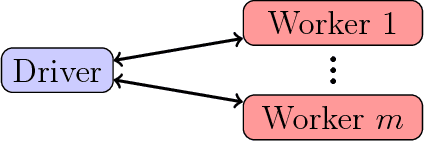

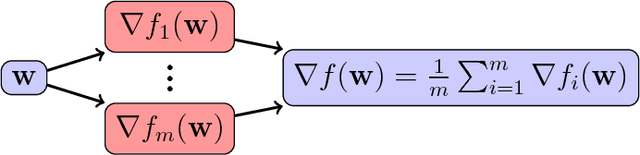
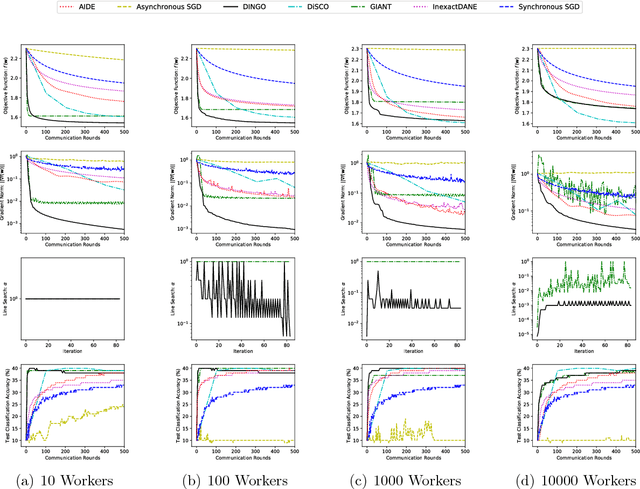
For optimization of a sum of functions in a distributed computing environment, we present a novel communication efficient Newton-type algorithm that enjoys a variety of advantages over similar existing methods. Similar to Newton-MR, our algorithm, DINGO, is derived by optimization of the gradient's norm as a surrogate function. DINGO does not impose any specific form on the underlying functions, and its application range extends far beyond convexity. In addition, the distribution of the data across the computing environment can be almost arbitrary. Further, the underlying sub-problems of DINGO are simple linear least-squares, for which a plethora of efficient algorithms exist. Lastly, DINGO involves a few hyper-parameters that are easy to tune. Moreover, we theoretically show that DINGO is not sensitive to the choice of its hyper-parameters in that a strict reduction in the gradient norm is guaranteed, regardless of the selected hyper-parameters. We demonstrate empirical evidence of the effectiveness, stability and versatility of our method compared to other relevant algorithms, on both convex and non-convex problems.