 Add to Chrome
 Add to Firefox
 Add to Edge
A Shortcut to Statistically Steady-State Turbulence with Flow Matching
Jul 14, 2026
Many nonlinear physical systems exhibit an initial transient phase in which perturbations grow before nonlinear interactions lead to a statistically steady state. While this saturated regime is of primary interest, direct numerical simulations must resolve the full transient dynamics before reaching it, incurring significant computational cost. In Computational Fluid Dynamics, reduced-order approaches such as Large Eddy Simulation mitigate computational cost by modeling small-scale dynamics, enabling tractable approximations of turbulent flows. In contrast, for systems such as gyrokinetics, comparably effective closures for the full dynamics are not generally available, and high-fidelity simulations remain necessary. Existing surrogate modeling approaches for these systems are autoregressive, hence they suffer from accumulating error. We instead propose to bypass explicit time evolution by directly modeling the distribution of saturated states under an ergodicity assumption, stating that ensemble averages over samples are equivalent to time averages of a single long simulation. We introduce GyroFlow, a latent generative model that directly estimates steady-state statistics of gyrokinetic turbulence in 5D phase space, without resolving the transient phase. GyroFlow generates saturated snapshots from noise, conditioned on dimensionless operating parameters and outperforms autoregressive, reduced-order, and other generative approaches, while providing substantial speedup. To evaluate generation quality we propose FGyD, a distributional metric computed in the latent space of a pretrained gyrokinetic model, and show that it correlates with downstream flux accuracy and solver convergence. Finally, GyroFlow can be used to warm-start the numerical code used to produce the data.

Data-Efficient Neural Operator Training via Physics-Based Active Learning
May 20, 2026Solving partial differential equations with neural operators significantly reduces computational costs but remains bottlenecked by high training data requirements. Active learning offers a natural framework to mitigate this by selectively acquiring the most informative samples in an iterative manner. We introduce physics-based acquisition - a novel physics-informed active learning algorithm that leverages the partial differential equation residual to guide data selection. We validate the method by presenting numerical experiments for the 1D Burgers equation and the 2D compressible Navier-Stokes equations. We show that, in our experiments, physics-based acquisition consistently outperforms random acquisition and matches the state of the art in data efficiency. At the same time, it has the unique advantage of injecting a physics inductive bias into the training process, ensuring that simulation cost is spent where the model's physical understanding is weakest.
Learning Physical Operators using Neural Operators
Feb 26, 2026Neural operators have emerged as promising surrogate models for solving partial differential equations (PDEs), but struggle to generalise beyond training distributions and are often constrained to a fixed temporal discretisation. This work introduces a physics-informed training framework that addresses these limitations by decomposing PDEs using operator splitting methods, training separate neural operators to learn individual non-linear physical operators while approximating linear operators with fixed finite-difference convolutions. This modular mixture-of-experts architecture enables generalisation to novel physical regimes by explicitly encoding the underlying operator structure. We formulate the modelling task as a neural ordinary differential equation (ODE) where these learned operators constitute the right-hand side, enabling continuous-in-time predictions through standard ODE solvers and implicitly enforcing PDE constraints. Demonstrated on incompressible and compressible Navier-Stokes equations, our approach achieves better convergence and superior performance when generalising to unseen physics. The method remains parameter-efficient, enabling temporal extrapolation beyond training horizons, and provides interpretable components whose behaviour can be verified against known physics.
TokaMind: A Multi-Modal Transformer Foundation Model for Tokamak Plasma Dynamics
Feb 16, 2026We present TokaMind, an open-source foundation model framework for fusion plasma modeling, based on a Multi-Modal Transformer (MMT) and trained on heterogeneous tokamak diagnostics from the publicly available MAST dataset. TokaMind supports multiple data modalities (time-series, 2D profiles, and videos) with different sampling rates, robust missing-signal handling, and efficient task adaptation via selectively loading and freezing four model components. To represent multi-modal signals, we use a training-free Discrete Cosine Transform embedding (DCT3D) and provide a clean interface for alternative embeddings (e.g., Variational Autoencoders - VAEs). We evaluate TokaMind on the recently introduced MAST benchmark TokaMark, comparing training and embedding strategies. Our results show that fine-tuned TokaMind outperforms the benchmark baseline on all but one task, and that, for several tasks, lightweight fine-tuning yields better performance than training the same architecture from scratch under a matched epoch budget. These findings highlight the benefits of multi-modal pretraining for tokamak plasma dynamics and provide a practical, extensible foundation for future fusion modeling tasks. Training code and model weights will be made publicly available.
TokaMark: A Comprehensive Benchmark for MAST Tokamak Plasma Models
Feb 12, 2026Development and operation of commercially viable fusion energy reactors such as tokamaks require accurate predictions of plasma dynamics from sparse, noisy, and incomplete sensors readings. The complexity of the underlying physics and the heterogeneity of experimental data pose formidable challenges for conventional numerical methods, while simultaneously highlight the promise of modern data-native AI approaches. A major obstacle in realizing this potential is, however, the lack of curated, openly available datasets and standardized benchmarks. Existing fusion datasets are scarce, fragmented across institutions, facility-specific, and inconsistently annotated, which limits reproducibility and prevents a fair and scalable comparison of AI approaches. In this paper, we introduce TokaMark, a structured benchmark to evaluate AI models on real experimental data collected from the Mega Ampere Spherical Tokamak (MAST). TokaMark provides a comprehensive suite of tools designed to (i) unify access to multi-modal heterogeneous fusion data, and (ii) harmonize formats, metadata, temporal alignment and evaluation protocols to enable consistent cross-model and cross-task comparisons. The benchmark includes a curated list of 14 tasks spanning a range of physical mechanisms, exploiting a variety of diagnostics and covering multiple operational use cases. A baseline model is provided to facilitate transparent comparison and validation within a unified framework. By establishing a unified benchmark for both the fusion and AI-for-science communities, TokaMark aims to accelerate progress in data-driven AI-based plasma modeling, contributing to the broader goal of achieving sustainable and stable fusion energy. The benchmark, documentation, and tooling will be fully open sourced upon acceptance to encourage community adoption and contribution.
GyroSwin: 5D Surrogates for Gyrokinetic Plasma Turbulence Simulations
Oct 08, 2025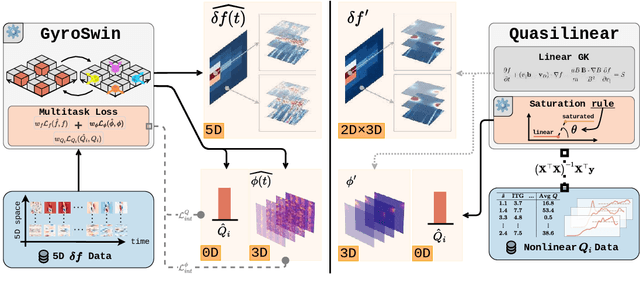

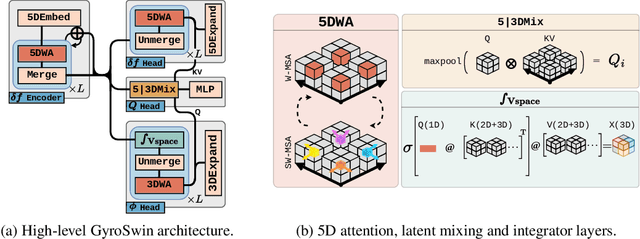
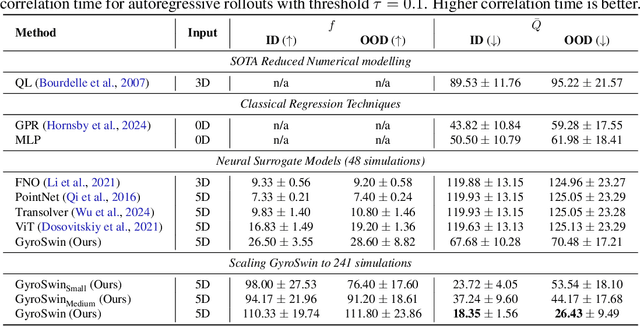
Nuclear fusion plays a pivotal role in the quest for reliable and sustainable energy production. A major roadblock to viable fusion power is understanding plasma turbulence, which significantly impairs plasma confinement, and is vital for next-generation reactor design. Plasma turbulence is governed by the nonlinear gyrokinetic equation, which evolves a 5D distribution function over time. Due to its high computational cost, reduced-order models are often employed in practice to approximate turbulent transport of energy. However, they omit nonlinear effects unique to the full 5D dynamics. To tackle this, we introduce GyroSwin, the first scalable 5D neural surrogate that can model 5D nonlinear gyrokinetic simulations, thereby capturing the physical phenomena neglected by reduced models, while providing accurate estimates of turbulent heat transport.GyroSwin (i) extends hierarchical Vision Transformers to 5D, (ii) introduces cross-attention and integration modules for latent 3D$\leftrightarrow$5D interactions between electrostatic potential fields and the distribution function, and (iii) performs channelwise mode separation inspired by nonlinear physics. We demonstrate that GyroSwin outperforms widely used reduced numerics on heat flux prediction, captures the turbulent energy cascade, and reduces the cost of fully resolved nonlinear gyrokinetics by three orders of magnitude while remaining physically verifiable. GyroSwin shows promising scaling laws, tested up to one billion parameters, paving the way for scalable neural surrogates for gyrokinetic simulations of plasma turbulence.
5D Neural Surrogates for Nonlinear Gyrokinetic Simulations of Plasma Turbulence
Feb 11, 2025Nuclear fusion plays a pivotal role in the quest for reliable and sustainable energy production. A major roadblock to achieving commercially viable fusion power is understanding plasma turbulence, which can significantly degrade plasma confinement. Modelling turbulence is crucial to design performing plasma scenarios for next-generation reactor-class devices and current experimental machines. The nonlinear gyrokinetic equation underpinning turbulence modelling evolves a 5D distribution function over time. Solving this equation numerically is extremely expensive, requiring up to weeks for a single run to converge, making it unfeasible for iterative optimisation and control studies. In this work, we propose a method for training neural surrogates for 5D gyrokinetic simulations. Our method extends a hierarchical vision transformer to five dimensions and is trained on the 5D distribution function for the adiabatic electron approximation. We demonstrate that our model can accurately infer downstream physical quantities such as heat flux time trace and electrostatic potentials for single-step predictions two orders of magnitude faster than numerical codes. Our work paves the way towards neural surrogates for plasma turbulence simulations to accelerate deployment of commercial energy production via nuclear fusion.
Calibrated Physics-Informed Uncertainty Quantification
Feb 06, 2025Neural PDEs offer efficient alternatives to computationally expensive numerical PDE solvers for simulating complex physical systems. However, their lack of robust uncertainty quantification (UQ) limits deployment in critical applications. We introduce a model-agnostic, physics-informed conformal prediction (CP) framework that provides guaranteed uncertainty estimates without requiring labelled data. By utilising a physics-based approach, we are able to quantify and calibrate the model's inconsistencies with the PDE rather than the uncertainty arising from the data. Our approach uses convolutional layers as finite-difference stencils and leverages physics residual errors as nonconformity scores, enabling data-free UQ with marginal and joint coverage guarantees across prediction domains for a range of complex PDEs. We further validate the efficacy of our method on neural PDE models for plasma modelling and shot design in fusion reactors.
Uncertainty Quantification of Pre-Trained and Fine-Tuned Surrogate Models using Conformal Prediction
Aug 19, 2024
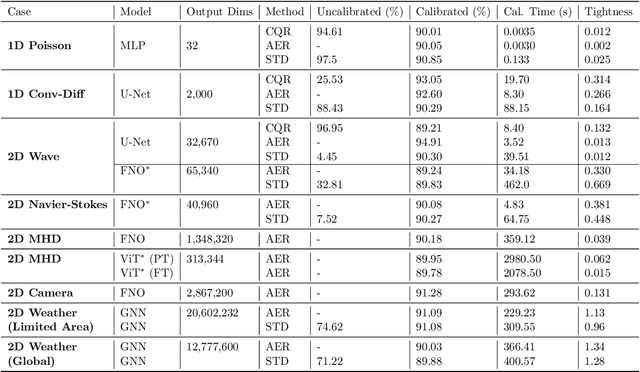
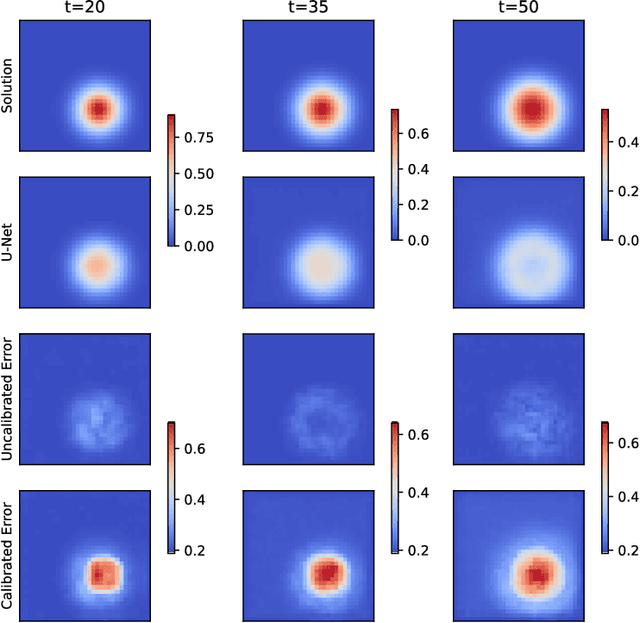
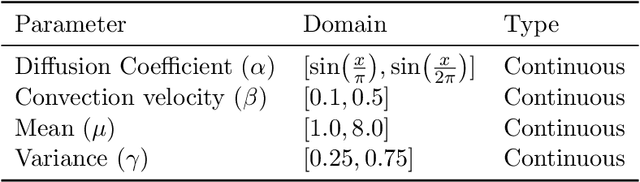
Data-driven surrogate models have shown immense potential as quick, inexpensive approximations to complex numerical and experimental modelling tasks. However, most surrogate models characterising physical systems do not quantify their uncertainty, rendering their predictions unreliable, and needing further validation. Though Bayesian approximations offer some solace in estimating the error associated with these models, they cannot provide they cannot provide guarantees, and the quality of their inferences depends on the availability of prior information and good approximations to posteriors for complex problems. This is particularly pertinent to multi-variable or spatio-temporal problems. Our work constructs and formalises a conformal prediction framework that satisfies marginal coverage for spatio-temporal predictions in a model-agnostic manner, requiring near-zero computational costs. The paper provides an extensive empirical study of the application of the framework to ascertain valid error bars that provide guaranteed coverage across the surrogate model's domain of operation. The application scope of our work extends across a large range of spatio-temporal models, ranging from solving partial differential equations to weather forecasting. Through the applications, the paper looks at providing statistically valid error bars for deterministic models, as well as crafting guarantees to the error bars of probabilistic models. The paper concludes with a viable conformal prediction formalisation that provides guaranteed coverage of the surrogate model, regardless of model architecture, and its training regime and is unbothered by the curse of dimensionality.
Valid Error Bars for Neural Weather Models using Conformal Prediction
Jun 20, 2024

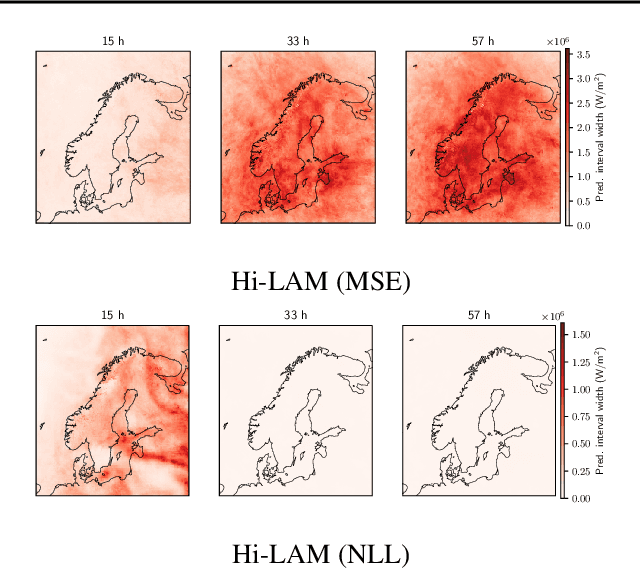
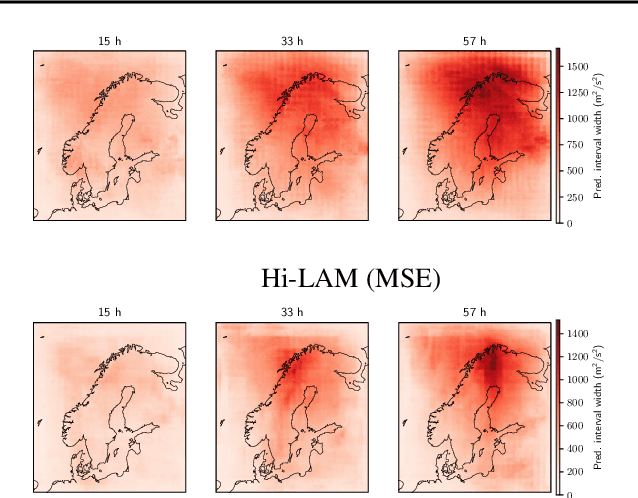
Neural weather models have shown immense potential as inexpensive and accurate alternatives to physics-based models. However, most models trained to perform weather forecasting do not quantify the uncertainty associated with their forecasts. This limits the trust in the model and the usefulness of the forecasts. In this work we construct and formalise a conformal prediction framework as a post-processing method for estimating this uncertainty. The method is model-agnostic and gives calibrated error bounds for all variables, lead times and spatial locations. No modifications are required to the model and the computational cost is negligible compared to model training. We demonstrate the usefulness of the conformal prediction framework on a limited area neural weather model for the Nordic region. We further explore the advantages of the framework for deterministic and probabilistic models.