 Add to Chrome
 Add to Firefox
 Add to Edge
EpiFlow: A framework for improving the utility of wastewater signals for disease forecasting
Aug 07, 2026
Wastewater-based surveillance is an effective tool for disease monitoring and can provide early warning of outbreaks. Although wastewater viral loads (WVL) correlate with disease burden, their utility for improving real-time forecasting remains under investigation. During the early phases of an epidemic, many indicators can effectively monitor disease spread, but their reliability may decline because of reporting fatigue and low prevalence. Hospital burden can vary substantially even during low-prevalence periods, making accurate forecasting of burden indicators essential for minimizing disease impacts. In this paper, we present principled approaches for processing wastewater data, characterizing its relationship with burden indicators, and generating real-time forecasts. We assess the predictability of WVL using entropy measures. We analyze the relationship between WVL and burden indicators using causality tests that capture temporal dynamics and the leading-indicator behavior of WVL. We incorporate these insights into a time-varying forecasting model that accounts for the evolving relationship between the signals. We also evaluate the effects of delays in WVL reporting through simulations. We test the utility of our methods by forecasting COVID-19 hospital admissions across Virginia and its health regions during periods of varying disease prevalence. Incorporating WVL improves forecast accuracy relative to baseline models, particularly during critical epidemic phases, and results in a 20 percentage point improvement in forecast coverage. Our results demonstrate that WVL signals can improve infectious disease forecasting even under conditions of low prevalence or delayed reporting.

Examining Deep Learning Models with Multiple Data Sources for COVID-19 Forecasting
Oct 27, 2020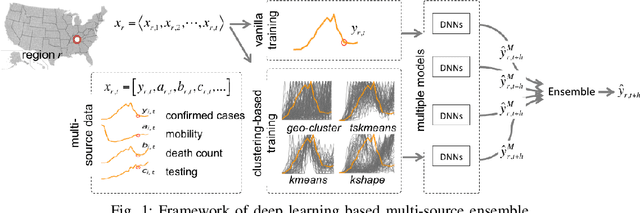
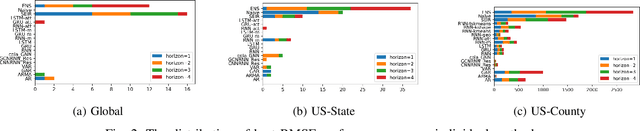
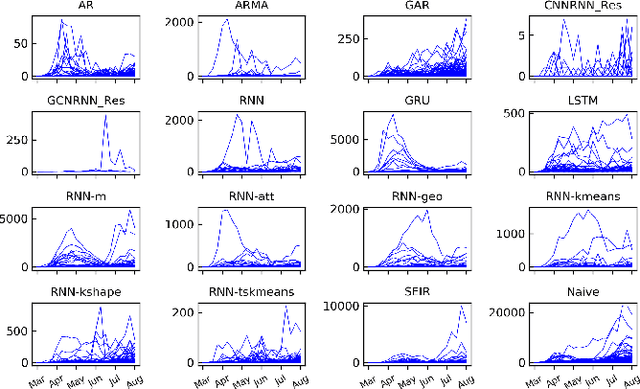
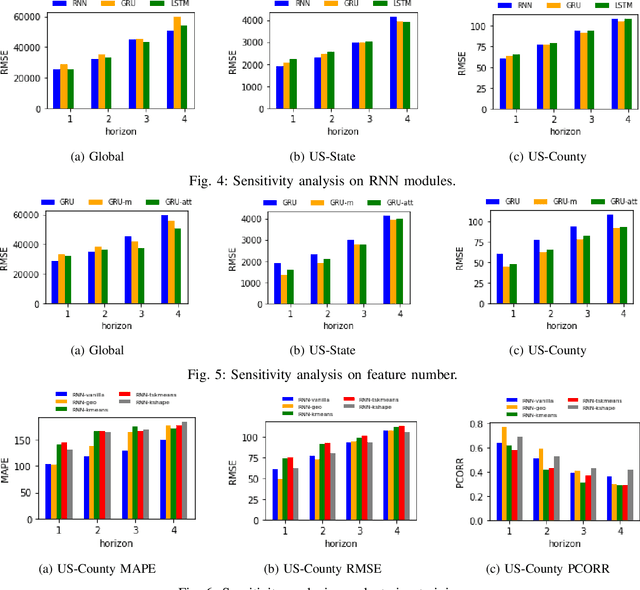
The COVID-19 pandemic represents the most significant public health disaster since the 1918 influenza pandemic. During pandemics such as COVID-19, timely and reliable spatio-temporal forecasting of epidemic dynamics is crucial. Deep learning-based time series models for forecasting have recently gained popularity and have been successfully used for epidemic forecasting. Here we focus on the design and analysis of deep learning-based models for COVID-19 forecasting. We implement multiple recurrent neural network-based deep learning models and combine them using the stacking ensemble technique. In order to incorporate the effects of multiple factors in COVID-19 spread, we consider multiple sources such as COVID-19 testing data and human mobility data for better predictions. To overcome the sparsity of training data and to address the dynamic correlation of the disease, we propose clustering-based training for high-resolution forecasting. The methods help us to identify the similar trends of certain groups of regions due to various spatio-temporal effects. We examine the proposed method for forecasting weekly COVID-19 new confirmed cases at county-, state-, and country-level. A comprehensive comparison between different time series models in COVID-19 context is conducted and analyzed. The results show that simple deep learning models can achieve comparable or better performance when compared with more complicated models. We are currently integrating our methods as a part of our weekly forecasts that we provide state and federal authorities.
Models for COVID-19 Pandemic: A Comparative Analysis
Sep 21, 2020
COVID-19 pandemic represents an unprecedented global health crisis in the last 100 years. Its economic, social and health impact continues to grow and is likely to end up as one of the worst global disasters since the 1918 pandemic and the World Wars. Mathematical models have played an important role in the ongoing crisis; they have been used to inform public policies and have been instrumental in many of the social distancing measures that were instituted worldwide. In this article we review some of the important mathematical models used to support the ongoing planning and response efforts. These models differ in their use, their mathematical form and their scope.