 Add to Chrome
 Add to Firefox
 Add to Edge
EpiFlow: A framework for improving the utility of wastewater signals for disease forecasting
Aug 07, 2026
Wastewater-based surveillance is an effective tool for disease monitoring and can provide early warning of outbreaks. Although wastewater viral loads (WVL) correlate with disease burden, their utility for improving real-time forecasting remains under investigation. During the early phases of an epidemic, many indicators can effectively monitor disease spread, but their reliability may decline because of reporting fatigue and low prevalence. Hospital burden can vary substantially even during low-prevalence periods, making accurate forecasting of burden indicators essential for minimizing disease impacts. In this paper, we present principled approaches for processing wastewater data, characterizing its relationship with burden indicators, and generating real-time forecasts. We assess the predictability of WVL using entropy measures. We analyze the relationship between WVL and burden indicators using causality tests that capture temporal dynamics and the leading-indicator behavior of WVL. We incorporate these insights into a time-varying forecasting model that accounts for the evolving relationship between the signals. We also evaluate the effects of delays in WVL reporting through simulations. We test the utility of our methods by forecasting COVID-19 hospital admissions across Virginia and its health regions during periods of varying disease prevalence. Incorporating WVL improves forecast accuracy relative to baseline models, particularly during critical epidemic phases, and results in a 20 percentage point improvement in forecast coverage. Our results demonstrate that WVL signals can improve infectious disease forecasting even under conditions of low prevalence or delayed reporting.

Predictive modelling of training loads and injury in Australian football
Jun 14, 2017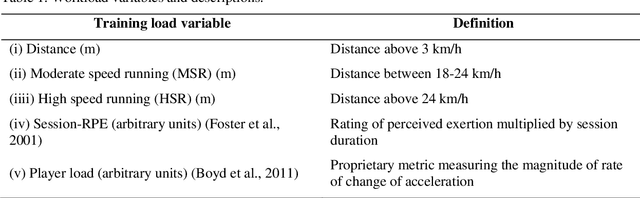
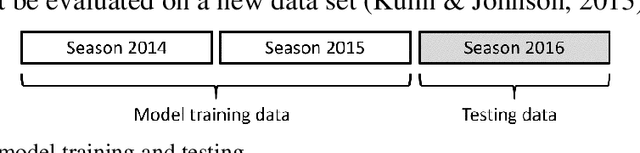
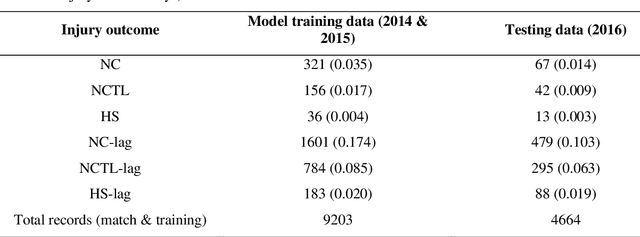
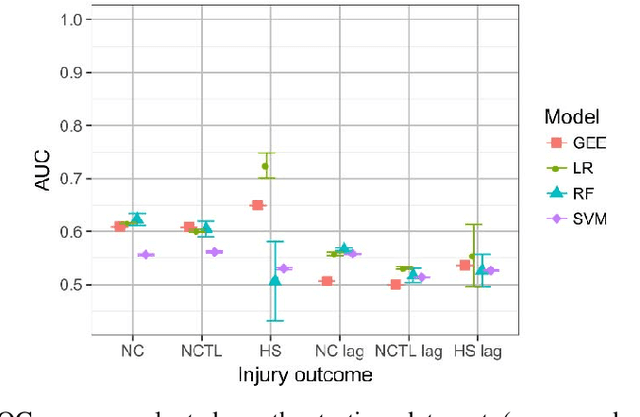
To investigate whether training load monitoring data could be used to predict injuries in elite Australian football players, data were collected from elite athletes over 3 seasons at an Australian football club. Loads were quantified using GPS devices, accelerometers and player perceived exertion ratings. Absolute and relative training load metrics were calculated for each player each day (rolling average, exponentially weighted moving average, acute:chronic workload ratio, monotony and strain). Injury prediction models (regularised logistic regression, generalised estimating equations, random forests and support vector machines) were built for non-contact, non-contact time-loss and hamstring specific injuries using the first two seasons of data. Injury predictions were generated for the third season and evaluated using the area under the receiver operator characteristic (AUC). Predictive performance was only marginally better than chance for models of non-contact and non-contact time-loss injuries (AUC$<$0.65). The best performing model was a multivariate logistic regression for hamstring injuries (best AUC=0.76). Learning curves suggested logistic regression was underfitting the load-injury relationship and that using a more complex model or increasing the amount of model building data may lead to future improvements. Injury prediction models built using training load data from a single club showed poor ability to predict injuries when tested on previously unseen data, suggesting they are limited as a daily decision tool for practitioners. Focusing the modelling approach on specific injury types and increasing the amount of training data may lead to the development of improved predictive models for injury prevention.