 Add to Chrome
 Add to Firefox
 Add to Edge
LLM within MCP Matters: Measuring Inefficient Resource Utilization Driven by LLMs
Aug 09, 2026
The Model Context Protocol (MCP) standardizes how servers expose data and tools to Large Language Models (LLMs). A common server design embeds frequently used reference data, such as identifier lookup tables, directly in the server instructions: the system-prompt text a server hands to the host application. When a query concerns an entry of the embedded table, the model can act on it immediately instead of re-discovering the same information through a search tool. We test whether client LLMs actually consume such instruction-embedded data, reporting a 54,000-trial study across 24 LLMs (9 Claude, 6 Gemini, 9 GPT) on a production legal-information MCP server. A diagnostic condition that removes the competing search tool shows that failures are dominated by behavioral preference rather than missing capability. With search unavailable, 23 of 24 models read the embedded data reliably (hit ratio at least 98%); with a search tool merely present, 9 models drop below 15%. A 2^3 factorial analysis of three instruction-level interventions reveals strong interaction effects: combining all three restores at least 86% for 20 of 24 models, but individual interventions can backfire for specific model families. Per-server prompt engineering is therefore a workaround rather than a fix; we argue that MCP host applications should provide an explicit mechanism that places server instructions ahead of tool selection in the client LLM's deliberation.

BankTweak: Adversarial Attack against Multi-Object Trackers by Manipulating Feature Banks
Aug 22, 2024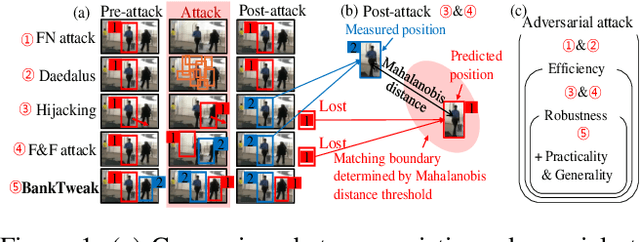
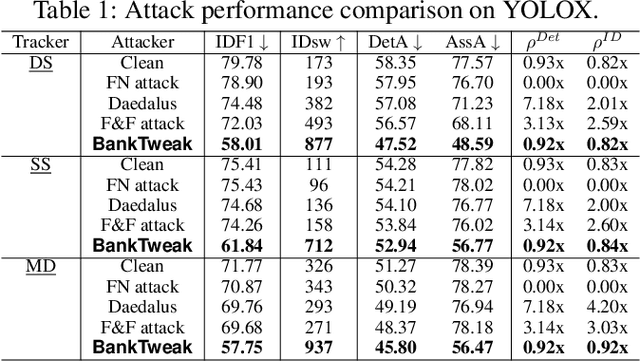
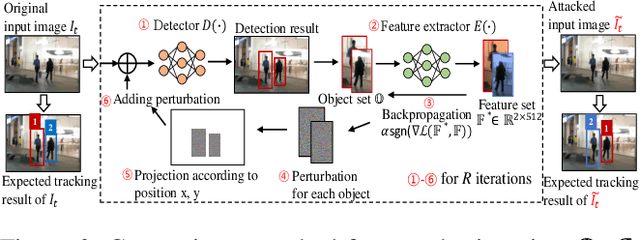
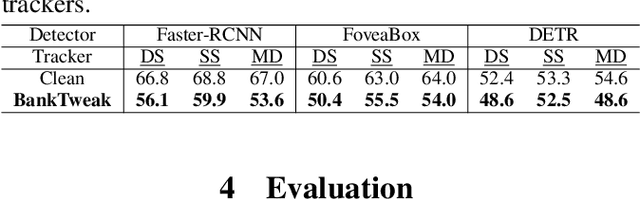
Multi-object tracking (MOT) aims to construct moving trajectories for objects, and modern multi-object trackers mainly utilize the tracking-by-detection methodology. Initial approaches to MOT attacks primarily aimed to degrade the detection quality of the frames under attack, thereby reducing accuracy only in those specific frames, highlighting a lack of \textit{efficiency}. To improve efficiency, recent advancements manipulate object positions to cause persistent identity (ID) switches during the association phase, even after the attack ends within a few frames. However, these position-manipulating attacks have inherent limitations, as they can be easily counteracted by adjusting distance-related parameters in the association phase, revealing a lack of \textit{robustness}. In this paper, we present \textsf{BankTweak}, a novel adversarial attack designed for MOT trackers, which features efficiency and robustness. \textsf{BankTweak} focuses on the feature extractor in the association phase and reveals vulnerability in the Hungarian matching method used by feature-based MOT systems. Exploiting the vulnerability, \textsf{BankTweak} induces persistent ID switches (addressing \textit{efficiency}) even after the attack ends by strategically injecting altered features into the feature banks without modifying object positions (addressing \textit{robustness}). To demonstrate the applicability, we apply \textsf{BankTweak} to three multi-object trackers (DeepSORT, StrongSORT, and MOTDT) with one-stage, two-stage, anchor-free, and transformer detectors. Extensive experiments on the MOT17 and MOT20 datasets show that our method substantially surpasses existing attacks, exposing the vulnerability of the tracking-by-detection framework to \textsf{BankTweak}.
Semantic-aware Binary Code Representation with BERT
Jun 10, 2021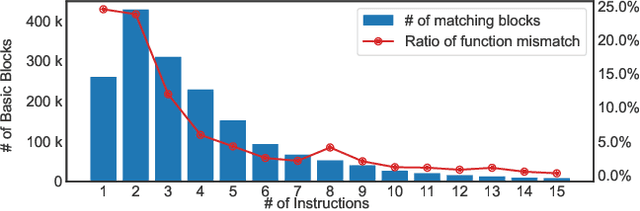
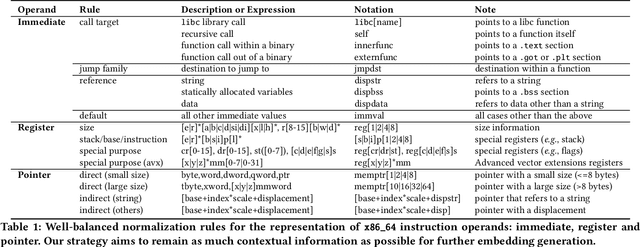
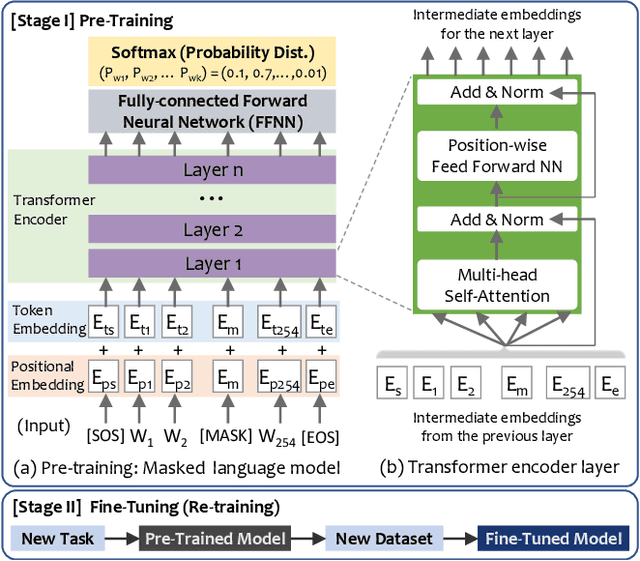
A wide range of binary analysis applications, such as bug discovery, malware analysis and code clone detection, require recovery of contextual meanings on a binary code. Recently, binary analysis techniques based on machine learning have been proposed to automatically reconstruct the code representation of a binary instead of manually crafting specifics of the analysis algorithm. However, the existing approaches utilizing machine learning are still specialized to solve one domain of problems, rendering recreation of models for different types of binary analysis. In this paper, we propose DeepSemantic utilizing BERT in producing the semantic-aware code representation of a binary code. To this end, we introduce well-balanced instruction normalization that holds rich information for each of instructions yet minimizing an out-of-vocabulary (OOV) problem. DeepSemantic has been carefully designed based on our study with large swaths of binaries. Besides, DeepSemantic leverages the essence of the BERT architecture into re-purposing a pre-trained generic model that is readily available as a one-time processing, followed by quickly applying specific downstream tasks with a fine-tuning process. We demonstrate DeepSemantic with two downstream tasks, namely, binary similarity comparison and compiler provenance (i.e., compiler and optimization level) prediction. Our experimental results show that the binary similarity model outperforms two state-of-the-art binary similarity tools, DeepBinDiff and SAFE, 49.84% and 15.83% on average, respectively.