 Add to Chrome
 Add to Firefox
 Add to Edge
FAMA: Failure-Aware Meta-Agentic Framework for Open-Source LLMs in Interactive Tool Use Environments
Apr 28, 2026
Large Language Models are being increasingly deployed as the decision-making core of autonomous agents capable of effecting change in external environments. Yet, in conversational benchmarks, which simulate real-world customer-centric issue resolution scenarios, these agents frequently fail due to the cascading effects of incorrect decision-making. These challenges are particularly pronounced for open-source LLMs with smaller parameter sizes, limited context windows, and constrained inference budgets, which contribute to increased error accumulation in agentic settings. To tackle these challenges, we present the Failure-Aware Meta-Agentic (FAMA) framework. FAMA operates in two stages: first, it analyzes failure trajectories from baseline agents to identify the most prevalent errors; second, it employs an orchestration mechanism that activates a minimal subset of specialized agents tailored to address these failures by injecting a targeted context for the tool-use agent before the decision-making step. Experiments across open-source LLMs demonstrate performance gains up to 27% across evaluation modes over standard baselines. These results highlight that targeted curation of context through specialized agents to address common failures is a valuable design principle for building reliable, multi-turn tool-use LLM agents that simulate real-world conversational scenarios.

GraphVL: Graph-Enhanced Semantic Modeling via Vision-Language Models for Generalized Class Discovery
Nov 04, 2024
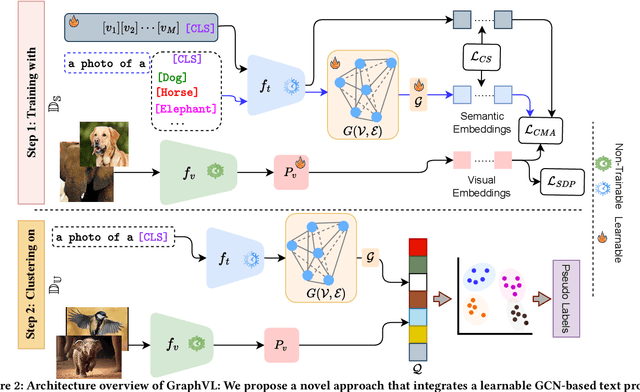

Generalized Category Discovery (GCD) aims to cluster unlabeled images into known and novel categories using labeled images from known classes. To address the challenge of transferring features from known to unknown classes while mitigating model bias, we introduce GraphVL, a novel approach for vision-language modeling in GCD, leveraging CLIP. Our method integrates a graph convolutional network (GCN) with CLIP's text encoder to preserve class neighborhood structure. We also employ a lightweight visual projector for image data, ensuring discriminative features through margin-based contrastive losses for image-text mapping. This neighborhood preservation criterion effectively regulates the semantic space, making it less sensitive to known classes. Additionally, we learn textual prompts from known classes and align them to create a more contextually meaningful semantic feature space for the GCN layer using a contextual similarity loss. Finally, we represent unlabeled samples based on their semantic distance to class prompts from the GCN, enabling semi-supervised clustering for class discovery and minimizing errors. Our experiments on seven benchmark datasets consistently demonstrate the superiority of GraphVL when integrated with the CLIP backbone.