 Add to Chrome
 Add to Firefox
 Add to Edge
Efficient Document Tampering Localization with Multi-Level Discrepancy Features and Unified DCT-Quantization Embedding
Jun 21, 2026
Localizing document tampering is extremely challenging, as manipulations are crafted to appear visually consistent and often leave only subtle traces that are nearly invisible to the human eye. In prior work, evaluation has been largely dominated by synthetic benchmarks that closely match the training distribution, and methods have shown steady progress under this setting. However, these gains often translate poorly to human-made forgeries and to cross-domain evaluation, where both the source documents and the tampering pipeline can change, leading to a distribution shift. In addition, since the introduction of the Frequency Perception Head for the discrete cosine transform (DCT) modality, it has become a standard choice, and subsequent work has largely focused on downstream modules and fusion strategies rather than revisiting the backbone itself. To help close this gap in cross-domain performance and improve the DCT backbone design, we propose \textbf{DiffNet}, a relatively simple yet effective RGB--DCT early-fusion architecture driven by two key design choices. First, to ensure that the decoder aggregates multi-scale inconsistency evidence rather than operating on raw, content-heavy activations, we apply a lightweight multi-level discrepancy transformation at the output of each backbone stage, replacing features with magnitude-only responses to learned zero-sum filters. Second, we design an efficient DCT-domain backbone that relies on a lightweight frequency-index-aware DCT--quantization joint embedding. Our approach achieves state-of-the-art performance on cross-domain and human-made document tampering localization, outperforming prior methods by around 30\%, with up to $7\times$ higher throughput than the previous best model.

RIDE: An Open Dataset and Benchmark for Train Delay Prediction
Jun 03, 2026Train delay prediction is an important problem for both passengers and railway operators, yet progress in the field remains difficult to assess due to the lack of standardized datasets, prediction targets, and evaluation protocols. To address this gap, we introduce RIDE, an open dataset and benchmark for train delay prediction built at nationwide scale over the Belgian railway network. RIDE covers 94.5M train events, 3.6M journeys, and 35.7M weather records from 2023 to 2025. It is organized as a layered data pipeline from raw railway and weather sources to two public releases: a reusable intermediate relational dataset and model-ready benchmark datasets. The benchmark standardizes the prediction task and the training and testing data. It also provides a unified evaluation protocol that supports direct comparison across models. Using this framework, we provide the first comprehensive comparative evaluation of non-learning, statistical learning, and deep learning models. We show that learning-based methods clearly outperform non-learning models, with graph neural networks achieving the best mean performance, while the strongest learning-based models remain relatively close to one another. Beyond aggregate mean absolute error (MAE) and root mean squared error (RMSE), the framework also provides breakdowns by prediction horizon and delay change, enabling more detailed analysis of model behavior across forecasting regimes.
Decoupling Communication from Policy: Robust MARL under Bandwidth Constraints
May 20, 2026Communication enables coordination in multi-agent reinforcement learning (MARL), but many real-world applications, e.g., search-and-rescue with drone swarms, operate under severe bandwidth constraints. Many communication architectures still expose a coupled bottleneck in which a shared latent representation is used for both policy execution and inter-agent communication. Consequently, reducing message size directly limits the policy's latent space, often leading to significant performance degradation. We address this with two contributions. First, we introduce $β$, a normalised per-agent bandwidth budget that unifies sparsity, rounds, and message dimension into a single comparable constraint. Second, we provide SLIM, a minimal architecture that decouples the communication pathway from the policy's latent representation, allowing us to isolate the effect of bandwidth from the effect of policy capacity while benefiting from in-step communication. We evaluate our method on several partially-observable MARL benchmarks, where communication is essential. Our approach achieves state-of-the-art performance and exhibits scalability and robustness under limited communication, with only marginal degradation as bandwidth is reduced.
Leveraging Contrastive Learning for a Similarity-Guided Tampered Document Data Generation Pipeline
Feb 19, 2026Detecting tampered text in document images is a challenging task due to data scarcity. To address this, previous work has attempted to generate tampered documents using rule-based methods. However, the resulting documents often suffer from limited variety and poor visual quality, typically leaving highly visible artifacts that are rarely observed in real-world manipulations. This undermines the model's ability to learn robust, generalizable features and results in poor performance on real-world data. Motivated by this discrepancy, we propose a novel method for generating high-quality tampered document images. We first train an auxiliary network to compare text crops, leveraging contrastive learning with a novel strategy for defining positive pairs and their corresponding negatives. We also train a second auxiliary network to evaluate whether a crop tightly encloses the intended characters, without cutting off parts of characters or including parts of adjacent ones. Using a carefully designed generation pipeline that leverages both networks, we introduce a framework capable of producing diverse, high-quality tampered document images. We assess the effectiveness of our data generation pipeline by training multiple models on datasets derived from the same source images, generated using our method and existing approaches, under identical training protocols. Evaluating these models on various open-source datasets shows that our pipeline yields consistent performance improvements across architectures and datasets.
Simulation-Driven Railway Delay Prediction: An Imitation Learning Approach
Dec 17, 2025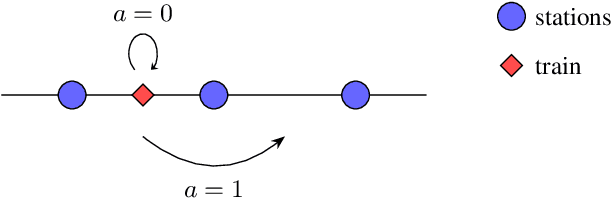
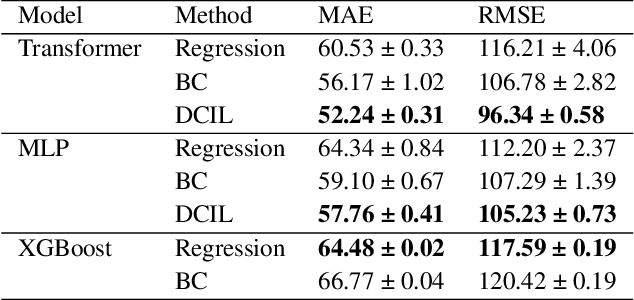
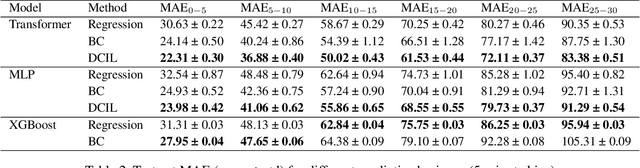
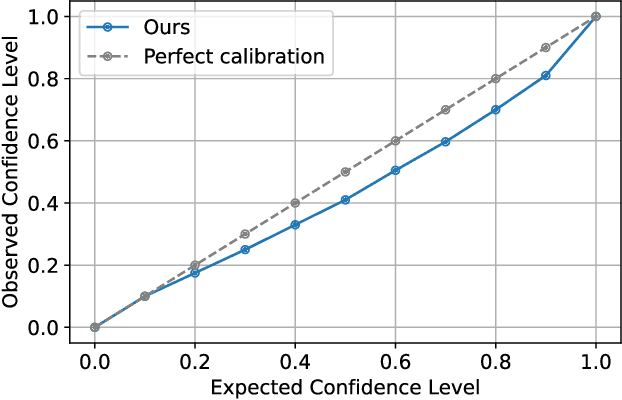
Reliable prediction of train delays is essential for enhancing the robustness and efficiency of railway transportation systems. In this work, we reframe delay forecasting as a stochastic simulation task, modeling state-transition dynamics through imitation learning. We introduce Drift-Corrected Imitation Learning (DCIL), a novel self-supervised algorithm that extends DAgger by incorporating distance-based drift correction, thereby mitigating covariate shift during rollouts without requiring access to an external oracle or adversarial schemes. Our approach synthesizes the dynamical fidelity of event-driven models with the representational capacity of data-driven methods, enabling uncertainty-aware forecasting via Monte Carlo simulation. We evaluate DCIL using a comprehensive real-world dataset from \textsc{Infrabel}, the Belgian railway infrastructure manager, which encompasses over three million train movements. Our results, focused on predictions up to 30 minutes ahead, demonstrate superior predictive performance of DCIL over traditional regression models and behavioral cloning on deep learning architectures, highlighting its effectiveness in capturing the sequential and uncertain nature of delay propagation in large-scale networks.
PACT: Pruning and Clustering-Based Token Reduction for Faster Visual Language Models
Apr 11, 2025Visual Language Models require substantial computational resources for inference due to the additional input tokens needed to represent visual information. However, these visual tokens often contain redundant and unimportant information, resulting in an unnecessarily high number of tokens. To address this, we introduce PACT, a method that reduces inference time and memory usage by pruning irrelevant tokens and merging visually redundant ones at an early layer of the language model. Our approach uses a novel importance metric to identify unimportant tokens without relying on attention scores, making it compatible with FlashAttention. We also propose a novel clustering algorithm, called Distance Bounded Density Peak Clustering, which efficiently clusters visual tokens while constraining the distances between elements within a cluster by a predefined threshold. We demonstrate the effectiveness of PACT through extensive experiments.