 Add to Chrome
 Add to Firefox
 Add to Edge
Simulation-Driven Railway Delay Prediction: An Imitation Learning Approach
Paper and Code

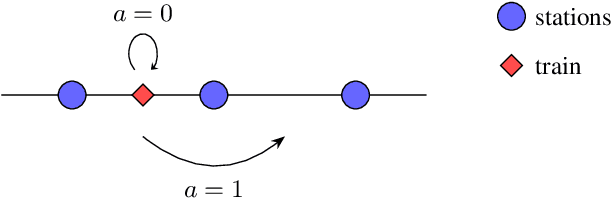
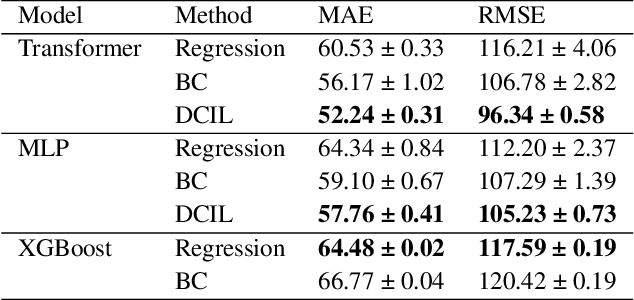
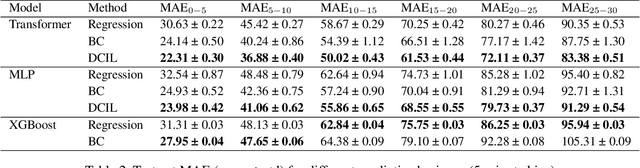
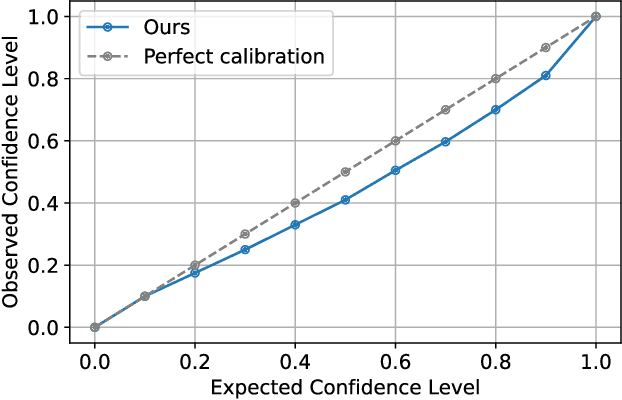
Reliable prediction of train delays is essential for enhancing the robustness and efficiency of railway transportation systems. In this work, we reframe delay forecasting as a stochastic simulation task, modeling state-transition dynamics through imitation learning. We introduce Drift-Corrected Imitation Learning (DCIL), a novel self-supervised algorithm that extends DAgger by incorporating distance-based drift correction, thereby mitigating covariate shift during rollouts without requiring access to an external oracle or adversarial schemes. Our approach synthesizes the dynamical fidelity of event-driven models with the representational capacity of data-driven methods, enabling uncertainty-aware forecasting via Monte Carlo simulation. We evaluate DCIL using a comprehensive real-world dataset from \textsc{Infrabel}, the Belgian railway infrastructure manager, which encompasses over three million train movements. Our results, focused on predictions up to 30 minutes ahead, demonstrate superior predictive performance of DCIL over traditional regression models and behavioral cloning on deep learning architectures, highlighting its effectiveness in capturing the sequential and uncertain nature of delay propagation in large-scale networks.
