 Add to Chrome
 Add to Firefox
 Add to Edge
Efficient Document Tampering Localization with Multi-Level Discrepancy Features and Unified DCT-Quantization Embedding
Jun 21, 2026
Localizing document tampering is extremely challenging, as manipulations are crafted to appear visually consistent and often leave only subtle traces that are nearly invisible to the human eye. In prior work, evaluation has been largely dominated by synthetic benchmarks that closely match the training distribution, and methods have shown steady progress under this setting. However, these gains often translate poorly to human-made forgeries and to cross-domain evaluation, where both the source documents and the tampering pipeline can change, leading to a distribution shift. In addition, since the introduction of the Frequency Perception Head for the discrete cosine transform (DCT) modality, it has become a standard choice, and subsequent work has largely focused on downstream modules and fusion strategies rather than revisiting the backbone itself. To help close this gap in cross-domain performance and improve the DCT backbone design, we propose \textbf{DiffNet}, a relatively simple yet effective RGB--DCT early-fusion architecture driven by two key design choices. First, to ensure that the decoder aggregates multi-scale inconsistency evidence rather than operating on raw, content-heavy activations, we apply a lightweight multi-level discrepancy transformation at the output of each backbone stage, replacing features with magnitude-only responses to learned zero-sum filters. Second, we design an efficient DCT-domain backbone that relies on a lightweight frequency-index-aware DCT--quantization joint embedding. Our approach achieves state-of-the-art performance on cross-domain and human-made document tampering localization, outperforming prior methods by around 30\%, with up to $7\times$ higher throughput than the previous best model.

Leveraging Contrastive Learning for a Similarity-Guided Tampered Document Data Generation Pipeline
Feb 19, 2026Detecting tampered text in document images is a challenging task due to data scarcity. To address this, previous work has attempted to generate tampered documents using rule-based methods. However, the resulting documents often suffer from limited variety and poor visual quality, typically leaving highly visible artifacts that are rarely observed in real-world manipulations. This undermines the model's ability to learn robust, generalizable features and results in poor performance on real-world data. Motivated by this discrepancy, we propose a novel method for generating high-quality tampered document images. We first train an auxiliary network to compare text crops, leveraging contrastive learning with a novel strategy for defining positive pairs and their corresponding negatives. We also train a second auxiliary network to evaluate whether a crop tightly encloses the intended characters, without cutting off parts of characters or including parts of adjacent ones. Using a carefully designed generation pipeline that leverages both networks, we introduce a framework capable of producing diverse, high-quality tampered document images. We assess the effectiveness of our data generation pipeline by training multiple models on datasets derived from the same source images, generated using our method and existing approaches, under identical training protocols. Evaluating these models on various open-source datasets shows that our pipeline yields consistent performance improvements across architectures and datasets.
PACT: Pruning and Clustering-Based Token Reduction for Faster Visual Language Models
Apr 11, 2025Visual Language Models require substantial computational resources for inference due to the additional input tokens needed to represent visual information. However, these visual tokens often contain redundant and unimportant information, resulting in an unnecessarily high number of tokens. To address this, we introduce PACT, a method that reduces inference time and memory usage by pruning irrelevant tokens and merging visually redundant ones at an early layer of the language model. Our approach uses a novel importance metric to identify unimportant tokens without relying on attention scores, making it compatible with FlashAttention. We also propose a novel clustering algorithm, called Distance Bounded Density Peak Clustering, which efficiently clusters visual tokens while constraining the distances between elements within a cluster by a predefined threshold. We demonstrate the effectiveness of PACT through extensive experiments.
DocParser: End-to-end OCR-free Information Extraction from Visually Rich Documents
May 01, 2023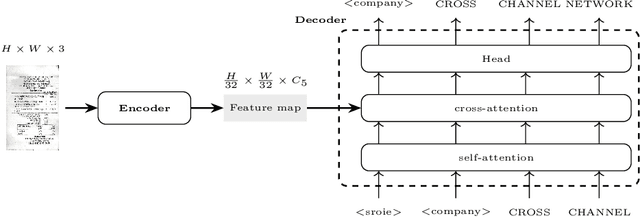
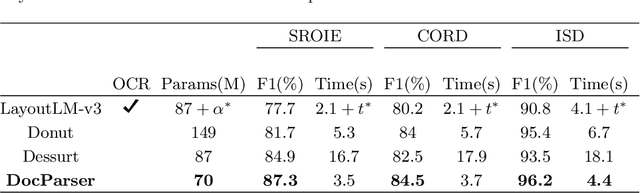
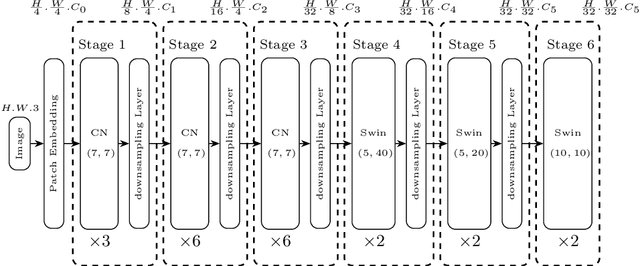
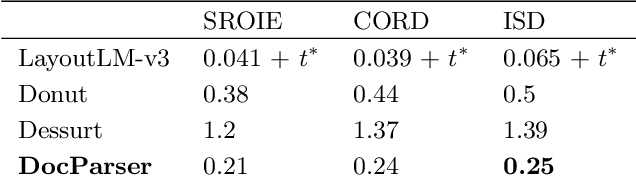
Information Extraction from visually rich documents is a challenging task that has gained a lot of attention in recent years due to its importance in several document-control based applications and its widespread commercial value. The majority of the research work conducted on this topic to date follow a two-step pipeline. First, they read the text using an off-the-shelf Optical Character Recognition (OCR) engine, then, they extract the fields of interest from the obtained text. The main drawback of these approaches is their dependence on an external OCR system, which can negatively impact both performance and computational speed. Recent OCR-free methods were proposed to address the previous issues. Inspired by their promising results, we propose in this paper an OCR-free end-to-end information extraction model named DocParser. It differs from prior end-to-end approaches by its ability to better extract discriminative character features. DocParser achieves state-of-the-art results on various datasets, while still being faster than previous works.