 Add to Chrome
 Add to Firefox
 Add to Edge
Tomo-center: an AI-based rotation-axis center finder for synchrotron micro- and nano-tomography
Jul 10, 2026
Accurate determination of the rotation-axis position is a prerequisite for artifact-free reconstruction in parallel-beam synchrotron micro-tomography. Traditional approaches such as Vo's method rely on sinogram features that can fail for low-contrast or weakly absorbing specimens. We present a learning-based method that treats center selection as a binary classification problem, using a DINOv2-pretrained vision transformer aggregated with attention-based multiple-instance learning, fine-tuned end-to-end on tomographic images. At inference time, the proposed algorithm was applied to a stack of tomograms reconstructed at a sweep of candidate centers to select the optimal center for reconstruction. We tested the estimation accuracy of the proposed method on two independent data sources and consistently achieved a mean absolute error of below 1 pixel. We also tested the method robustness to sparse or noisy acquisitions with the same datasets and demonstrated consistent performance when the number of projections was reduced by a factor of up to 10 or the blank scan factor of the underlying Poisson's noise was increased to 10. We also illustrated the interpretability of the proposed method by mapping out the relative contributions of continuous spatial features to the overall classification task. This method, delivered as tomo-center, an open-source command-line tool, has been integrated into several tomography software packages to assist experiments during the routine beamline operations.

Multimodal Classification Network Guided Trajectory Planning for Four-Wheel Independent Steering Autonomous Parking Considering Obstacle Attributes
Dec 21, 2025Four-wheel Independent Steering (4WIS) vehicles have attracted increasing attention for their superior maneuverability. Human drivers typically choose to cross or drive over the low-profile obstacles (e.g., plastic bags) to efficiently navigate through narrow spaces, while existing planners neglect obstacle attributes, causing inefficiency or path-finding failures. To address this, we propose a trajectory planning framework integrating the 4WIS hybrid A* and Optimal Control Problem (OCP), in which the hybrid A* provides an initial path to enhance the OCP solution. Specifically, a multimodal classification network is introduced to assess scene complexity (hard/easy task) by fusing image and vehicle state data. For hard tasks, guided points are set to decompose complex tasks into local subtasks, improving the search efficiency of 4WIS hybrid A*. The multiple steering modes of 4WIS vehicles (Ackermann, diagonal, and zero-turn) are also incorporated into node expansion and heuristic designs. Moreover, a hierarchical obstacle handling strategy is designed to guide the node expansion considering obstacle attributes, i.e., 'non-traversable', 'crossable', and 'drive-over' obstacles. It allows crossing or driving over obstacles instead of the 'avoid-only' strategy, greatly enhancing success rates of pathfinding. We also design a logical constraint for the 'drive-over' obstacle by limiting its velocity to ensure safety. Furthermore, to address dynamic obstacles with motion uncertainty, we introduce a probabilistic risk field model, constructing risk-aware driving corridors that serve as linear collision constraints in OCP. Experimental results demonstrate the proposed framework's effectiveness in generating safe, efficient, and smooth trajectories for 4WIS vehicles, especially in constrained environments.
Deep learning-based spatio-temporal fusion for high-fidelity ultra-high-speed x-ray radiography
Nov 27, 2024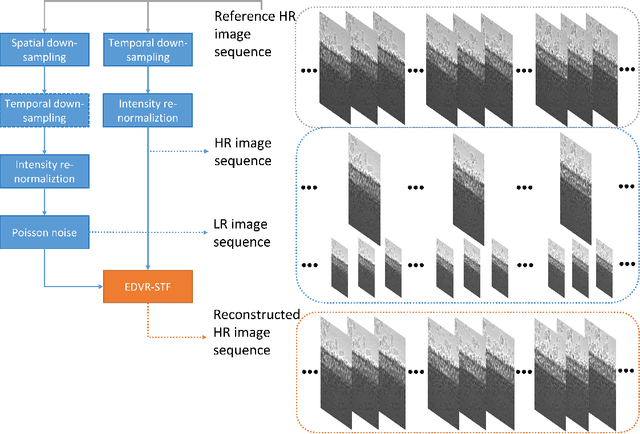
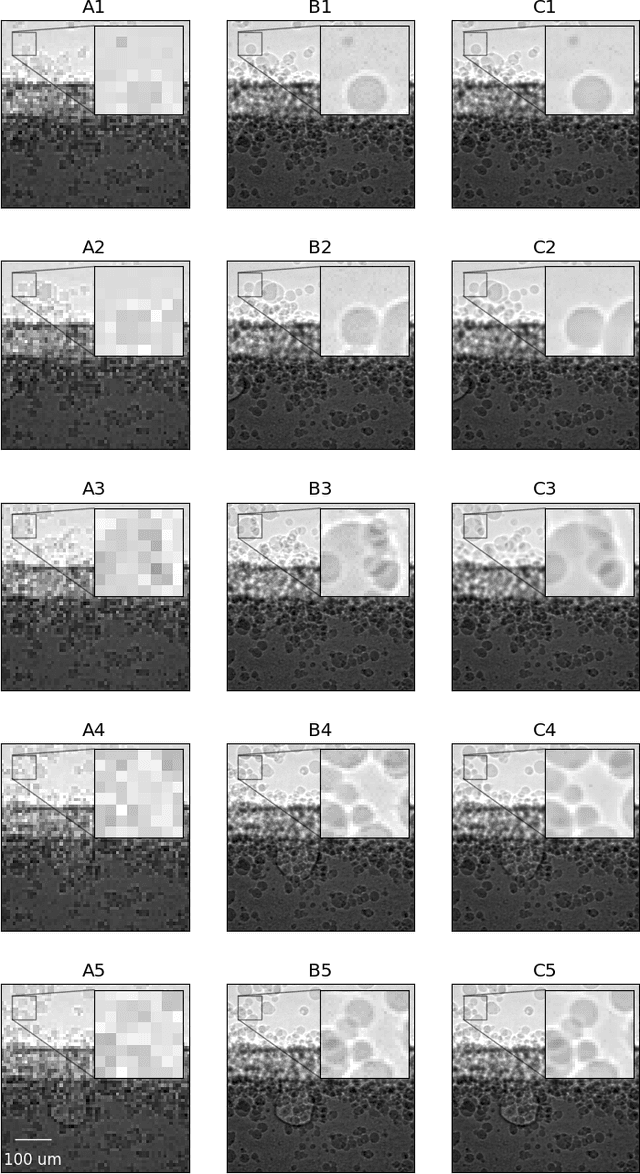
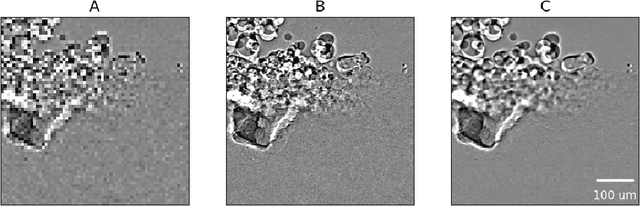
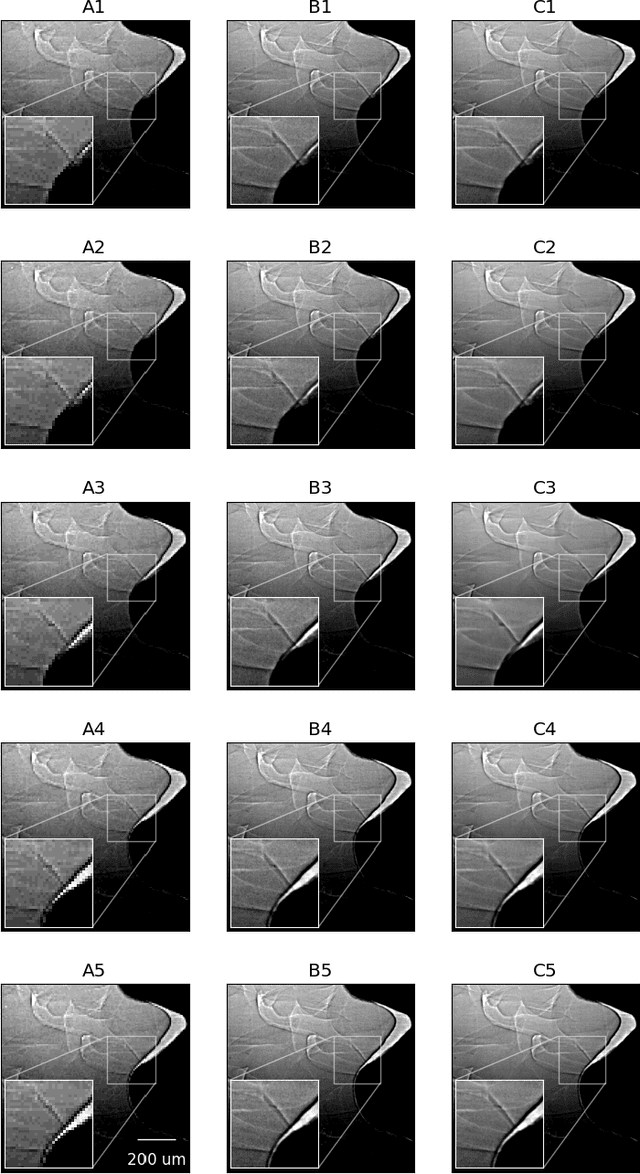
Full-field ultra-high-speed (UHS) x-ray imaging experiments have been well established to characterize various processes and phenomena. However, the potential of UHS experiments through the joint acquisition of x-ray videos with distinct configurations has not been fully exploited. In this paper, we investigate the use of a deep learning-based spatio-temporal fusion (STF) framework to fuse two complementary sequences of x-ray images and reconstruct the target image sequence with high spatial resolution, high frame rate, and high fidelity. We applied a transfer learning strategy to train the model and compared the peak signal-to-noise ratio (PSNR), average absolute difference (AAD), and structural similarity (SSIM) of the proposed framework on two independent x-ray datasets with those obtained from a baseline deep learning model, a Bayesian fusion framework, and the bicubic interpolation method. The proposed framework outperformed the other methods with various configurations of the input frame separations and image noise levels. With 3 subsequent images from the low resolution (LR) sequence of a 4-time lower spatial resolution and another 2 images from the high resolution (HR) sequence of a 20-time lower frame rate, the proposed approach achieved an average PSNR of 37.57 dB and 35.15 dB, respectively. When coupled with the appropriate combination of high-speed cameras, the proposed approach will enhance the performance and therefore scientific value of the UHS x-ray imaging experiments.