 Add to Chrome
 Add to Firefox
 Add to Edge
FRIEDA: Benchmarking Multi-Step Cartographic Reasoning in Vision-Language Models
Dec 08, 2025
Cartographic reasoning is the skill of interpreting geographic relationships by aligning legends, map scales, compass directions, map texts, and geometries across one or more map images. Although essential as a concrete cognitive capability and for critical tasks such as disaster response and urban planning, it remains largely unevaluated. Building on progress in chart and infographic understanding, recent large vision language model studies on map visual question-answering often treat maps as a special case of charts. In contrast, map VQA demands comprehension of layered symbology (e.g., symbols, geometries, and text labels) as well as spatial relations tied to orientation and distance that often span multiple maps and are not captured by chart-style evaluations. To address this gap, we introduce FRIEDA, a benchmark for testing complex open-ended cartographic reasoning in LVLMs. FRIEDA sources real map images from documents and reports in various domains and geographical areas. Following classifications in Geographic Information System (GIS) literature, FRIEDA targets all three categories of spatial relations: topological (border, equal, intersect, within), metric (distance), and directional (orientation). All questions require multi-step inference, and many require cross-map grounding and reasoning. We evaluate eleven state-of-the-art LVLMs under two settings: (1) the direct setting, where we provide the maps relevant to the question, and (2) the contextual setting, where the model may have to identify the maps relevant to the question before reasoning. Even the strongest models, Gemini-2.5-Pro and GPT-5-Think, achieve only 38.20% and 37.20% accuracy, respectively, far below human performance of 84.87%. These results reveal a persistent gap in multi-step cartographic reasoning, positioning FRIEDA as a rigorous benchmark to drive progress on spatial intelligence in LVLMs.

Context-Aware Trajectory Anomaly Detection
Oct 24, 2024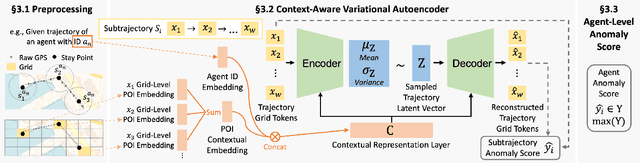

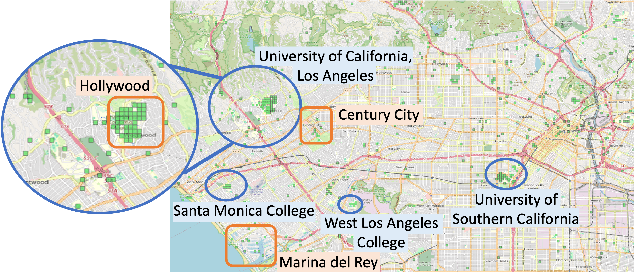
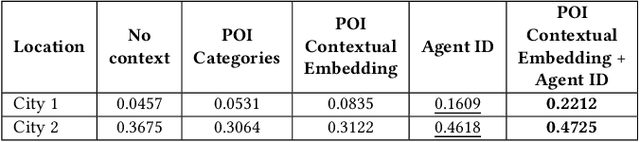
Trajectory anomaly detection is crucial for effective decision-making in urban and human mobility management. Existing methods of trajectory anomaly detection generally focus on training a trajectory generative model and evaluating the likelihood of reconstructing a given trajectory. However, previous work often lacks important contextual information on the trajectory, such as the agent's information (e.g., agent ID) or geographic information (e.g., Points of Interest (POI)), which could provide additional information on accurately capturing anomalous behaviors. To fill this gap, we propose a context-aware anomaly detection approach that models contextual information related to trajectories. The proposed method is based on a trajectory reconstruction framework guided by contextual factors such as agent ID and contextual POI embedding. The injection of contextual information aims to improve the performance of anomaly detection. We conducted experiments in two cities and demonstrated that the proposed approach significantly outperformed existing methods by effectively modeling contextual information. Overall, this paper paves a new direction for advancing trajectory anomaly detection.