 Add to Chrome
 Add to Firefox
 Add to Edge
Estimating Mutual Information between Time Series and Temporal Event Sequences Across Diverse Analysis Tasks
Jun 01, 2026
Pairwise dependence measures such as correlation and causality are fundamental to temporal data mining, yet there is still no principled and robust way to quantify dependence between heterogeneous data types, especially between continuous time series and discrete temporal event sequences. Existing approaches rely on ad hoc transformations or mutual-information estimators that are highly sensitive to quantization, repeated values, and event redundancy, leading to biased or unstable results in practice. We propose a nonparametric mutual information estimator that directly measures the dependence between time series and event sequences without data transformation, learning, or ad hoc discretization. Our method models the continuous-discrete duality of real-world time series to handle quantization and repeated-value artifacts and introduces a latent event clustering strategy to mitigate bias from event co-occurrence and redundancy. Together, these yield a robust and unified framework that bridges discrete and continuous mutual information. We evaluate the proposed estimator on four representative tasks: discrete-continuous time-delayed mutual information for causality analysis, global and local temporal repetition discovery, discrete covariate selection for time series forecasting, and continuous feature selection for classification. Experiments on synthetic and real-world datasets show consistent improvements over existing methods in accuracy, robustness, and interpretability, positioning our approach as a general-purpose dependence operator for heterogeneous temporal data, similar to Pearson correlation for homogeneous time series. Code available at: https://github.com/HaojiHu/Multimodal-Temporal-Data-Quantification

Context-Aware Trajectory Anomaly Detection
Oct 24, 2024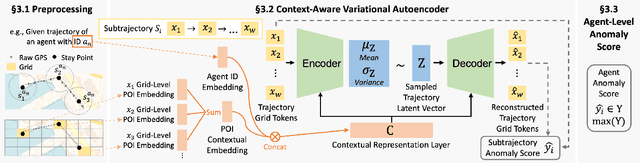

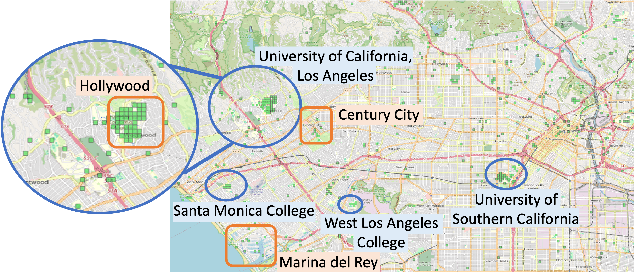
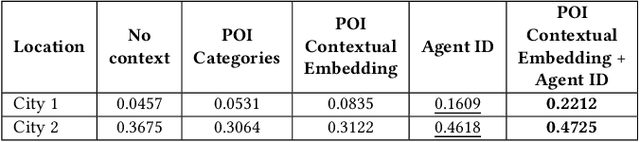
Trajectory anomaly detection is crucial for effective decision-making in urban and human mobility management. Existing methods of trajectory anomaly detection generally focus on training a trajectory generative model and evaluating the likelihood of reconstructing a given trajectory. However, previous work often lacks important contextual information on the trajectory, such as the agent's information (e.g., agent ID) or geographic information (e.g., Points of Interest (POI)), which could provide additional information on accurately capturing anomalous behaviors. To fill this gap, we propose a context-aware anomaly detection approach that models contextual information related to trajectories. The proposed method is based on a trajectory reconstruction framework guided by contextual factors such as agent ID and contextual POI embedding. The injection of contextual information aims to improve the performance of anomaly detection. We conducted experiments in two cities and demonstrated that the proposed approach significantly outperformed existing methods by effectively modeling contextual information. Overall, this paper paves a new direction for advancing trajectory anomaly detection.