 Add to Chrome
 Add to Firefox
 Add to Edge
Misalignment Has a Personality: A Big Five Account of Emergent Misalignment
Jul 29, 2026
Fine-tuning a language model on data containing a narrow flaw, such as insecure code or incorrect mathematical answers, can cause broad misalignment through a mechanism that remains debated. We provide an interpretable account: in the models and corpora we study, misalignment behaves like a shift in personality. Prior work extracts activation directions for character traits from a single binary contrast, which can separate or steer behavior without establishing a calibrated scale. We instead extract personality vectors for the Big Five using a graded, three-level intervention and validate them on two open-weight models. The three levels are linearly ordered, with Cohen's d values of up to 6.2; the vectors transfer zero-shot and trait-specifically to an independent corpus; and their effects are strongest within a middle-layer band. Applied to training data, the vectors reveal that misaligned corpora across eight domains share a common Big Five signature: lower agreeableness and conscientiousness, together with higher extraversion and neuroticism. This signature is recovered by both models with a correlation of r = 0.94. Fine-tuning imprints the same profile, shifting the model's generations along the corresponding signature, with r = 0.83 using activation-based measurements and r = 0.90 using a text-based judge, while also shifting internal activations with r = 0.69. The same vectors characterize sycophancy as high extraversion and low conscientiousness rather than excess agreeableness, a distinction that a single direction cannot capture. Calibrated personality vectors transform an opaque safety phenomenon into a human-legible diagnostic profile.

Behavior-Adaptive Conversational Agents: Toward a Fluid Personality Framework
Jul 01, 2026Large language model (LLM)-based conversational agents (CAs) are now ubiquitous, creating new opportunities for AI-mediated behavior change. Their capacity to project nuanced personalities and adopt diverse metaphorical roles raises a design question: how should an agent's persona and personality be calibrated to the moment? Recent evidence suggests that (i) moderate personality expression outperforms low or high extremes on trust, enjoyment, and intention to adopt in goal-oriented tasks, and (ii) context-appropriate metaphors outperform static one-note assistants on user experience and uptake. Yet most CAs still fix both persona and style, risking misalignment when dynamics, urgency, and formality vary, for example in medical information seeking, fitness coaching, and reflective learning. We propose a Fluid Personality Framework that jointly adapts (1) the agent's metaphorical persona, such as coach, tutor, librarian, or tool, and (2) its personality expression intensity, low, medium, or high, as a function of task context, user goals and traits, and situational urgency. We sketch the framework and its core design dimensions.
Personas Evolved: Designing Ethical LLM-Based Conversational Agent Personalities
Feb 27, 2025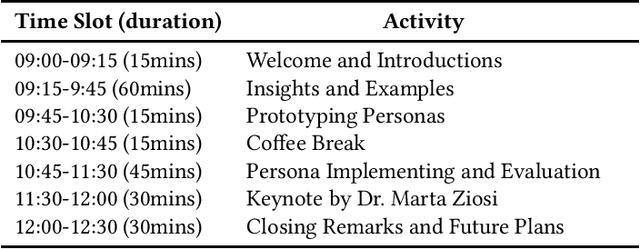
The emergence of Large Language Models (LLMs) has revolutionized Conversational User Interfaces (CUIs), enabling more dynamic, context-aware, and human-like interactions across diverse domains, from social sciences to healthcare. However, the rapid adoption of LLM-based personas raises critical ethical and practical concerns, including bias, manipulation, and unforeseen social consequences. Unlike traditional CUIs, where personas are carefully designed with clear intent, LLM-based personas generate responses dynamically from vast datasets, making their behavior less predictable and harder to govern. This workshop aims to bridge the gap between CUI and broader AI communities by fostering a cross-disciplinary dialogue on the responsible design and evaluation of LLM-based personas. Bringing together researchers, designers, and practitioners, we will explore best practices, develop ethical guidelines, and promote frameworks that ensure transparency, inclusivity, and user-centered interactions. By addressing these challenges collaboratively, we seek to shape the future of LLM-driven CUIs in ways that align with societal values and expectations.
Toward Metaphor-Fluid Conversation Design for Voice User Interfaces
Feb 17, 2025
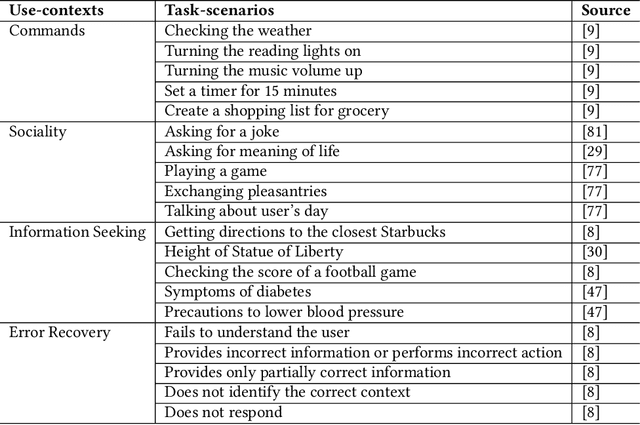
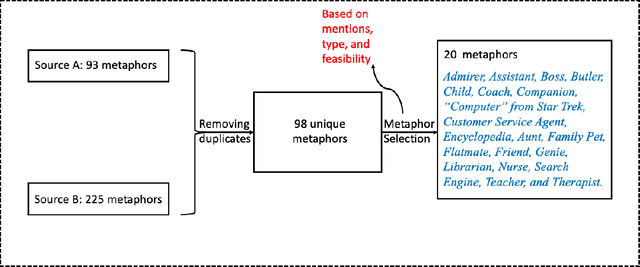
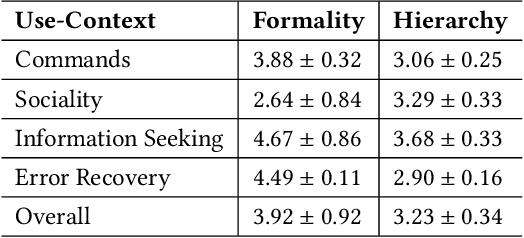
Metaphors play a critical role in shaping user experiences with Voice User Interfaces (VUIs), yet existing designs often rely on static, human-centric metaphors that fail to adapt to diverse contexts and user needs. This paper introduces Metaphor-Fluid Design, a novel approach that dynamically adjusts metaphorical representations based on conversational use-contexts. We compare this approach to a Default VUI, which characterizes the present implementation of commercial VUIs commonly designed around the persona of an assistant, offering a uniform interaction style across contexts. In Study 1 (N=130), metaphors were mapped to four key use-contexts-commands, information seeking, sociality, and error recovery-along the dimensions of formality and hierarchy, revealing distinct preferences for task-specific metaphorical designs. Study 2 (N=91) evaluates a Metaphor-Fluid VUI against a Default VUI, showing that the Metaphor-Fluid VUI enhances perceived intention to adopt, enjoyment, and likability by aligning better with user expectations for different contexts. However, individual differences in metaphor preferences highlight the need for personalization. These findings challenge the one-size-fits-all paradigm of VUI design and demonstrate the potential of Metaphor-Fluid Design to create more adaptive and engaging human-AI interactions.
"It Felt Like I Was Left in the Dark": Exploring Information Needs and Design Opportunities for Family Caregivers of Older Adult Patients in Critical Care Settings
Feb 07, 2025Older adult patients constitute a rapidly growing subgroup of Intensive Care Unit (ICU) patients. In these situations, their family caregivers are expected to represent the unconscious patients to access and interpret patients' medical information. However, caregivers currently have to rely on overloaded clinicians for information updates and typically lack the health literacy to understand complex medical information. Our project aims to explore the information needs of caregivers of ICU older adult patients, from which we can propose design opportunities to guide future AI systems. The project begins with formative interviews with 11 caregivers to identify their challenges in accessing and interpreting medical information; From these findings, we then synthesize design requirements and propose an AI system prototype to cope with caregivers' challenges. The system prototype has two key features: a timeline visualization to show the AI extracted and summarized older adult patients' key medical events; and an LLM-based chatbot to provide context-aware informational support. We conclude our paper by reporting on the follow-up user evaluation of the system and discussing future AI-based systems for ICU caregivers of older adults.
Designing AI Personalities: Enhancing Human-Agent Interaction Through Thoughtful Persona Design
Oct 30, 2024In the rapidly evolving field of artificial intelligence (AI) agents, designing the agent's characteristics is crucial for shaping user experience. This workshop aims to establish a research community focused on AI agent persona design for various contexts, such as in-car assistants, educational tools, and smart home environments. We will explore critical aspects of persona design, such as voice, embodiment, and demographics, and their impact on user satisfaction and engagement. Through discussions and hands-on activities, we aim to propose practices and standards that enhance the ecological validity of agent personas. Topics include the design of conversational interfaces, the influence of agent personas on user experience, and approaches for creating contextually appropriate AI agents. This workshop will provide a platform for building a community dedicated to developing AI agent personas that better fit diverse, everyday interactions.