 Add to Chrome
 Add to Firefox
 Add to Edge
Misalignment Has a Personality: A Big Five Account of Emergent Misalignment
Jul 29, 2026
Fine-tuning a language model on data containing a narrow flaw, such as insecure code or incorrect mathematical answers, can cause broad misalignment through a mechanism that remains debated. We provide an interpretable account: in the models and corpora we study, misalignment behaves like a shift in personality. Prior work extracts activation directions for character traits from a single binary contrast, which can separate or steer behavior without establishing a calibrated scale. We instead extract personality vectors for the Big Five using a graded, three-level intervention and validate them on two open-weight models. The three levels are linearly ordered, with Cohen's d values of up to 6.2; the vectors transfer zero-shot and trait-specifically to an independent corpus; and their effects are strongest within a middle-layer band. Applied to training data, the vectors reveal that misaligned corpora across eight domains share a common Big Five signature: lower agreeableness and conscientiousness, together with higher extraversion and neuroticism. This signature is recovered by both models with a correlation of r = 0.94. Fine-tuning imprints the same profile, shifting the model's generations along the corresponding signature, with r = 0.83 using activation-based measurements and r = 0.90 using a text-based judge, while also shifting internal activations with r = 0.69. The same vectors characterize sycophancy as high extraversion and low conscientiousness rather than excess agreeableness, a distinction that a single direction cannot capture. Calibrated personality vectors transform an opaque safety phenomenon into a human-legible diagnostic profile.

Behavior-Adaptive Conversational Agents: Toward a Fluid Personality Framework
Jul 01, 2026Large language model (LLM)-based conversational agents (CAs) are now ubiquitous, creating new opportunities for AI-mediated behavior change. Their capacity to project nuanced personalities and adopt diverse metaphorical roles raises a design question: how should an agent's persona and personality be calibrated to the moment? Recent evidence suggests that (i) moderate personality expression outperforms low or high extremes on trust, enjoyment, and intention to adopt in goal-oriented tasks, and (ii) context-appropriate metaphors outperform static one-note assistants on user experience and uptake. Yet most CAs still fix both persona and style, risking misalignment when dynamics, urgency, and formality vary, for example in medical information seeking, fitness coaching, and reflective learning. We propose a Fluid Personality Framework that jointly adapts (1) the agent's metaphorical persona, such as coach, tutor, librarian, or tool, and (2) its personality expression intensity, low, medium, or high, as a function of task context, user goals and traits, and situational urgency. We sketch the framework and its core design dimensions.
Singularity: Planet-Scale, Preemptive and Elastic Scheduling of AI Workloads
Feb 21, 2022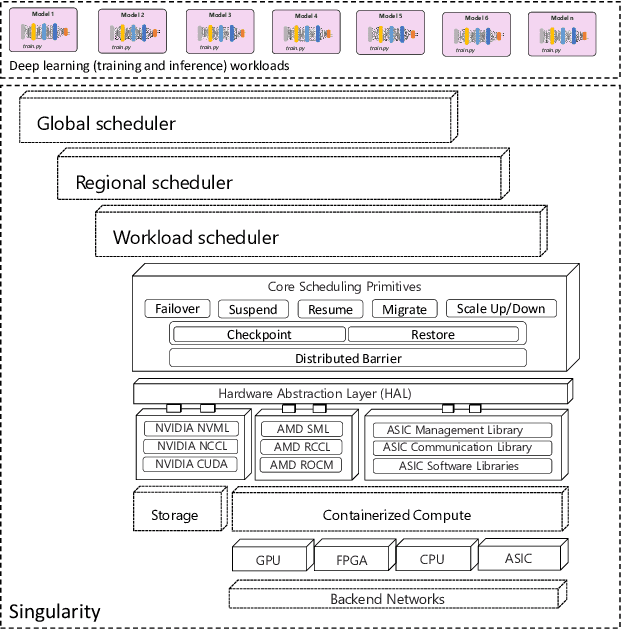
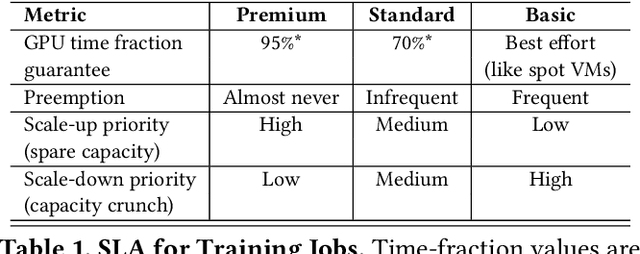
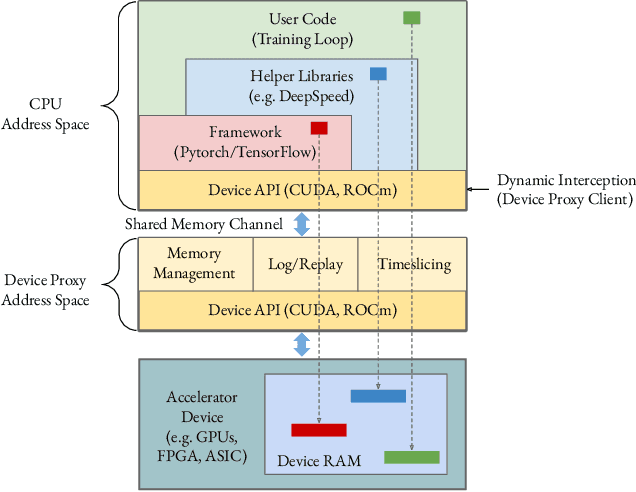
Lowering costs by driving high utilization across deep learning workloads is a crucial lever for cloud providers. We present Singularity, Microsoft's globally distributed scheduling service for highly-efficient and reliable execution of deep learning training and inference workloads. At the heart of Singularity is a novel, workload-aware scheduler that can transparently preempt and elastically scale deep learning workloads to drive high utilization without impacting their correctness or performance, across a global fleet of AI accelerators (e.g., GPUs, FPGAs). All jobs in Singularity are preemptable, migratable, and dynamically resizable (elastic) by default: a live job can be dynamically and transparently (a) preempted and migrated to a different set of nodes, cluster, data center or a region and resumed exactly from the point where the execution was preempted, and (b) resized (i.e., elastically scaled-up/down) on a varying set of accelerators of a given type. Our mechanisms are transparent in that they do not require the user to make any changes to their code or require using any custom libraries that may limit flexibility. Additionally, our approach significantly improves the reliability of deep learning workloads. We show that the resulting efficiency and reliability gains with Singularity are achieved with negligible impact on the steady-state performance. Finally, our design approach is agnostic of DNN architectures and handles a variety of parallelism strategies (e.g., data/pipeline/model parallelism).