 Add to Chrome
 Add to Firefox
 Add to Edge
On the sensitivity of machine-learned probabilistic weather forecast models to scale-aware scoring rules
Jul 21, 2026
Probabilistic forecast models can be machine-learned from data using loss functions based on scoring rules such as the Continuous Ranked Probability Score (CRPS). This note summarises a preliminary study comparing versions of AIFS-CRPS, a global weather forecast model, trained with different univariate and multivariate scoring rules that aim to explicitly represent scale-awareness in the loss function. In the first part, we compare the (almost) fair CRPS, a fair global energy score, and a graph energy score based on node neighbourhoods. Across standard verification metrics, forecast skill is broadly similar. In the extratropics we find only small differences, while in the tropics the graph energy score setup performs somewhat better and the global energy score shows some degradation. These results suggest that multivariate scores are a viable alternative to CRPS-based training for global machine-learned weather forecasting. In the second part of the study, we analyse how different scoring rules and scale-aware loss constraints shape the spectra of forecast fields. It is apparent that any form of explicit scale-awareness improves realism. Here, the largest differences are likely associated with different effective weights per scale.

AIFS-SUBS: Extending Data-Driven Forecasting to Sub-Seasonal Timescales
Jul 06, 2026Data-driven models now rival numerical weather prediction in the medium range, but extending them to sub-seasonal lead times raises challenges absent at shorter horizons. Errors accumulate over long autoregressive rollouts, systematic biases grow with lead time, and several years of data must be held out for independent verification, even though machine-learning models otherwise benefit from longer training records. To address these challenges, we adapt ECMWF's AIFS-CRPS medium-range model. AIFS-SUBS adopts a 24h autoregressive time step to reduce error accumulation, adds stratospheric levels and top-of-atmosphere thermal radiation as predictors, and reserves 2007--2011 as an independent verification window. We evaluate two config-durations: AIFS-SUBS, fine-tuned on operational analyses, and AIFS-SUBS-ERA5, trained on ERA5 alone. Across weeks 2--6, AIFS-SUBS matches the operational Integrated Forecasting System (IFS) in probabilistic skill while reducing systematic biases. For the convective (OLR) component of the Madden--Julian Oscillation (MJO), AIFS-SUBS extends skilful forecasts (correlation > 0.5) by eight days relative to the IFS, while matching or exceeding the IFS for the full multivariate RMM index. AIFS-SUBS also reproduces the observed MJO modulation of tropical cyclone activity comparably. Stratospheric skill is particularly strong with AIFS-SUBS reproducing sudden stratospheric warming (SSW) frequency and surface impact. In the AI Weather Quest, AIFS-SUBS-ERA5 attains a variable-averaged ranked probability skill score slightly ahead of the IFS at weeks 3 and 4. At inference, AIFS-SUBS uses about 200 times less energy than the IFS, opening the door to much larger real-time ensembles. AIFS-SUBS is ECMWF's first machine-learning model targeted at sub-seasonal time-scales.
Learning Coupled Earth System Dynamics with GraphDOP
Oct 23, 2025Interactions between different components of the Earth System (e.g. ocean, atmosphere, land and cryosphere) are a crucial driver of global weather patterns. Modern Numerical Weather Prediction (NWP) systems typically run separate models of the different components, explicitly coupled across their interfaces to additionally model exchanges between the different components. Accurately representing these coupled interactions remains a major scientific and technical challenge of weather forecasting. GraphDOP is a graph-based machine learning model that learns to forecast weather directly from raw satellite and in-situ observations, without reliance on reanalysis products or traditional physics-based NWP models. GraphDOP simultaneously embeds information from diverse observation sources spanning the full Earth system into a shared latent space. This enables predictions that implicitly capture cross-domain interactions in a single model without the need for any explicit coupling. Here we present a selection of case studies which illustrate the capability of GraphDOP to forecast events where coupled processes play a particularly key role. These include rapid sea-ice freezing in the Arctic, mixing-induced ocean surface cooling during Hurricane Ian and the severe European heat wave of 2022. The results suggest that learning directly from Earth System observations can successfully characterise and propagate cross-component interactions, offering a promising path towards physically consistent end-to-end data-driven Earth System prediction with a single model.
A multi-scale loss formulation for learning a probabilistic model with proper score optimisation
Jun 12, 2025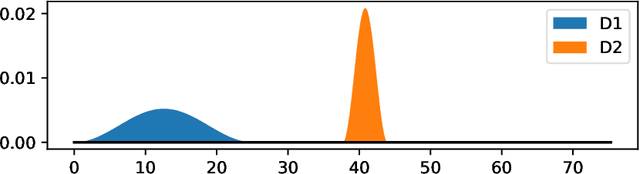
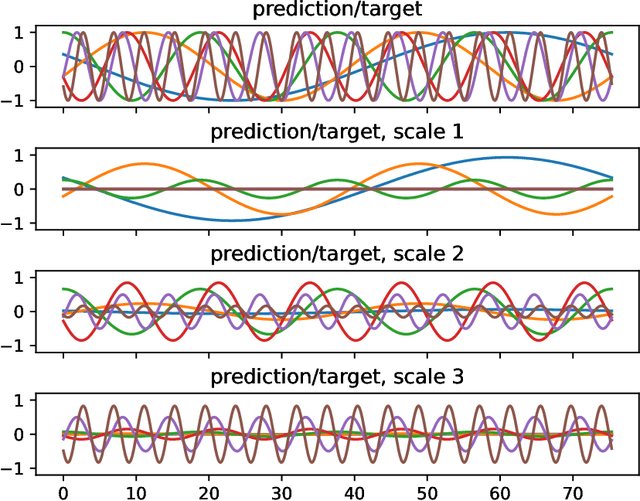
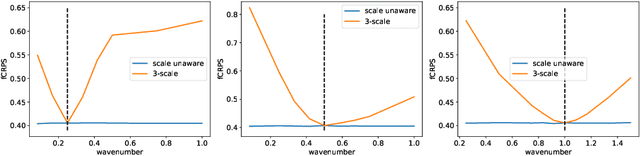
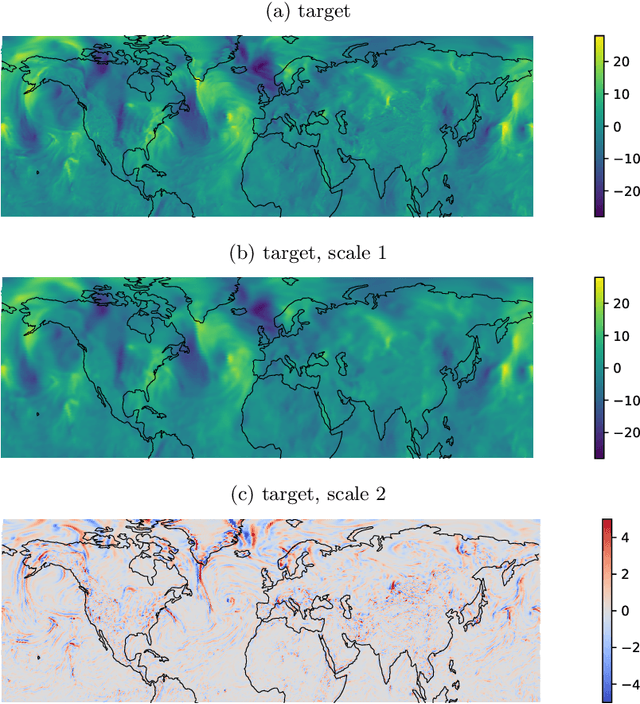
We assess the impact of a multi-scale loss formulation for training probabilistic machine-learned weather forecasting models. The multi-scale loss is tested in AIFS-CRPS, a machine-learned weather forecasting model developed at the European Centre for Medium-Range Weather Forecasts (ECMWF). AIFS-CRPS is trained by directly optimising the almost fair continuous ranked probability score (afCRPS). The multi-scale loss better constrains small scale variability without negatively impacting forecast skill. This opens up promising directions for future work in scale-aware model training.
GraphDOP: Towards skilful data-driven medium-range weather forecasts learnt and initialised directly from observations
Dec 20, 2024We introduce GraphDOP, a new data-driven, end-to-end forecast system developed at the European Centre for Medium-Range Weather Forecasts (ECMWF) that is trained and initialised exclusively from Earth System observations, with no physics-based (re)analysis inputs or feedbacks. GraphDOP learns the correlations between observed quantities - such as brightness temperatures from polar orbiters and geostationary satellites - and geophysical quantities of interest (that are measured by conventional observations), to form a coherent latent representation of Earth System state dynamics and physical processes, and is capable of producing skilful predictions of relevant weather parameters up to five days into the future.
Regional data-driven weather modeling with a global stretched-grid
Sep 04, 2024A data-driven model (DDM) suitable for regional weather forecasting applications is presented. The model extends the Artificial Intelligence Forecasting System by introducing a stretched-grid architecture that dedicates higher resolution over a regional area of interest and maintains a lower resolution elsewhere on the globe. The model is based on graph neural networks, which naturally affords arbitrary multi-resolution grid configurations. The model is applied to short-range weather prediction for the Nordics, producing forecasts at 2.5 km spatial and 6 h temporal resolution. The model is pre-trained on 43 years of global ERA5 data at 31 km resolution and is further refined using 3.3 years of 2.5 km resolution operational analyses from the MetCoOp Ensemble Prediction System (MEPS). The performance of the model is evaluated using surface observations from measurement stations across Norway and is compared to short-range weather forecasts from MEPS. The DDM outperforms both the control run and the ensemble mean of MEPS for 2 m temperature. The model also produces competitive precipitation and wind speed forecasts, but is shown to underestimate extreme events.
Data driven weather forecasts trained and initialised directly from observations
Jul 22, 2024Skilful Machine Learned weather forecasts have challenged our approach to numerical weather prediction, demonstrating competitive performance compared to traditional physics-based approaches. Data-driven systems have been trained to forecast future weather by learning from long historical records of past weather such as the ECMWF ERA5. These datasets have been made freely available to the wider research community, including the commercial sector, which has been a major factor in the rapid rise of ML forecast systems and the levels of accuracy they have achieved. However, historical reanalyses used for training and real-time analyses used for initial conditions are produced by data assimilation, an optimal blending of observations with a physics-based forecast model. As such, many ML forecast systems have an implicit and unquantified dependence on the physics-based models they seek to challenge. Here we propose a new approach, training a neural network to predict future weather purely from historical observations with no dependence on reanalyses. We use raw observations to initialise a model of the atmosphere (in observation space) learned directly from the observations themselves. Forecasts of crucial weather parameters (such as surface temperature and wind) are obtained by predicting weather parameter observations (e.g. SYNOP surface data) at future times and arbitrary locations. We present preliminary results on forecasting observations 12-hours into the future. These already demonstrate successful learning of time evolutions of the physical processes captured in real observations. We argue that this new approach, by staying purely in observation space, avoids many of the challenges of traditional data assimilation, can exploit a wider range of observations and is readily expanded to simultaneous forecasting of the full Earth system (atmosphere, land, ocean and composition).