 Add to Chrome
 Add to Firefox
 Add to Edge
AIFS-SUBS: Extending Data-Driven Forecasting to Sub-Seasonal Timescales
Jul 06, 2026
Data-driven models now rival numerical weather prediction in the medium range, but extending them to sub-seasonal lead times raises challenges absent at shorter horizons. Errors accumulate over long autoregressive rollouts, systematic biases grow with lead time, and several years of data must be held out for independent verification, even though machine-learning models otherwise benefit from longer training records. To address these challenges, we adapt ECMWF's AIFS-CRPS medium-range model. AIFS-SUBS adopts a 24h autoregressive time step to reduce error accumulation, adds stratospheric levels and top-of-atmosphere thermal radiation as predictors, and reserves 2007--2011 as an independent verification window. We evaluate two config-durations: AIFS-SUBS, fine-tuned on operational analyses, and AIFS-SUBS-ERA5, trained on ERA5 alone. Across weeks 2--6, AIFS-SUBS matches the operational Integrated Forecasting System (IFS) in probabilistic skill while reducing systematic biases. For the convective (OLR) component of the Madden--Julian Oscillation (MJO), AIFS-SUBS extends skilful forecasts (correlation > 0.5) by eight days relative to the IFS, while matching or exceeding the IFS for the full multivariate RMM index. AIFS-SUBS also reproduces the observed MJO modulation of tropical cyclone activity comparably. Stratospheric skill is particularly strong with AIFS-SUBS reproducing sudden stratospheric warming (SSW) frequency and surface impact. In the AI Weather Quest, AIFS-SUBS-ERA5 attains a variable-averaged ranked probability skill score slightly ahead of the IFS at weeks 3 and 4. At inference, AIFS-SUBS uses about 200 times less energy than the IFS, opening the door to much larger real-time ensembles. AIFS-SUBS is ECMWF's first machine-learning model targeted at sub-seasonal time-scales.

Robustness of AI-based weather forecasts in a changing climate
Sep 27, 2024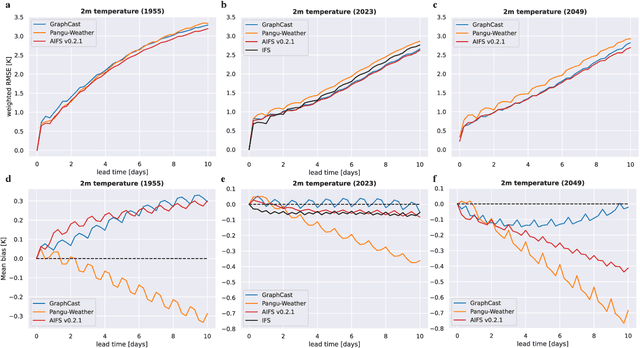

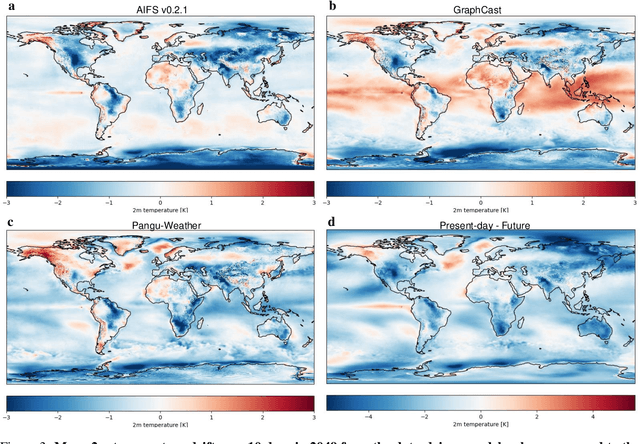
Data-driven machine learning models for weather forecasting have made transformational progress in the last 1-2 years, with state-of-the-art ones now outperforming the best physics-based models for a wide range of skill scores. Given the strong links between weather and climate modelling, this raises the question whether machine learning models could also revolutionize climate science, for example by informing mitigation and adaptation to climate change or to generate larger ensembles for more robust uncertainty estimates. Here, we show that current state-of-the-art machine learning models trained for weather forecasting in present-day climate produce skillful forecasts across different climate states corresponding to pre-industrial, present-day, and future 2.9K warmer climates. This indicates that the dynamics shaping the weather on short timescales may not differ fundamentally in a changing climate. It also demonstrates out-of-distribution generalization capabilities of the machine learning models that are a critical prerequisite for climate applications. Nonetheless, two of the models show a global-mean cold bias in the forecasts for the future warmer climate state, i.e. they drift towards the colder present-day climate they have been trained for. A similar result is obtained for the pre-industrial case where two out of three models show a warming. We discuss possible remedies for these biases and analyze their spatial distribution, revealing complex warming and cooling patterns that are partly related to missing ocean-sea ice and land surface information in the training data. Despite these current limitations, our results suggest that data-driven machine learning models will provide powerful tools for climate science and transform established approaches by complementing conventional physics-based models.