 Add to Chrome
 Add to Firefox
 Add to Edge
SimRPD: Optimizing Recruitment Proactive Dialogue Agents through Simulator-Based Data Evaluation and Selection
Jan 08, 2026
Task-oriented proactive dialogue agents play a pivotal role in recruitment, particularly for steering conversations towards specific business outcomes, such as acquiring social-media contacts for private-channel conversion. Although supervised fine-tuning and reinforcement learning have proven effective for training such agents, their performance is heavily constrained by the scarcity of high-quality, goal-oriented domain-specific training data. To address this challenge, we propose SimRPD, a three-stage framework for training recruitment proactive dialogue agents. First, we develop a high-fidelity user simulator to synthesize large-scale conversational data through multi-turn online dialogue. Then we introduce a multi-dimensional evaluation framework based on Chain-of-Intention (CoI) to comprehensively assess the simulator and effectively select high-quality data, incorporating both global-level and instance-level metrics. Finally, we train the recruitment proactive dialogue agent on the selected dataset. Experiments in a real-world recruitment scenario demonstrate that SimRPD outperforms existing simulator-based data selection strategies, highlighting its practical value for industrial deployment and its potential applicability to other business-oriented dialogue scenarios.

LLM-QE: Improving Query Expansion by Aligning Large Language Models with Ranking Preferences
Feb 24, 2025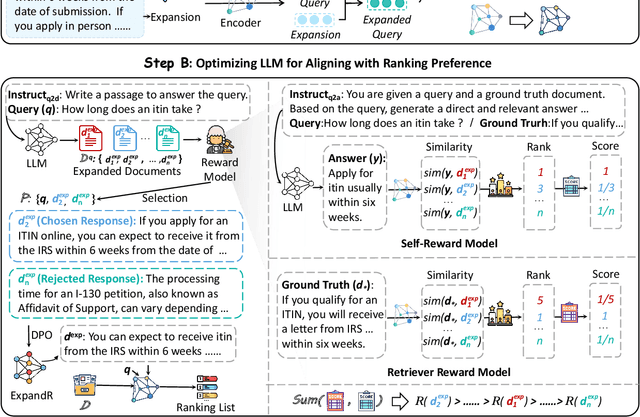
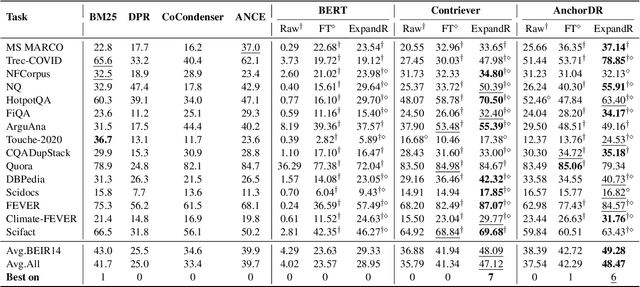
Query expansion plays a crucial role in information retrieval, which aims to bridge the semantic gap between queries and documents to improve matching performance. This paper introduces LLM-QE, a novel approach that leverages Large Language Models (LLMs) to generate document-based query expansions, thereby enhancing dense retrieval models. Unlike traditional methods, LLM-QE designs both rank-based and answer-based rewards and uses these reward models to optimize LLMs to align with the ranking preferences of both retrievers and LLMs, thus mitigating the hallucination of LLMs during query expansion. Our experiments on the zero-shot dense retrieval model, Contriever, demonstrate the effectiveness of LLM-QE, achieving an improvement of over 8%. Furthermore, by incorporating answer-based reward modeling, LLM-QE generates more relevant and precise information related to the documents, rather than simply producing redundant tokens to maximize rank-based rewards. Notably, LLM-QE also improves the training process of dense retrievers, achieving a more than 5% improvement after fine-tuning. All codes are available at https://github.com/NEUIR/LLM-QE.