 Add to Chrome
 Add to Firefox
 Add to Edge
ReQAT: Achieving Full-Precision Reasoning Accuracy with 4-bit Floating-Point Quantization-Aware Training
Jun 14, 2026
Large Reasoning Models (LRMs) achieve strong problem-solving through long chain-of-thought, but their deployment is constrained by the high cost of full-precision inference and growing KV cache footprints. Microscaled FP4 formats enable efficient FP4 deployment; however, fully quantizing weights, activations, and KV caches (W4A4KV4) causes severe reasoning degradation that existing PTQ and QAT fail to recover. We identify that FP4 failures concentrate on low-entropy tokens--precise symbolic commitments such as digits and operators--where quantization noise inflates sampling errors that cascade through reasoning traces. Based on this insight, we propose ReQAT, a reasoning-centric FP4 training framework with three components: (i) Trace-Aligned QAT (TAQ), which revisits identical reasoning traces to focus updates on critical low-entropy decisions; (ii) Selective Entropy Minimization (SEM), which reinforces confidence at low-entropy positions; and (iii) Q-FIT, a quantization-friendly initialization that jointly calibrates RoPE-consistent KV cache transformations to stabilize QAT. Under the same training budget, ReQAT not only recovers but surpasses BF16 fine-tuning accuracy, while delivering up to 3.9x throughput speedup on NVIDIA DGX Spark and 3.1x on B200.

ReSET: Accurate Latency-Critical NVFP4 Reasoning via Step-Aware Temperature Scaling
Jun 11, 2026Large reasoning models (LRMs) improve complex problem-solving by generating long intermediate reasoning traces, but this substantially increases inference costs. NVFP4 inference offers a promising approach to reduce both computational and memory costs through hardware-supported low-precision execution. However, directly applying NVFP4 to LRMs introduces two practical limitations: reasoning accuracy degrades under quantization, and existing NVFP4 kernels do not fully realize latency benefits in small-batch autoregressive decoding. In this work, we analyze the effect of NVFP4 quantization on token-level uncertainty during reasoning. We show that quantization increases incorrect sampling at low-entropy symbolic tokens, while causing over-concentration on a small set of tokens in high-uncertainty reasoning steps. Based on this observation, we propose \textbf{ReSET}, a reasoning-step entropy-based temperature-scaling method that estimates step-level uncertainty online and adapts the decoding temperature using both token-level and step-level entropy signals. To address the latency gap, we further design a CUDA-core small-$M$ NVFP4 kernel for latency-critical autoregressive decoding. Across reasoning benchmarks and model scales, ReSET improves NVFP4 reasoning accuracy by up to $\sim\!$2 points over the NVFP4 baseline. Our CUDA-core small-$M$ kernel further improves latency-critical decoding, delivering up to $2.5\!\times$ kernel-level speedup over NVFP4 vLLM and approximately $2\!\times$ end-to-end decoding speedup over BF16. Code is available at https://github.com/aiha-lab/ReSET.
Token-Scaled Logit Distillation for Ternary Weight Generative Language Models
Aug 13, 2023Generative Language Models (GLMs) have shown impressive performance in tasks such as text generation, understanding, and reasoning. However, the large model size poses challenges for practical deployment. To solve this problem, Quantization-Aware Training (QAT) has become increasingly popular. However, current QAT methods for generative models have resulted in a noticeable loss of accuracy. To counteract this issue, we propose a novel knowledge distillation method specifically designed for GLMs. Our method, called token-scaled logit distillation, prevents overfitting and provides superior learning from the teacher model and ground truth. This research marks the first evaluation of ternary weight quantization-aware training of large-scale GLMs with less than 1.0 degradation in perplexity and no loss of accuracy in a reasoning task.
Understanding and Improving Knowledge Distillation for Quantization-Aware Training of Large Transformer Encoders
Nov 20, 2022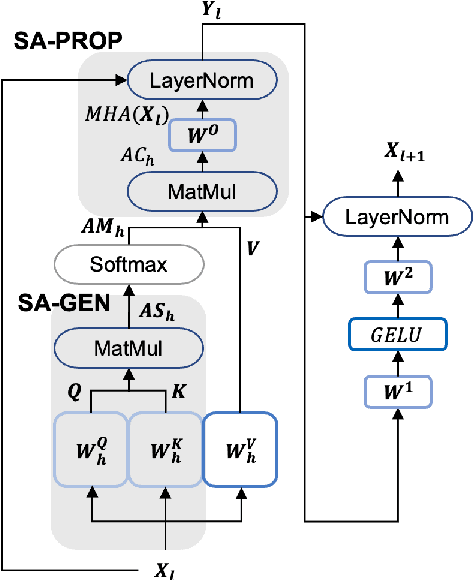
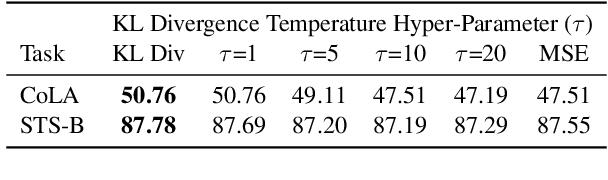
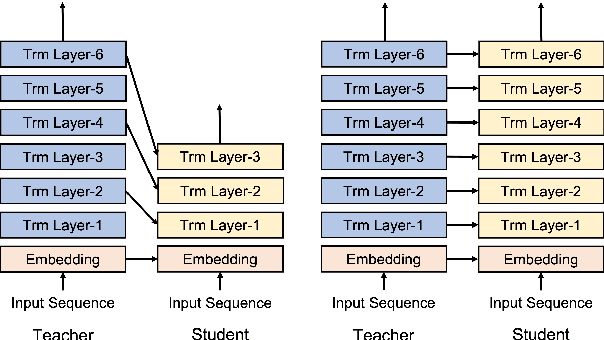
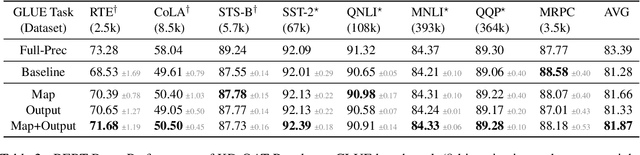
Knowledge distillation (KD) has been a ubiquitous method for model compression to strengthen the capability of a lightweight model with the transferred knowledge from the teacher. In particular, KD has been employed in quantization-aware training (QAT) of Transformer encoders like BERT to improve the accuracy of the student model with the reduced-precision weight parameters. However, little is understood about which of the various KD approaches best fits the QAT of Transformers. In this work, we provide an in-depth analysis of the mechanism of KD on attention recovery of quantized large Transformers. In particular, we reveal that the previously adopted MSE loss on the attention score is insufficient for recovering the self-attention information. Therefore, we propose two KD methods; attention-map and attention-output losses. Furthermore, we explore the unification of both losses to address task-dependent preference between attention-map and output losses. The experimental results on various Transformer encoder models demonstrate that the proposed KD methods achieve state-of-the-art accuracy for QAT with sub-2-bit weight quantization.
NN-LUT: Neural Approximation of Non-Linear Operations for Efficient Transformer Inference
Dec 03, 2021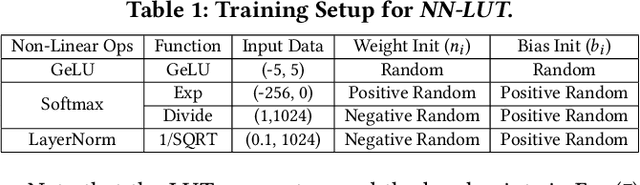
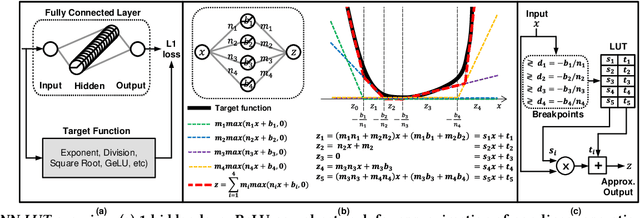
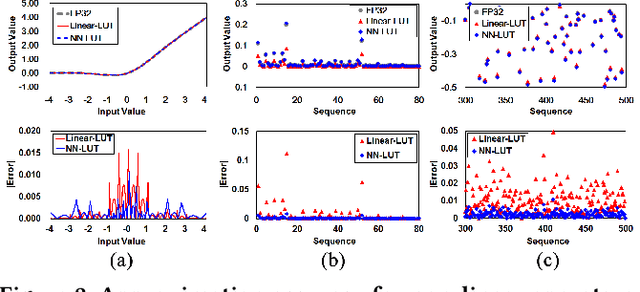
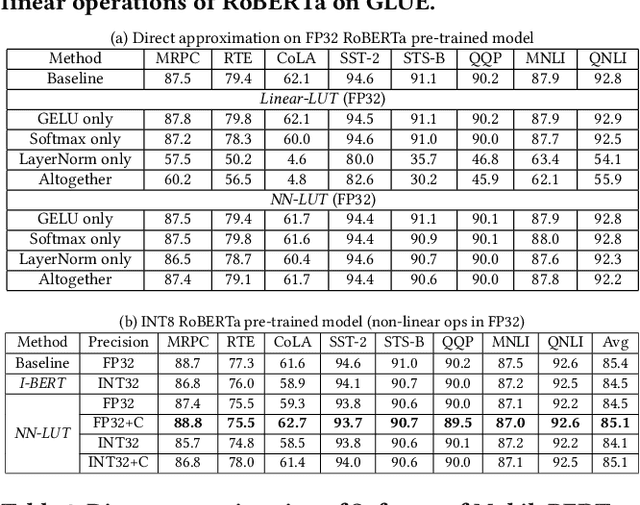
Non-linear operations such as GELU, Layer normalization, and Softmax are essential yet costly building blocks of Transformer models. Several prior works simplified these operations with look-up tables or integer computations, but such approximations suffer inferior accuracy or considerable hardware cost with long latency. This paper proposes an accurate and hardware-friendly approximation framework for efficient Transformer inference. Our framework employs a simple neural network as a universal approximator with its structure equivalently transformed into a LUT. The proposed framework called NN-LUT can accurately replace all the non-linear operations in popular BERT models with significant reductions in area, power consumption, and latency.