 Add to Chrome
 Add to Firefox
 Add to Edge
ReSET: Accurate Latency-Critical NVFP4 Reasoning via Step-Aware Temperature Scaling
Jun 11, 2026
Large reasoning models (LRMs) improve complex problem-solving by generating long intermediate reasoning traces, but this substantially increases inference costs. NVFP4 inference offers a promising approach to reduce both computational and memory costs through hardware-supported low-precision execution. However, directly applying NVFP4 to LRMs introduces two practical limitations: reasoning accuracy degrades under quantization, and existing NVFP4 kernels do not fully realize latency benefits in small-batch autoregressive decoding. In this work, we analyze the effect of NVFP4 quantization on token-level uncertainty during reasoning. We show that quantization increases incorrect sampling at low-entropy symbolic tokens, while causing over-concentration on a small set of tokens in high-uncertainty reasoning steps. Based on this observation, we propose \textbf{ReSET}, a reasoning-step entropy-based temperature-scaling method that estimates step-level uncertainty online and adapts the decoding temperature using both token-level and step-level entropy signals. To address the latency gap, we further design a CUDA-core small-$M$ NVFP4 kernel for latency-critical autoregressive decoding. Across reasoning benchmarks and model scales, ReSET improves NVFP4 reasoning accuracy by up to $\sim\!$2 points over the NVFP4 baseline. Our CUDA-core small-$M$ kernel further improves latency-critical decoding, delivering up to $2.5\!\times$ kernel-level speedup over NVFP4 vLLM and approximately $2\!\times$ end-to-end decoding speedup over BF16. Code is available at https://github.com/aiha-lab/ReSET.

Privacy-Preserving Machine Learning with Fully Homomorphic Encryption for Deep Neural Network
Jun 14, 2021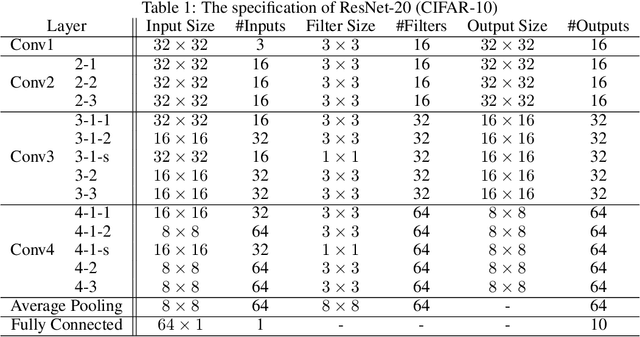
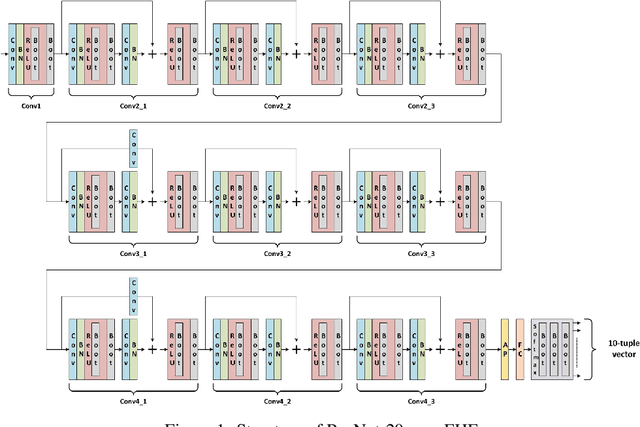

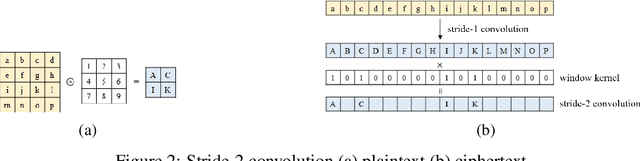
Fully homomorphic encryption (FHE) is one of the prospective tools for privacypreserving machine learning (PPML), and several PPML models have been proposed based on various FHE schemes and approaches. Although the FHE schemes are known as suitable tools to implement PPML models, previous PPML models on FHE encrypted data are limited to only simple and non-standard types of machine learning models. These non-standard machine learning models are not proven efficient and accurate with more practical and advanced datasets. Previous PPML schemes replace non-arithmetic activation functions with simple arithmetic functions instead of adopting approximation methods and do not use bootstrapping, which enables continuous homomorphic evaluations. Thus, they could not use standard activation functions and could not employ a large number of layers. The maximum classification accuracy of the existing PPML model with the FHE for the CIFAR-10 dataset was only 77% until now. In this work, we firstly implement the standard ResNet-20 model with the RNS-CKKS FHE with bootstrapping and verify the implemented model with the CIFAR-10 dataset and the plaintext model parameters. Instead of replacing the non-arithmetic functions with the simple arithmetic function, we use state-of-the-art approximation methods to evaluate these non-arithmetic functions, such as the ReLU, with sufficient precision [1]. Further, for the first time, we use the bootstrapping technique of the RNS-CKKS scheme in the proposed model, which enables us to evaluate a deep learning model on the encrypted data. We numerically verify that the proposed model with the CIFAR-10 dataset shows 98.67% identical results to the original ResNet-20 model with non-encrypted data. The classification accuracy of the proposed model is 90.67%, which is pretty close to that of the original ResNet-20 CNN model...