 Add to Chrome
 Add to Firefox
 Add to Edge
ReQAT: Achieving Full-Precision Reasoning Accuracy with 4-bit Floating-Point Quantization-Aware Training
Jun 14, 2026
Large Reasoning Models (LRMs) achieve strong problem-solving through long chain-of-thought, but their deployment is constrained by the high cost of full-precision inference and growing KV cache footprints. Microscaled FP4 formats enable efficient FP4 deployment; however, fully quantizing weights, activations, and KV caches (W4A4KV4) causes severe reasoning degradation that existing PTQ and QAT fail to recover. We identify that FP4 failures concentrate on low-entropy tokens--precise symbolic commitments such as digits and operators--where quantization noise inflates sampling errors that cascade through reasoning traces. Based on this insight, we propose ReQAT, a reasoning-centric FP4 training framework with three components: (i) Trace-Aligned QAT (TAQ), which revisits identical reasoning traces to focus updates on critical low-entropy decisions; (ii) Selective Entropy Minimization (SEM), which reinforces confidence at low-entropy positions; and (iii) Q-FIT, a quantization-friendly initialization that jointly calibrates RoPE-consistent KV cache transformations to stabilize QAT. Under the same training budget, ReQAT not only recovers but surpasses BF16 fine-tuning accuracy, while delivering up to 3.9x throughput speedup on NVIDIA DGX Spark and 3.1x on B200.

AMXFP4: Taming Activation Outliers with Asymmetric Microscaling Floating-Point for 4-bit LLM Inference
Nov 15, 2024

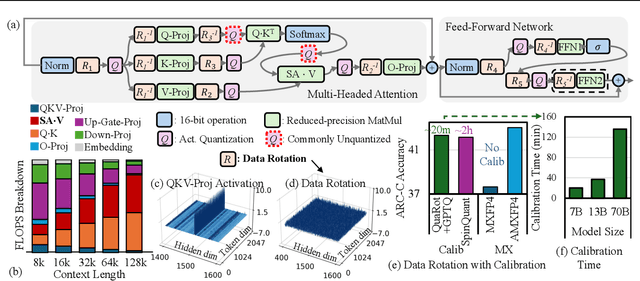

Scaling Large Language Models (LLMs) with extended context lengths has increased the need for efficient low-bit quantization to manage their substantial computational demands. However, reducing precision to 4 bits frequently degrades performance due to activation outliers. To address this, we propose Asymmetric Microscaling 4-bit Floating-Point (AMXFP4) for efficient LLM inference. This novel data format leverages asymmetric shared scales to mitigate outliers while naturally capturing the asymmetry introduced by group-wise quantization. Unlike conventional 4-bit quantization methods that rely on data rotation and costly calibration, AMXFP4 uses asymmetric shared scales for direct 4-bit casting, achieving near-ideal quantization accuracy across various LLM tasks, including multi-turn conversations, long-context reasoning, and visual question answering. Our AMXFP4 format significantly outperforms MXFP4 and other leading quantization techniques, enabling robust, calibration-free 4-bit inference.