 Add to Chrome
 Add to Firefox
 Add to Edge
Anatomy of Post-Training: Using Interpretability to Characterize Data and Shape the Learning Signal
Jun 10, 2026
Language-model post-training is the main stage at which model behavior is shaped, yet it still largely involves optimization of scalar rewards that summarize diverse desiderata. This abstraction gives practitioners little visibility into what their data actually teaches models, allowing spurious correlations to be learned by a model and inducing undesirable behaviors such as over-stylization and sycophancy. To address this problem, we ask: can we inspect a preference dataset before optimization and decide, at the level of concepts, which behaviors a model should be allowed to learn? Motivated by this, we introduce a data-centric post-training pipeline that uses interpretability protocols to develop statistical hypotheses for the latent concepts separating preferred from dispreferred generations, making them explicit for fine-grained user feedback. Building on this view, we unify several interpretability-based training protocols as ways of shaping rewards via feature or data interventions. Empirically, we show that our pipeline diagnoses undesirable signals in existing preference data, mitigates off-target learning, and can also help amplify or shape desired properties such as safeguards and model personality. More broadly, our results suggest that interpretability can turn post-training from optimizing opaque proxy rewards into a process of auditing and sculpting the learning signal itself.

HyperDAS: Towards Automating Mechanistic Interpretability with Hypernetworks
Mar 13, 2025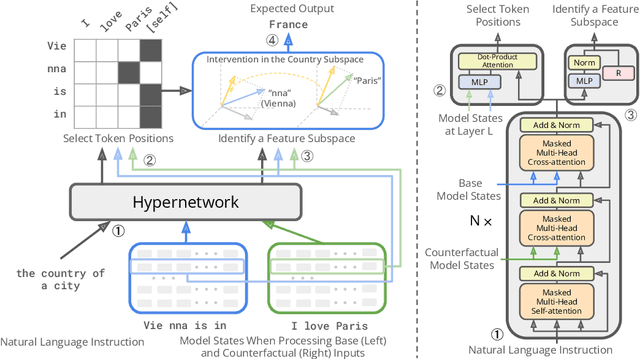
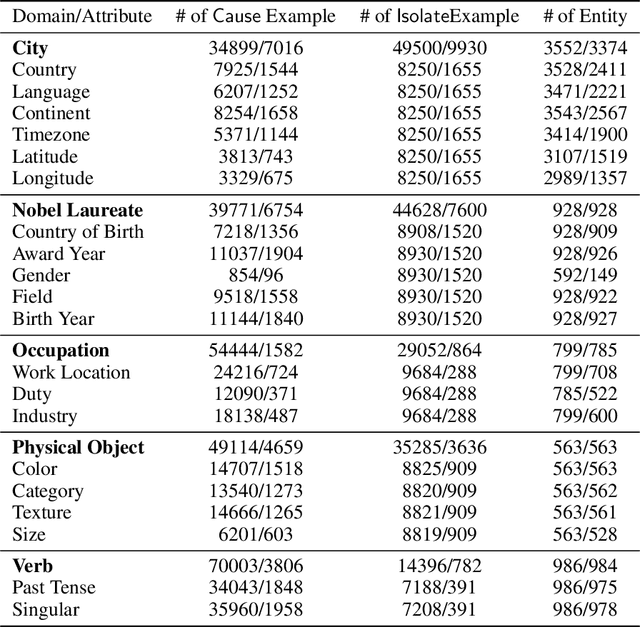
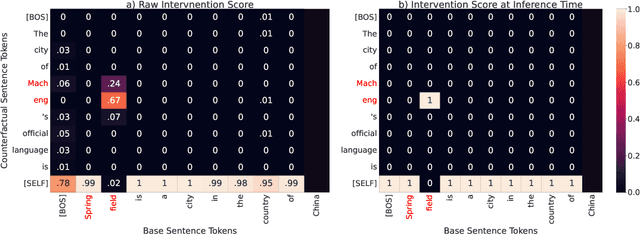
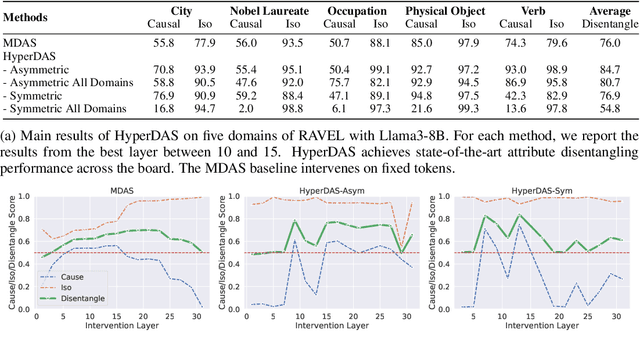
Mechanistic interpretability has made great strides in identifying neural network features (e.g., directions in hidden activation space) that mediate concepts(e.g., the birth year of a person) and enable predictable manipulation. Distributed alignment search (DAS) leverages supervision from counterfactual data to learn concept features within hidden states, but DAS assumes we can afford to conduct a brute force search over potential feature locations. To address this, we present HyperDAS, a transformer-based hypernetwork architecture that (1) automatically locates the token-positions of the residual stream that a concept is realized in and (2) constructs features of those residual stream vectors for the concept. In experiments with Llama3-8B, HyperDAS achieves state-of-the-art performance on the RAVEL benchmark for disentangling concepts in hidden states. In addition, we review the design decisions we made to mitigate the concern that HyperDAS (like all powerful interpretabilty methods) might inject new information into the target model rather than faithfully interpreting it.