 Add to Chrome
 Add to Firefox
 Add to Edge
Train-Small Deploy-Large: Leveraging Diffusion-Based Multi-Robot Planning
Apr 08, 2026
Learning based multi-robot path planning methods struggle to scale or generalize to changes, particularly variations in the number of robots during deployment. Most existing methods are trained on a fixed number of robots and may tolerate a reduced number during testing, but typically fail when the number increases. Additionally, training such methods for a larger number of agents can be both time consuming and computationally expensive. However, analytical methods can struggle to scale computationally or handle dynamic changes in the environment. In this work, we propose to leverage a diffusion model based planner capable of handling dynamically varying number of agents. Our approach is trained on a limited number of agents and generalizes effectively to larger numbers of agents during deployment. Results show that integrating a single shared diffusion model based planner with dedicated inter-agent attention computation and temporal convolution enables a train small deploy-large paradigm with good accuracy. We validate our method across multiple scenarios and compare the performance with existing multi-agent reinforcement learning techniques and heuristic control based methods.

DEMIX: Dual-Encoder Latent Masking Framework for Mixed Noise Reduction in Ultrasound Imaging
Feb 06, 2026Ultrasound imaging is widely used in noninvasive medical diagnostics due to its efficiency, portability, and avoidance of ionizing radiation. However, its utility is limited by the quality of the signal. Signal-dependent speckle noise, signal-independent sensor noise, and non-uniform spatial blurring caused by the transducer and modeled by the point spread function (PSF) degrade the image quality. These degradations challenge conventional image restoration methods, which assume simplified noise models, and highlight the need for specialized algorithms capable of effectively reducing the degradations while preserving fine structural details. We propose DEMIX, a novel dual-encoder denoising framework with a masked gated fusion mechanism, for denoising ultrasound images degraded by mixed noise and further degraded by PSF-induced distortions. DEMIX is inspired by diffusion models and is characterized by a forward process and a deterministic reverse process. DEMIX adaptively assesses the different noise components, disentangles them in the latent space, and suppresses these components while compensating for PSF degradations. Extensive experiments on two ultrasound datasets, along with a downstream segmentation task, demonstrate that DEMIX consistently outperforms state-of-the-art baselines, achieving superior noise suppression and preserving structural details. The code will be made publicly available.
SDDPM: Speckle Denoising Diffusion Probabilistic Models
Nov 17, 2023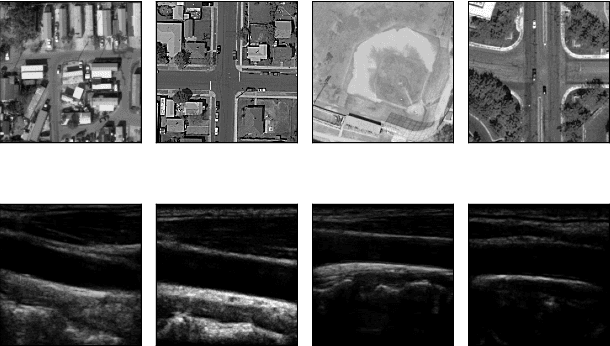
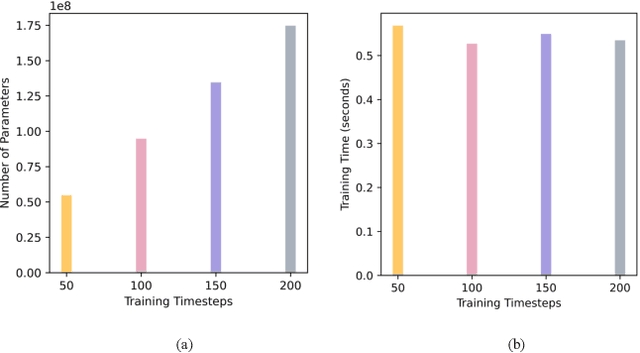
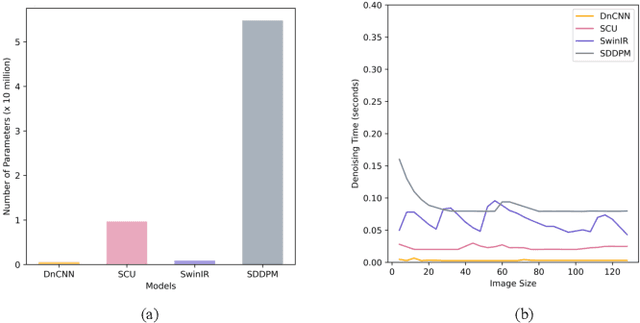
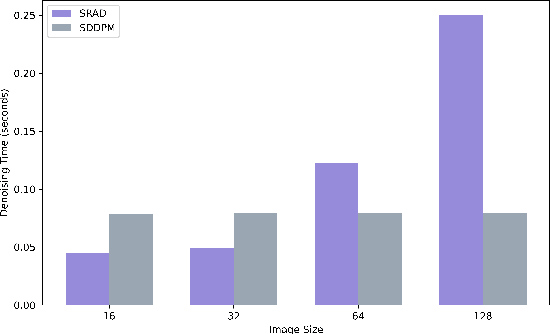
Coherent imaging systems, such as medical ultrasound and synthetic aperture radar (SAR), are subject to corruption from speckle due to sub-resolution scatterers. Since speckle is multiplicative in nature, the constituent image regions become corrupted to different extents. The task of denoising such images requires algorithms specifically designed for removing signal-dependent noise. This paper proposes a novel image denoising algorithm for removing signal-dependent multiplicative noise with diffusion models, called Speckle Denoising Diffusion Probabilistic Models (SDDPM). We derive the mathematical formulations for the forward process, the reverse process, and the training objective. In the forward process, we apply multiplicative noise to a given image and prove that the forward process is Gaussian. We show that the reverse process is also Gaussian and the final training objective can be expressed as the Kullback Leibler (KL) divergence between the forward and reverse processes. As derived in the paper, the final denoising task is a single step process, thereby reducing the denoising time significantly. We have trained our model with natural land-use images and ultrasound images for different noise levels. Extensive experiments centered around two different applications show that SDDPM is robust and performs significantly better than the comparative models even when the images are severely corrupted.