 Add to Chrome
 Add to Firefox
 Add to Edge
VISION-SLS: Safe Perception-Based Control from Learned Visual Representations via System Level Synthesis
Apr 27, 2026
We propose VISION-SLS, a method for nonlinear output-feedback control from high-resolution RGB images which provides robust constraint satisfaction guarantees under calibrated uncertainty bounds despite partial observability, sensor noise, and nonlinear dynamics. To enable scalability while retaining guarantees, we propose: (i) a learned low-dimensional observation map from pretrained visual features with state-dependent error bounds, and (ii) a causal affine time-varying output-feedback policy optimized via System Level Synthesis (SLS). We develop a scalable, novel solver for the resulting nonconvex program that leverages sequential convex programming coupled with efficient Riccati recursions. On two simulated visuomotor tasks (a 4D car and a 10D quadrotor) with >= 512 x 512 pixels and a 59D humanoid task with partial observability, our method enables safe, information-gathering behavior that reduces uncertainty while guaranteeing constraint satisfaction with empirically-calibrated error bounds. We also validate our method on hardware, safely controlling a ground vehicle from onboard images, outperforming baselines in safety rate and solve times. Together, these results show that learned visual abstractions coupled with an efficient solver make SLS-based safe visuomotor output-feedback practical at scale. The code implementation of our method is available at https://github.com/trustworthyrobotics/VISION-SLS.

Why Antiwork: A RoBERTa-Based System for Work-Related Stress Identification and Leading Factor Analysis
Aug 24, 2024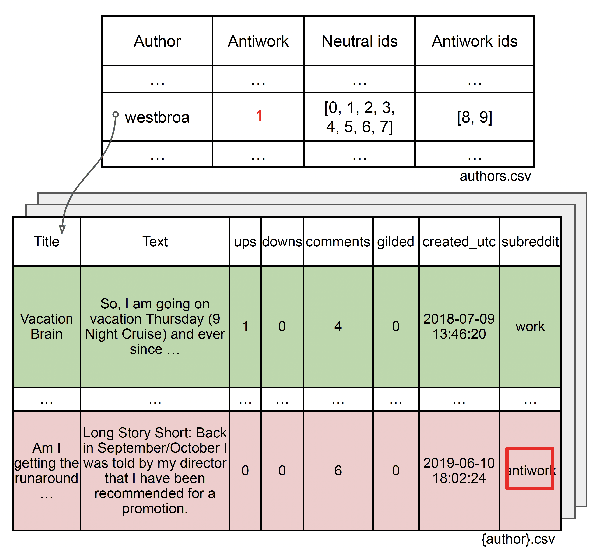
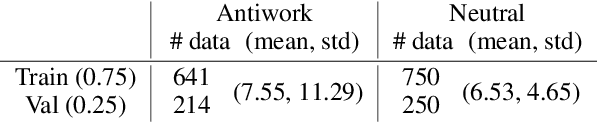
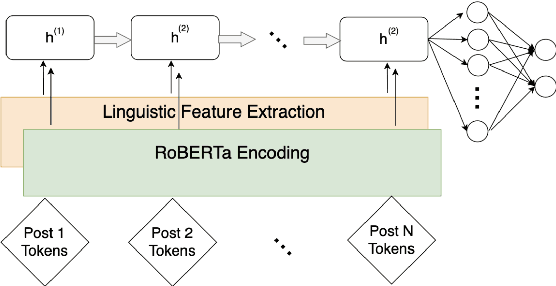
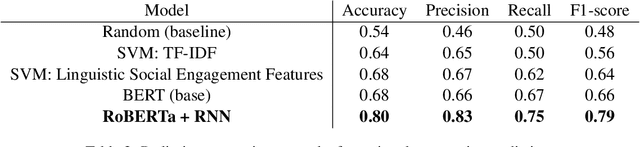
Harsh working environments and work-related stress have been known to contribute to mental health problems such as anxiety, depression, and suicidal ideation. As such, it is paramount to create solutions that can both detect employee unhappiness and find the root cause of the problem. While prior works have examined causes of mental health using machine learning, they typically focus on general mental health analysis, with few of them focusing on explainable solutions or looking at the workplace-specific setting. r/antiwork is a subreddit for the antiwork movement, which is the desire to stop working altogether. Using this subreddit as a proxy for work environment dissatisfaction, we create a new dataset for antiwork sentiment detection and subsequently train a model that highlights the words with antiwork sentiments. Following this, we performed a qualitative and quantitative analysis to uncover some of the key insights into the mindset of individuals who identify with the antiwork movement and how their working environments influenced them. We find that working environments that do not give employees authority or responsibility, frustrating recruiting experiences, and unfair compensation, are some of the leading causes of the antiwork sentiment, resulting in a lack of self-confidence and motivation among their employees.