 Add to Chrome
 Add to Firefox
 Add to Edge
SpikingBrain2.0: Brain-Inspired Foundation Models for Efficient Long-Context and Cross-Platform Inference
Apr 24, 2026
Scaling context length is reshaping large-model development, yet full-attention Transformers suffer from prohibitive computation and inference bottlenecks at long sequences. A key challenge is to design foundation models that maintain performance and long-context efficiency with minimal training overhead. We introduce SpikingBrain2.0 (SpB2.0), a 5B model that advances both architecture and training efficiency of its predecessor. Our contributions are two-fold. (1) Architectural Innovation: We propose Dual-Space Sparse Attention (DSSA), an inter-layer hybrid of Sparse Softmax Attention (MoBA) and Sparse Linear Attention (SSE), achieving an improved performance-efficiency trade-off for long-context modeling. SpB2.0 further supports dual quantization paths: INT8-Spiking coding enables sparse event-driven computation, while FP8 coding accelerates inference on modern GPUs. (2) Enhanced Training Strategy: We develop an optimized Transformer-to-Hybrid (T2H) pipeline with dual conversion paths for LLMs and VLMs using curated open-source data. Empirically, SpB2.0-5B and SpB2.0-VL-5B recover most of the base Transformer (Qwen3-4B) capability with under 7k A100 GPU hours. SpB2.0 achieves a 10.13x TTFT speedup at 4M context and supports over 10M tokens on 8 A100 GPUs under vLLM, where full-attention models exceed memory limits. It also demonstrates strong cross-platform compatibility, enabling FP8 GPU inference (2.52x speedup at 250k) and efficient neuromorphic execution (64.31% sparsity, with 70.6% and 46.5% area and power reduction at 500MHz). Overall, SpikingBrain2.0 provides a practical pathway for lightweight, multimodal, spiking foundation models, highlighting the potential of combining brain-inspired mechanisms with efficient architectures for resource-constrained and edge scenarios.

MoE$^2$: Optimizing Collaborative Inference for Edge Large Language Models
Jan 16, 2025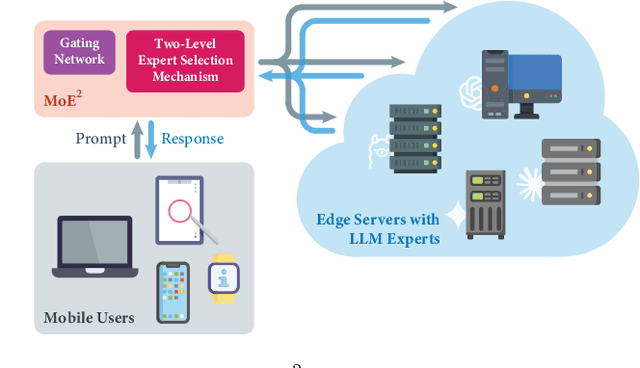
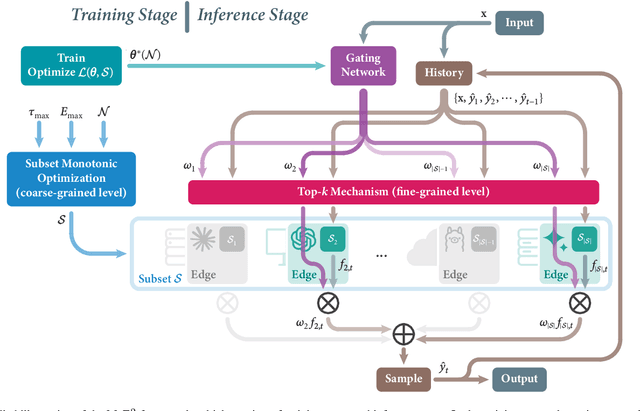
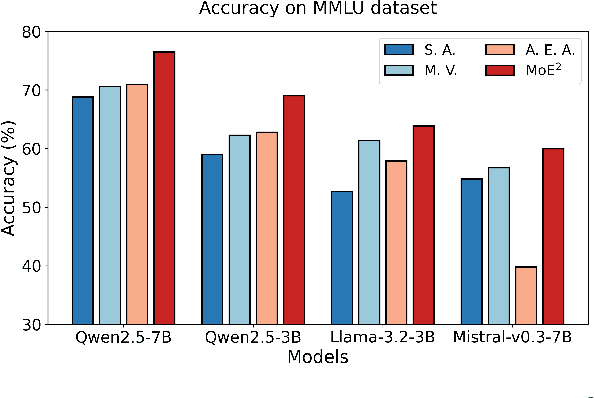

Large language models (LLMs) have demonstrated remarkable capabilities across a wide range of natural language processing tasks. Exploiting the heterogeneous capabilities of edge LLMs is crucial for diverse emerging applications, as it enables greater cost-effectiveness and reduced latency. In this work, we introduce \textit{Mixture-of-Edge-Experts (MoE$^2$)}, a novel collaborative inference framework for edge LLMs. We formulate the joint gating and expert selection problem to optimize inference performance under energy and latency constraints. Unlike conventional MoE problems, LLM expert selection is significantly more challenging due to the combinatorial nature and the heterogeneity of edge LLMs across various attributes. To this end, we propose a two-level expert selection mechanism through which we uncover an optimality-preserving property of gating parameters across expert selections. This property enables the decomposition of the training and selection processes, significantly reducing complexity. Furthermore, we leverage the objective's monotonicity and design a discrete monotonic optimization algorithm for optimal expert selection. We implement edge servers with NVIDIA Jetson AGX Orins and NVIDIA RTX 4090 GPUs, and perform extensive experiments. Our results validate that performance improvements of various LLM models and show that our MoE$^2$ method can achieve optimal trade-offs among different delay and energy budgets, and outperforms baselines under various system resource constraints.
DynFrs: An Efficient Framework for Machine Unlearning in Random Forest
Oct 02, 2024Random Forests are widely recognized for establishing efficacy in classification and regression tasks, standing out in various domains such as medical diagnosis, finance, and personalized recommendations. These domains, however, are inherently sensitive to privacy concerns, as personal and confidential data are involved. With increasing demand for the right to be forgotten, particularly under regulations such as GDPR and CCPA, the ability to perform machine unlearning has become crucial for Random Forests. However, insufficient attention was paid to this topic, and existing approaches face difficulties in being applied to real-world scenarios. Addressing this gap, we propose the DynFrs framework designed to enable efficient machine unlearning in Random Forests while preserving predictive accuracy. Dynfrs leverages subsampling method Occ(q) and a lazy tag strategy Lzy, and is still adaptable to any Random Forest variant. In essence, Occ(q) ensures that each sample in the training set occurs only in a proportion of trees so that the impact of deleting samples is limited, and Lzy delays the reconstruction of a tree node until necessary, thereby avoiding unnecessary modifications on tree structures. In experiments, applying Dynfrs on Extremely Randomized Trees yields substantial improvements, achieving orders of magnitude faster unlearning performance and better predictive accuracy than existing machine unlearning methods for Random Forests.
Harmonizing Human Insights and AI Precision: Hand in Hand for Advancing Knowledge Graph Task
May 15, 2024Knowledge graph embedding (KGE) has caught significant interest for its effectiveness in knowledge graph completion (KGC), specifically link prediction (LP), with recent KGE models cracking the LP benchmarks. Despite the rapidly growing literature, insufficient attention has been paid to the cooperation between humans and AI on KG. However, humans' capability to analyze graphs conceptually may further improve the efficacy of KGE models with semantic information. To this effect, we carefully designed a human-AI team (HAIT) system dubbed KG-HAIT, which harnesses the human insights on KG by leveraging fully human-designed ad-hoc dynamic programming (DP) on KG to produce human insightful feature (HIF) vectors that capture the subgraph structural feature and semantic similarities. By integrating HIF vectors into the training of KGE models, notable improvements are observed across various benchmarks and metrics, accompanied by accelerated model convergence. Our results underscore the effectiveness of human-designed DP in the task of LP, emphasizing the pivotal role of collaboration between humans and AI on KG. We open avenues for further exploration and innovation through KG-HAIT, paving the way towards more effective and insightful KG analysis techniques.