 Add to Chrome
 Add to Firefox
 Add to Edge
UniDoc-RL: Coarse-to-Fine Visual RAG with Hierarchical Actions and Dense Rewards
Apr 16, 2026
Retrieval-Augmented Generation (RAG) extends Large Vision-Language Models (LVLMs) with external visual knowledge. However, existing visual RAG systems typically rely on generic retrieval signals that overlook the fine-grained visual semantics essential for complex reasoning. To address this limitation, we propose UniDoc-RL, a unified reinforcement learning framework in which an LVLM agent jointly performs retrieval, reranking, active visual perception, and reasoning. UniDoc-RL formulates visual information acquisition as a sequential decision-making problem with a hierarchical action space. Specifically, it progressively refines visual evidence from coarse-grained document retrieval to fine-grained image selection and active region cropping, allowing the model to suppress irrelevant content and attend to information-dense regions. For effective end-to-end training, we introduce a dense multi-reward scheme that provides task-aware supervision for each action. Based on Group Relative Policy Optimization (GRPO), UniDoc-RL aligns agent behavior with multiple objectives without relying on a separate value network. To support this training paradigm, we curate a comprehensive dataset of high-quality reasoning trajectories with fine-grained action annotations. Experiments on three benchmarks demonstrate that UniDoc-RL consistently surpasses state-of-the-art baselines, yielding up to 17.7% gains over prior RL-based methods.

DanQing: An Up-to-Date Large-Scale Chinese Vision-Language Pre-training Dataset
Jan 15, 2026Vision-Language Pre-training (VLP) models demonstrate strong performance across various downstream tasks by learning from large-scale image-text pairs through contrastive pretraining. The release of extensive English image-text datasets (e.g., COYO-700M and LAION-400M) has enabled widespread adoption of models such as CLIP and SigLIP in tasks including cross-modal retrieval and image captioning. However, the advancement of Chinese vision-language pretraining has substantially lagged behind, due to the scarcity of high-quality Chinese image-text data. To address this gap, we develop a comprehensive pipeline for constructing a high-quality Chinese cross-modal dataset. As a result, we propose DanQing, which contains 100 million image-text pairs collected from Common Crawl. Different from existing datasets, DanQing is curated through a more rigorous selection process, yielding superior data quality. Moreover, DanQing is primarily built from 2024-2025 web data, enabling models to better capture evolving semantic trends and thus offering greater practical utility. We compare DanQing with existing datasets by continual pre-training of the SigLIP2 model. Experimental results show that DanQing consistently achieves superior performance across a range of Chinese downstream tasks, including zero-shot classification, cross-modal retrieval, and LMM-based evaluations. To facilitate further research in Chinese vision-language pre-training, we will open-source the DanQing dataset under the Creative Common CC-BY 4.0 license.
Flexible Coded Distributed Convolution Computing for Enhanced Fault Tolerance and Numerical Stability in Distributed CNNs
Nov 03, 2024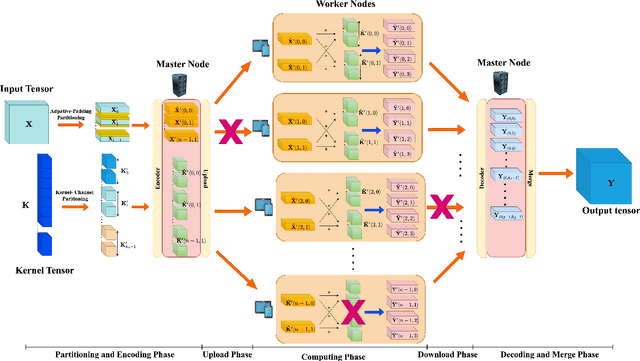
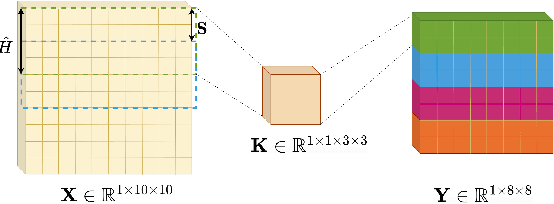
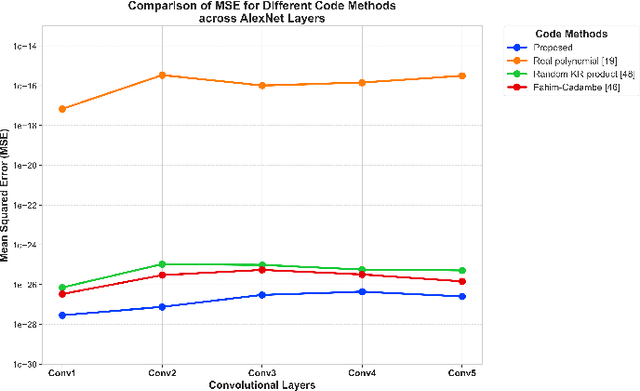
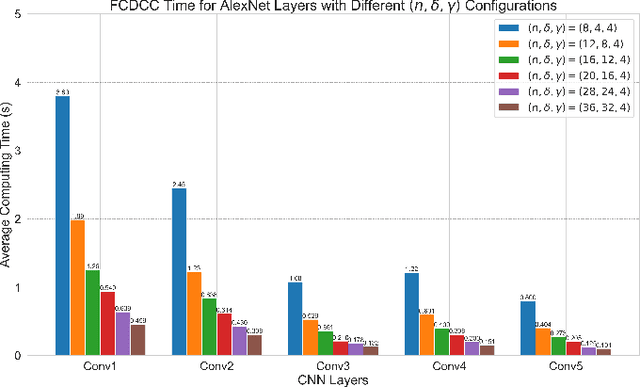
Deploying Convolutional Neural Networks (CNNs) on resource-constrained devices necessitates efficient management of computational resources, often via distributed systems susceptible to latency from straggler nodes. This paper introduces the Flexible Coded Distributed Convolution Computing (FCDCC) framework to enhance fault tolerance and numerical stability in distributed CNNs. We extend Coded Distributed Computing (CDC) with Circulant and Rotation Matrix Embedding (CRME) which was originally proposed for matrix multiplication to high-dimensional tensor convolution. For the proposed scheme, referred to as Numerically Stable Coded Tensor Convolution (NSCTC) scheme, we also propose two new coded partitioning schemes: Adaptive-Padding Coded Partitioning (APCP) for input tensor and Kernel-Channel Coded Partitioning (KCCP) for filter tensor. These strategies enable linear decomposition of tensor convolutions and encoding them into CDC sub-tasks, combining model parallelism with coded redundancy for robust and efficient execution. Theoretical analysis identifies an optimal trade-off between communication and storage costs. Empirical results validate the framework's effectiveness in computational efficiency, fault tolerance, and scalability across various CNN architectures.