 Add to Chrome
 Add to Firefox
 Add to Edge
Dual Sparse Aggregation Transformer for Multispectral Object Detection
Jun 30, 2026
Transformer-based approaches have obtained excellent performance in multispectral object detection tasks due to their ability to model long-range dependencies and capture complementary information. However, previous transformer-based multispectral detection methods tend to use all available tokens for similarity calculation, which results in redundant information interaction from irrelevant areas, leading to degraded detection performance. To overcome this challenge, we propose a novel Dual Sparse Aggregation Transformer (DSAFormer) for multispectral object detection, which consists of a Dual Sparse Transformer (DSFormer) and a Learnable Addition Fusion Block (LAFB). Specifically, the DSFormer is designed to exploit and boost cross-modal complementary information, thereby improving detection performance. It incorporates three key components: A Spatial Sparse Multi-Head Cross-Attention (SSMHCA) mechanism selectively captures cross-modal relationships at the spatial level by reserving only the high query-key similarity scores, eliminating irrelevant interactions. A Channel Sparse Multi-Head Cross-Attention (CSMHCA) mechanism performs similar sparse calculations at the channel level to enhance feature representation and filter out low matching query-key. A Multi-Scale Feature Refinement Layer (MSFRL) is developed to aggregate hierarchical features and suppress redundant information. To effectively fuse multimodal features, the LAFB is introduced to aggregate intramodal and intermodal feature information by feature reweighting. Extensive experimental results have demonstrated that our proposed DSAFormer achieves better detection performance against state-of-the-art methods on four public datasets, including the MFAD, FLIR, M$^3$FD, and LLVIP. The source code of our DSAFormer will be released at https://github.com/WenCongWu/DSAFormer.

FreDFT: Frequency Domain Fusion Transformer for Visible-Infrared Object Detection
Nov 14, 2025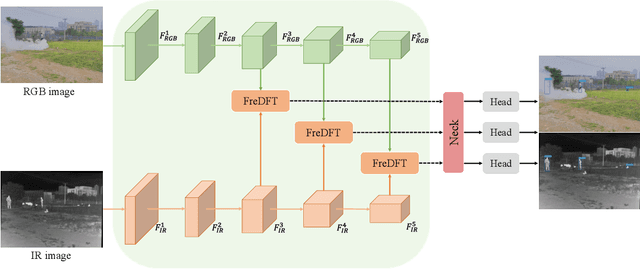
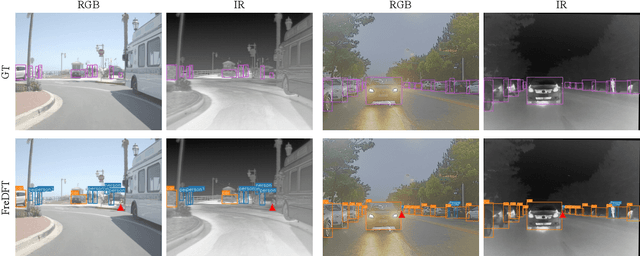
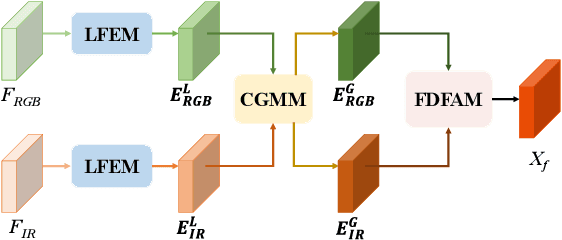
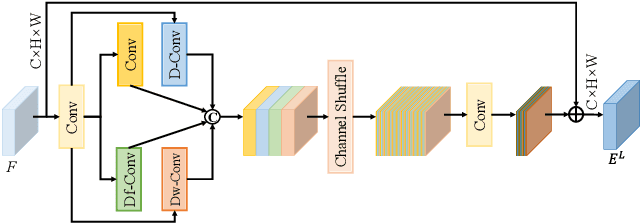
Visible-infrared object detection has gained sufficient attention due to its detection performance in low light, fog, and rain conditions. However, visible and infrared modalities captured by different sensors exist the information imbalance problem in complex scenarios, which can cause inadequate cross-modal fusion, resulting in degraded detection performance. \textcolor{red}{Furthermore, most existing methods use transformers in the spatial domain to capture complementary features, ignoring the advantages of developing frequency domain transformers to mine complementary information.} To solve these weaknesses, we propose a frequency domain fusion transformer, called FreDFT, for visible-infrared object detection. The proposed approach employs a novel multimodal frequency domain attention (MFDA) to mine complementary information between modalities and a frequency domain feed-forward layer (FDFFL) via a mixed-scale frequency feature fusion strategy is designed to better enhance multimodal features. To eliminate the imbalance of multimodal information, a cross-modal global modeling module (CGMM) is constructed to perform pixel-wise inter-modal feature interaction in a spatial and channel manner. Moreover, a local feature enhancement module (LFEM) is developed to strengthen multimodal local feature representation and promote multimodal feature fusion by using various convolution layers and applying a channel shuffle. Extensive experimental results have verified that our proposed FreDFT achieves excellent performance on multiple public datasets compared with other state-of-the-art methods. The code of our FreDFT is linked at https://github.com/WenCongWu/FreDFT.