 Add to Chrome
 Add to Firefox
 Add to Edge
Multi-level context Modeling for consistent expert selection in Mixture-of-Experts
Jul 17, 2026
Mixture-of-Experts (MoE) enables efficient scaling of Transformer models by routing tokens to a small subset of experts. However, existing routers typically condition expert selection on shallow or isolated token representations, which often produce unstable and semantically inconsistent routing decisions across layers. In this work, we revisit expert selection from a representation perspective and identify context incompleteness as a key bottleneck limiting effective expert specialization. To address this issue, we propose Multi-level Context Fusion MOE (MCF-MOE), a framework that constructs context-aware representations by integrating complementary signals from cross-layer semantic aggregation and local token-level interactions, enabling more informative and consistent expert selection. Experiments on language modeling and understanding benchmarks demonstrate that MCF-MOE consistently improves routing consistency and downstream performance over strong MoE baselines, highlighting the importance of contextual completeness in expert routing. The code is available at https://anonymous.4open.science/r/MCFMOE.

A Degree of Flowability for Virtual Tubes
Oct 29, 2024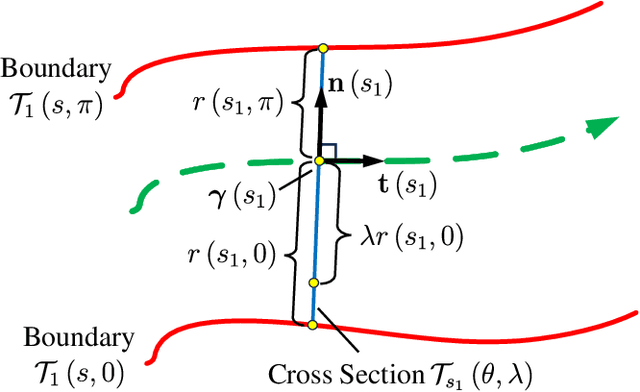
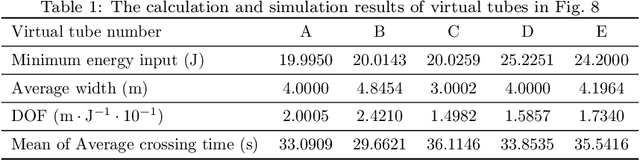
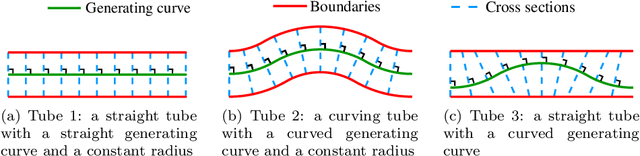
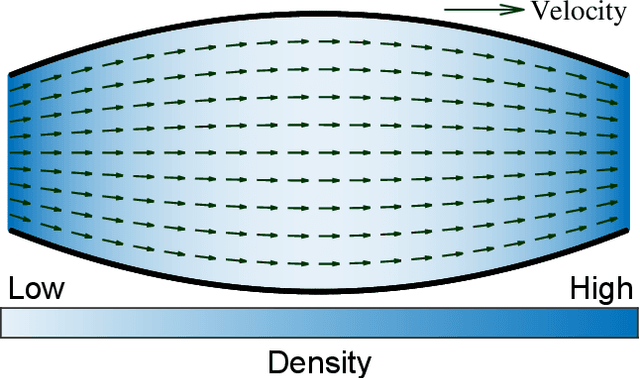
With the rapid development of robotics swarm technology, there are more tasks that require the swarm to pass through complicate environments safely and efficiently. Virtual tube technology is a novel way to achieve this goal. Virtual tubes are free spaces connecting two places that provide safety boundaries and direction of motion for swarm robotics. How to determine the design quality of a virtual tube is a fundamental problem. For such a purpose, this paper presents a degree of flowability (DOF) for two-dimensional virtual tubes according to a minimum energy principle. After that, methods to calculate DOF are proposed with a feasibility analysis. Simulations of swarm robotics in different kinds of two-dimensional virtual tubes are performed to demonstrate the effectiveness of the proposed method of calculating DOF.