 Add to Chrome
 Add to Firefox
 Add to Edge
Chaos Is a LADDER: Domain Generalization Beyond Invariance via Reweighting
Jul 29, 2026
Domain generalization (DG) aims to learn from multiple source domains and generalize to unseen target domains. Most DG methods pursue invariance: they seek a causal representation whose prediction rule is invariant across domains. This principle is effective when the causal mechanism is stable, but becomes restrictive when the domain itself modulates how causal content maps to the response. In this case, directly feeding domain style into the predictor can create misleading shortcuts, since style does not by itself cause the response. Yet the apparent chaos of multiple styles can become a ladder: style can locate the unseen target domain among source domains and guide which domain-dependent prediction rules should be trusted. We propose \emph{Latent Adaptive Domain Disentanglement and Environment Reweighting} (LADDER), a fixed-model DG pipeline that learns causal/style representations, freezes the encoders, fits source-specific classifiers, and uses an unlabeled target-domain covariate set only at inference to compute weights over these fixed classifiers, with no target labels or model-state updates. We establish theoretical guarantees for source reweighting and validate LADDER on simulations, FMoW, and a location-grouped iWildCam protocol, with gains in overall and group-averaged accuracy.

Deep Multitask Learning for Mixed-Type Outcomes with Shared Sparsity
Jul 01, 2026Most existing multitask learning approaches are limited by their reliance on task-specific loss functions tailored to the scale and type of each outcome. When outcomes differ across tasks, these losses are generally not directly comparable, which makes it difficult to formulate a unified objective and may limit information sharing across tasks. We propose a multitask transformation framework in which task-specific responses may differ through unknown monotone transformations. Motivated by high-dimensional biological applications in which the predictor dimension may diverge with the sample size while only a common subset of predictors is informative, we consider shared sparsity across tasks. Under this framework, we estimate the target functions and identify important predictors by optimizing a smoothed rank-based criterion with a group-Lasso penalty, implemented through a multitask deep neural network with a shared first layer. We establish the nonasymptotic excess-risk bounds, and variable-selection consistency for the proposed estimator. Simulation studies show that the proposed method achieves competitive prediction and variable-selection performance compared with competing approaches. Analyses of gene-expression studies with continuous, binary, and mixed outcomes further illustrate that the proposed method improves prediction and identifies biologically meaningful shared predictors.
An efficient likelihood-free Bayesian inference method based on sequential neural posterior estimation
Nov 27, 2023Sequential neural posterior estimation (SNPE) techniques have been recently proposed for dealing with simulation-based models with intractable likelihoods. Unlike approximate Bayesian computation, SNPE techniques learn the posterior from sequential simulation using neural network-based conditional density estimators by minimizing a specific loss function. The SNPE method proposed by Lueckmann et al. (2017) used a calibration kernel to boost the sample weights around the observed data, resulting in a concentrated loss function. However, the use of calibration kernels may increase the variances of both the empirical loss and its gradient, making the training inefficient. To improve the stability of SNPE, this paper proposes to use an adaptive calibration kernel and several variance reduction techniques. The proposed method greatly speeds up the process of training, and provides a better approximation of the posterior than the original SNPE method and some existing competitors as confirmed by numerical experiments.
Conditional Density Estimations from Privacy-Protected Data
Oct 20, 2023
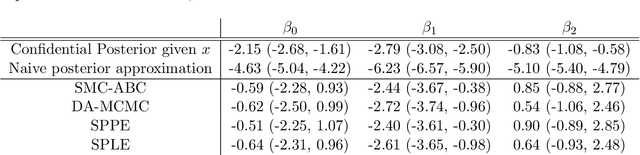
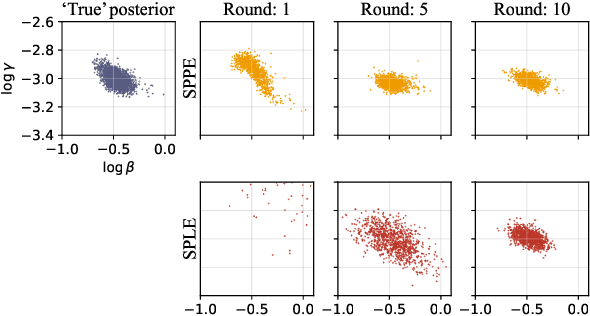
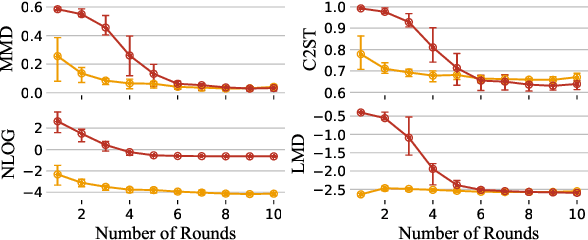
Many modern statistical analysis and machine learning applications require training models on sensitive user data. Differential privacy provides a formal guarantee that individual-level information about users does not leak. In this framework, randomized algorithms inject calibrated noise into the confidential data, resulting in privacy-protected datasets or queries. However, restricting access to only the privatized data during statistical analysis makes it computationally challenging to perform valid inferences on parameters underlying the confidential data. In this work, we propose simulation-based inference methods from privacy-protected datasets. Specifically, we use neural conditional density estimators as a flexible family of distributions to approximate the posterior distribution of model parameters given the observed private query results. We illustrate our methods on discrete time-series data under an infectious disease model and on ordinary linear regression models. Illustrating the privacy-utility trade-off, our experiments and analysis demonstrate the necessity and feasibility of designing valid statistical inference procedures to correct for biases introduced by the privacy-protection mechanisms.