 Add to Chrome
 Add to Firefox
 Add to Edge
EARS: Explanatory Abstention for Reliable Sub-Agent Modeling in Large-scale Multi-Agent Systems
Jun 17, 2026
In large-scale enterprise settings, centralized multi-agent systems (MAS) are increasingly adopted, in which a coordinator delegates user requests to lightweight, domain-specialized sub-agents. While this architecture improves modularity, scalability, and cost efficiency, its reliability depends not only on accurate routing but also on sub-agents' ability to calibrate their responses to capability constraints. In particular, sub-agents built on smaller fine-tuned models often struggle with such calibration, leading them to over-answer ambiguous, underspecified, misrouted, or unsupported requests and produce hallucinated outputs instead of actionable feedback. To address this challenge, we present EARS (Explanatory Abstention for Reliable Sub-Agent Modeling), a production-oriented framework that reframes sub-agent abstention as an inter-agent communication protocol: a sub-agent does not merely abstain, but exposes an actionable failure state to the coordinator. EARS curates human-agent interaction data using an ensemble of calibrated LLM-as-a-Judge models, producing structured abstention labels and rationales under a taxonomy of sub-agent failure modes. These data are used to fine-tune sub-agents to detect failure conditions and return rationales for coordinator-level clarification, rerouting, or fallback. We evaluate EARS in a large-scale production e-commerce assistant supporting enterprise business intelligence workflows. EARS improves the overall response pass rate from 68.5% to 78.9%, demonstrating that sub-agent-side explanatory abstention improves MAS reliability.

SimGym: A Framework for A/B Test Simulation in E-Commerce with Traffic-Grounded VLM Agents
May 19, 2026A/B testing remains the gold standard for evaluating modifications to e-commerce storefronts, yet it diverts traffic, requires weeks to reach statistical significance, and risks degrading user experience. We present SimGym, a framework for simulating A/B tests on e-commerce storefronts using vision-language model (VLM) agents operating in a live browser. The framework comprises three key components: (a) a traffic-grounded persona generation pipeline that derives per-shop buyer archetypes and intents from production clickstream data; (b) a live-browser agent architecture that combines multimodal perception over visual and browser-structured observations with episodic memory and guardrails to conduct coherent shopping sessions across control and treatment storefronts; and (c) an evaluation protocol that compares simulated outcome shifts with observed shifts in real buyer behavior. We validate SimGym on A/B tests of visually driven UI theme changes from a major e-commerce platform across diverse storefronts and product categories. Empirical results show that SimGym agents achieve strong agreement with observed outcome shifts, attaining 77% directional alignment with add-to-cart shifts observed across interface variants in real-buyer traffic. It reduces experimental cycles from weeks to under an hour, enabling rapid experimentation without exposing real buyers to candidate variants.
SimPersona: Learning Discrete Buyer Personas from Raw Clickstreams for Grounded E-Commerce Agents
May 14, 2026LLM-based web agents can navigate live storefronts, yet they often collapse to a single "average buyer" policy, failing to capture the heterogeneous and distributional nature of real buyer populations. Existing personalization methods rely on hand-crafted prompt-based personas that are brittle, difficult to scale, context-inefficient, and unable to faithfully represent population-level behavior. We introduce SimPersona, a novel framework that learns discrete buyer types from historical traffic and exposes them to LLM-based web agents as compact persona tokens. Given raw clickstreams, a behavior-aware VQ-VAE induces a discrete buyer-type space that captures the statistical structure of real buyer behavior and merchant-specific buyer population distributions. To provide behavior-specific guidance to LLM-based web agents, SimPersona maps each learned buyer type to a dedicated persona token in the LLM agent vocabulary and fine-tunes the agent with these tokens on real browsing traces. At inference, each synthetic buyer is assigned to a learned buyer type with a single encoder forward pass, requiring no retraining or store-specific prompt engineering. For population-level simulation, SimPersona samples buyer types from each merchant's empirical distribution over the learned VQ-VAE codebook and instantiates agents with the corresponding persona tokens, preserving merchant-specific buyer population distributions. Evaluated on $8.37$M buyers across $42$ held-out live storefronts, SimPersona achieves $78\%$ conversion-rate alignment with real buyers, exhibits interpretable behavioral variation across buyer types, and outperforms a baseline with $8\times$ more parameters on goal-oriented shopping tasks. We further release an open-source data pipeline that converts raw e-commerce event logs into buyer representations and agent-training traces.
SimGym: Traffic-Grounded Browser Agents for Offline A/B Testing in E-Commerce
Feb 01, 2026A/B testing remains the gold standard for evaluating e-commerce UI changes, yet it diverts traffic, takes weeks to reach significance, and risks harming user experience. We introduce SimGym, a scalable system for rapid offline A/B testing using traffic-grounded synthetic buyers powered by Large Language Model agents operating in a live browser. SimGym extracts per-shop buyer profiles and intents from production interaction data, identifies distinct behavioral archetypes, and simulates cohort-weighted sessions across control and treatment storefronts. We validate SimGym against real human outcomes from real UI changes on a major e-commerce platform under confounder control. Even without alignment post training, SimGym agents achieve state of the art alignment with observed outcome shifts and reduces experiment cycles from weeks to under an hour , enabling rapid experimentation without exposure to real buyers.
MetaDecorator: Generating Immersive Virtual Tours through Multimodality
Jan 27, 2025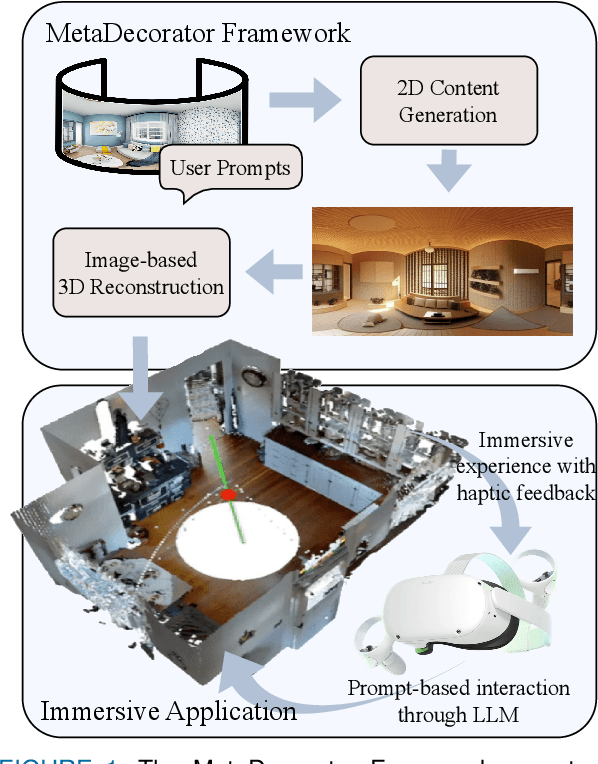
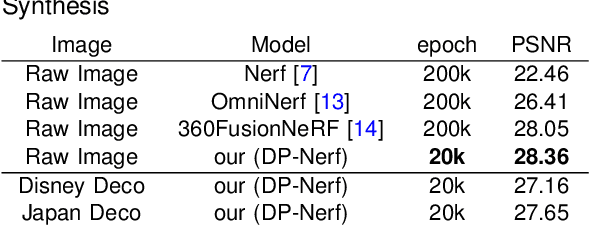
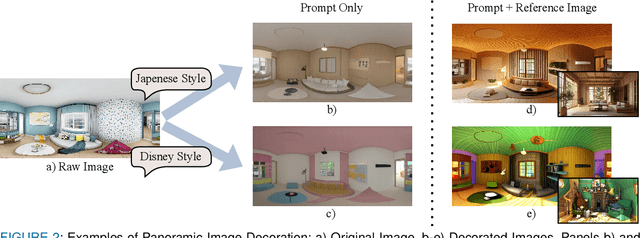
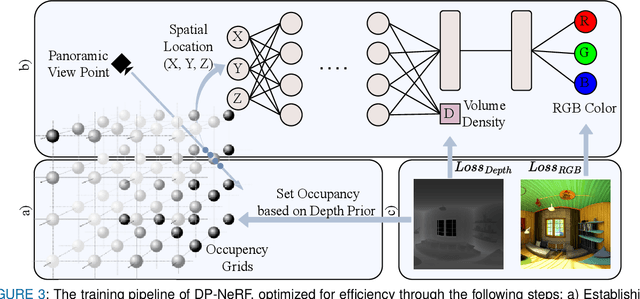
MetaDecorator, is a framework that empowers users to personalize virtual spaces. By leveraging text-driven prompts and image synthesis techniques, MetaDecorator adorns static panoramas captured by 360{\deg} imaging devices, transforming them into uniquely styled and visually appealing environments. This significantly enhances the realism and engagement of virtual tours compared to traditional offerings. Beyond the core framework, we also discuss the integration of Large Language Models (LLMs) and haptics in the VR application to provide a more immersive experience.