 Add to Chrome
 Add to Firefox
 Add to Edge
Breaking the Evaluation Paradox: Evaluating High-Entropy Search with Computationally Irreducible Constraints
Jun 22, 2026
Evaluating the exhaustive search capabilities of large language models (LLMs) is plagued by a fundamental paradox: verifying completeness requires complete ground truth, yet high-entropy enumeration tasks make such ground truth impossible for humans to create. This causes benchmarks to systematically penalize models for outperforming their human annotators. Despite rapid progress in web-search and deep research agents -- which now issue hundreds of queries, traverse diverse sites, and synthesize long reports -- evaluation still largely relies on partially annotated answer sets, LLM-based judges, or single-answer questions that avoid genuinely exhaustive search scenarios. We break this paradox by shifting the evaluation paradigm from simulating a messy reality to constructing computationally pure challenges. We introduce VERITAS (Verifiable Traversal Assessment for Search), a framework built on the principle of computationally irreducible constraints. By introducing novel, non-optimizable constraints, we create verifiable, sparse-answer search tasks that are computationally equivalent to exhaustive enumeration. These constraints are easy to verify but impossible for LLMs or search engines to optimize, forcing agents to genuinely traverse the entire search space. VERITAS can automatically generate a virtually infinite number of test cases with perfect ground truth and precise difficulty control, with marginal instance cost dominated by hash computations. This provides not only a robust benchmark for evaluating systematic exploration under uncertainty but also a scalable method for generating training data to improve these crucial, yet underdeveloped, capabilities.

Mention Extraction and Linking for SQL Query Generation
Dec 18, 2020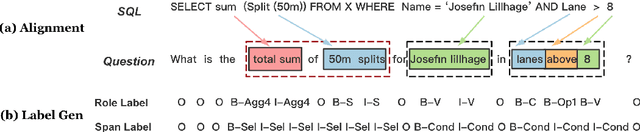
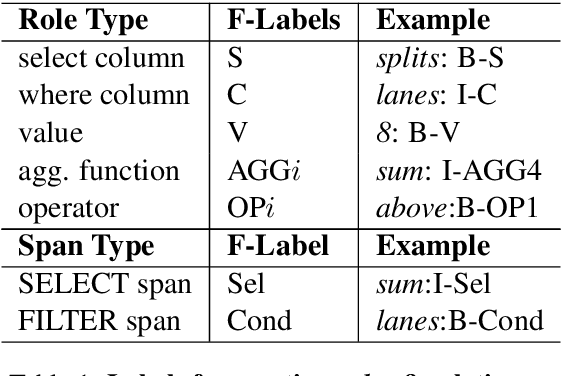
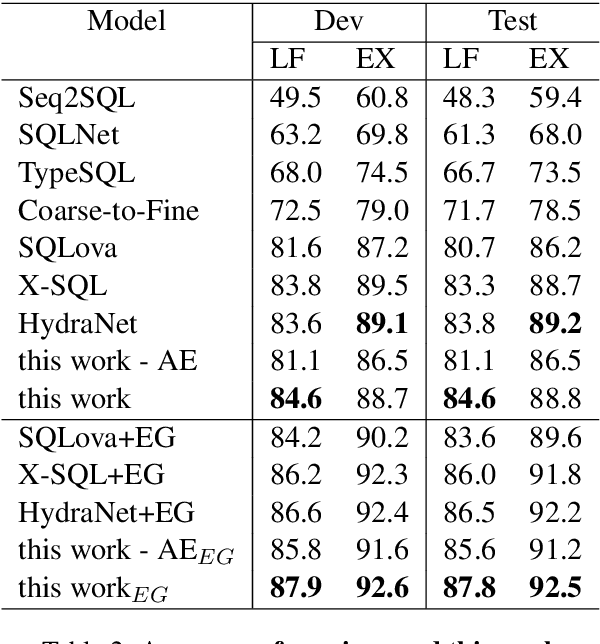
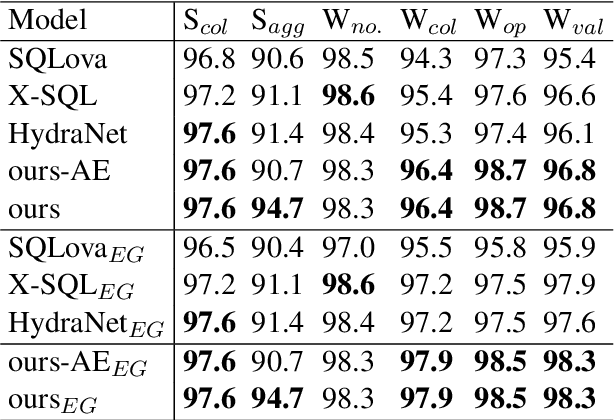
On the WikiSQL benchmark, state-of-the-art text-to-SQL systems typically take a slot-filling approach by building several dedicated models for each type of slots. Such modularized systems are not only complex butalso of limited capacity for capturing inter-dependencies among SQL clauses. To solve these problems, this paper proposes a novel extraction-linking approach, where a unified extractor recognizes all types of slot mentions appearing in the question sentence before a linker maps the recognized columns to the table schema to generate executable SQL queries. Trained with automatically generated annotations, the proposed method achieves the first place on the WikiSQL benchmark.