 Add to Chrome
 Add to Firefox
 Add to Edge
SENSE: Efficient EEG-to-Text via Privacy-Preserving Semantic Retrieval
Mar 17, 2026
Decoding brain activity into natural language is a major challenge in AI with important applications in assistive communication, neurotechnology, and human-computer interaction. Most existing Brain-Computer Interface (BCI) approaches rely on memory-intensive fine-tuning of Large Language Models (LLMs) or encoder-decoder models on raw EEG signals, resulting in expensive training pipelines, limited accessibility, and potential exposure of sensitive neural data. We introduce SENSE (SEmantic Neural Sparse Extraction), a lightweight and privacy-preserving framework that translates non-invasive electroencephalography (EEG) into text without LLM fine-tuning. SENSE decouples decoding into two stages: on-device semantic retrieval and prompt-based language generation. EEG signals are locally mapped to a discrete textual space to extract a non-sensitive Bag-of-Words (BoW), which conditions an off-the-shelf LLM to synthesize fluent text in a zero-shot manner. The EEG-to-keyword module contains only ~6M parameters and runs fully on-device, ensuring raw neural signals remain local while only abstract semantic cues interact with language models. Evaluated on a 128-channel EEG dataset across six subjects, SENSE matches or surpasses the generative quality of fully fine-tuned baselines such as Thought2Text while substantially reducing computational overhead. By localizing neural decoding and sharing only derived textual cues, SENSE provides a scalable and privacy-aware retrieval-augmented architecture for next-generation BCIs.

LoR-LUT: Learning Compact 3D Lookup Tables via Low-Rank Residuals
Feb 26, 2026We present LoR-LUT, a unified low-rank formulation for compact and interpretable 3D lookup table (LUT) generation. Unlike conventional 3D-LUT-based techniques that rely on fusion of basis LUTs, which are usually dense tensors, our unified approach extends the current framework by jointly using residual corrections, which are in fact low-rank tensors, together with a set of basis LUTs. The approach described here improves the existing perceptual quality of an image, which is primarily due to the technique's novel use of residual corrections. At the same time, we achieve the same level of trilinear interpolation complexity, using a significantly smaller number of network, residual corrections, and LUT parameters. The experimental results obtained from LoR-LUT, which is trained on the MIT-Adobe FiveK dataset, reproduce expert-level retouching characteristics with high perceptual fidelity and a sub-megabyte model size. Furthermore, we introduce an interactive visualization tool, termed LoR-LUT Viewer, which transforms an input image into the LUT-adjusted output image, via a number of slidebars that control different parameters. The tool provides an effective way to enhance interpretability and user confidence in the visual results. Overall, our proposed formulation offers a compact, interpretable, and efficient direction for future LUT-based image enhancement and style transfer.
A Survey on Bridging EEG Signals and Generative AI: From Image and Text to Beyond
Feb 18, 2025Integration of Brain-Computer Interfaces (BCIs) and Generative Artificial Intelligence (GenAI) has opened new frontiers in brain signal decoding, enabling assistive communication, neural representation learning, and multimodal integration. BCIs, particularly those leveraging Electroencephalography (EEG), provide a non-invasive means of translating neural activity into meaningful outputs. Recent advances in deep learning, including Generative Adversarial Networks (GANs) and Transformer-based Large Language Models (LLMs), have significantly improved EEG-based generation of images, text, and speech. This paper provides a literature review of the state-of-the-art in EEG-based multimodal generation, focusing on (i) EEG-to-image generation through GANs, Variational Autoencoders (VAEs), and Diffusion Models, and (ii) EEG-to-text generation leveraging Transformer based language models and contrastive learning methods. Additionally, we discuss the emerging domain of EEG-to-speech synthesis, an evolving multimodal frontier. We highlight key datasets, use cases, challenges, and EEG feature encoding methods that underpin generative approaches. By providing a structured overview of EEG-based generative AI, this survey aims to equip researchers and practitioners with insights to advance neural decoding, enhance assistive technologies, and expand the frontiers of brain-computer interaction.
Thought2Text: Text Generation from EEG Signal using Large Language Models (LLMs)
Oct 10, 2024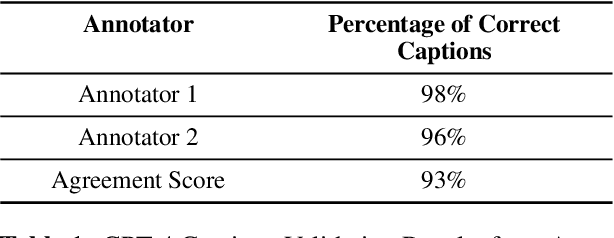
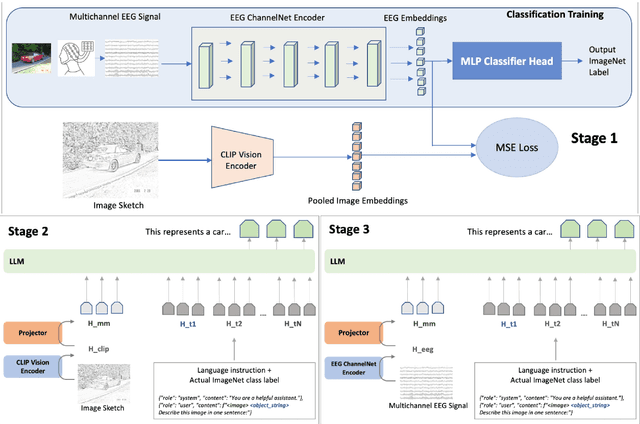
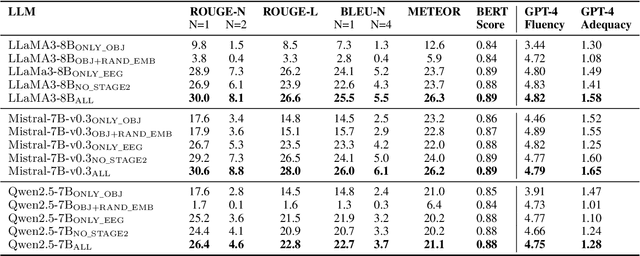
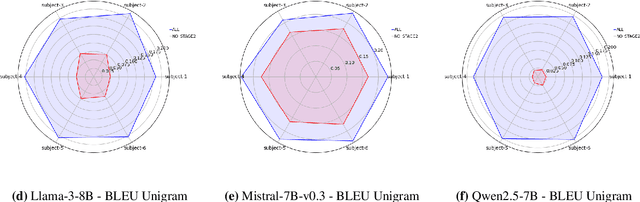
Decoding and expressing brain activity in a comprehensible form is a challenging frontier in AI. This paper presents Thought2Text, which uses instruction-tuned Large Language Models (LLMs) fine-tuned with EEG data to achieve this goal. The approach involves three stages: (1) training an EEG encoder for visual feature extraction, (2) fine-tuning LLMs on image and text data, enabling multimodal description generation, and (3) further fine-tuning on EEG embeddings to generate text directly from EEG during inference. Experiments on a public EEG dataset collected for six subjects with image stimuli demonstrate the efficacy of multimodal LLMs (LLaMa-v3, Mistral-v0.3, Qwen2.5), validated using traditional language generation evaluation metrics, GPT-4 based assessments, and evaluations by human expert. This approach marks a significant advancement towards portable, low-cost "thoughts-to-text" technology with potential applications in both neuroscience and natural language processing (NLP).