 Add to Chrome
 Add to Firefox
 Add to Edge
SENSE: Efficient EEG-to-Text via Privacy-Preserving Semantic Retrieval
Mar 17, 2026
Decoding brain activity into natural language is a major challenge in AI with important applications in assistive communication, neurotechnology, and human-computer interaction. Most existing Brain-Computer Interface (BCI) approaches rely on memory-intensive fine-tuning of Large Language Models (LLMs) or encoder-decoder models on raw EEG signals, resulting in expensive training pipelines, limited accessibility, and potential exposure of sensitive neural data. We introduce SENSE (SEmantic Neural Sparse Extraction), a lightweight and privacy-preserving framework that translates non-invasive electroencephalography (EEG) into text without LLM fine-tuning. SENSE decouples decoding into two stages: on-device semantic retrieval and prompt-based language generation. EEG signals are locally mapped to a discrete textual space to extract a non-sensitive Bag-of-Words (BoW), which conditions an off-the-shelf LLM to synthesize fluent text in a zero-shot manner. The EEG-to-keyword module contains only ~6M parameters and runs fully on-device, ensuring raw neural signals remain local while only abstract semantic cues interact with language models. Evaluated on a 128-channel EEG dataset across six subjects, SENSE matches or surpasses the generative quality of fully fine-tuned baselines such as Thought2Text while substantially reducing computational overhead. By localizing neural decoding and sharing only derived textual cues, SENSE provides a scalable and privacy-aware retrieval-augmented architecture for next-generation BCIs.

A Tool Bottleneck Framework for Clinically-Informed and Interpretable Medical Image Understanding
Dec 24, 2025Recent tool-use frameworks powered by vision-language models (VLMs) improve image understanding by grounding model predictions with specialized tools. Broadly, these frameworks leverage VLMs and a pre-specified toolbox to decompose the prediction task into multiple tool calls (often deep learning models) which are composed to make a prediction. The dominant approach to composing tools is using text, via function calls embedded in VLM-generated code or natural language. However, these methods often perform poorly on medical image understanding, where salient information is encoded as spatially-localized features that are difficult to compose or fuse via text alone. To address this, we propose a tool-use framework for medical image understanding called the Tool Bottleneck Framework (TBF), which composes VLM-selected tools using a learned Tool Bottleneck Model (TBM). For a given image and task, TBF leverages an off-the-shelf medical VLM to select tools from a toolbox that each extract clinically-relevant features. Instead of text-based composition, these tools are composed by the TBM, which computes and fuses the tool outputs using a neural network before outputting the final prediction. We propose a simple and effective strategy for TBMs to make predictions with any arbitrary VLM tool selection. Overall, our framework not only improves tool-use in medical imaging contexts, but also yields more interpretable, clinically-grounded predictors. We evaluate TBF on tasks in histopathology and dermatology and find that these advantages enable our framework to perform on par with or better than deep learning-based classifiers, VLMs, and state-of-the-art tool-use frameworks, with particular gains in data-limited regimes. Our code is available at https://github.com/christinaliu2020/tool-bottleneck-framework.
Learning Keypoints for Multi-Agent Behavior Analysis using Self-Supervision
Sep 14, 2024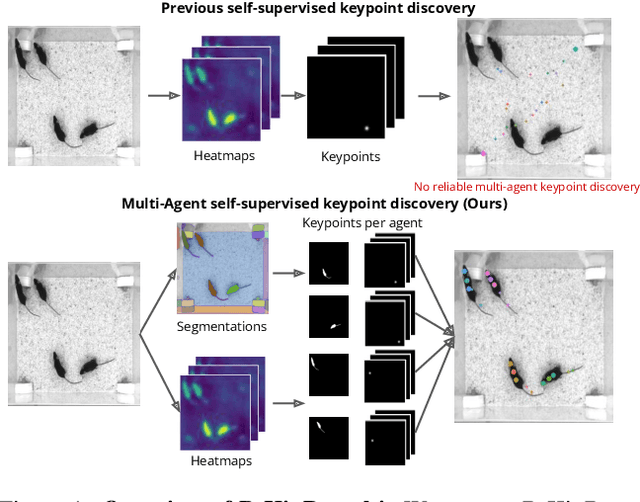


The study of social interactions and collective behaviors through multi-agent video analysis is crucial in biology. While self-supervised keypoint discovery has emerged as a promising solution to reduce the need for manual keypoint annotations, existing methods often struggle with videos containing multiple interacting agents, especially those of the same species and color. To address this, we introduce B-KinD-multi, a novel approach that leverages pre-trained video segmentation models to guide keypoint discovery in multi-agent scenarios. This eliminates the need for time-consuming manual annotations on new experimental settings and organisms. Extensive evaluations demonstrate improved keypoint regression and downstream behavioral classification in videos of flies, mice, and rats. Furthermore, our method generalizes well to other species, including ants, bees, and humans, highlighting its potential for broad applications in automated keypoint annotation for multi-agent behavior analysis. Code available under: https://danielpkhalil.github.io/B-KinD-Multi