 Add to Chrome
 Add to Firefox
 Add to Edge
Race, Ethnicity and Their Implication on Bias in Large Language Models
Jan 19, 2026
Large language models (LLMs) increasingly operate in high-stakes settings including healthcare and medicine, where demographic attributes such as race and ethnicity may be explicitly stated or implicitly inferred from text. However, existing studies primarily document outcome-level disparities, offering limited insight into internal mechanisms underlying these effects. We present a mechanistic study of how race and ethnicity are represented and operationalized within LLMs. Using two publicly available datasets spanning toxicity-related generation and clinical narrative understanding tasks, we analyze three open-source models with a reproducible interpretability pipeline combining probing, neuron-level attribution, and targeted intervention. We find that demographic information is distributed across internal units with substantial cross-model variation. Although some units encode sensitive or stereotype-related associations from pretraining, identical demographic cues can induce qualitatively different behaviors. Interventions suppressing such neurons reduce bias but leave substantial residual effects, suggesting behavioral rather than representational change and motivating more systematic mitigation.

Zero-shot Large Language Models for Long Clinical Text Summarization with Temporal Reasoning
Jan 30, 2025
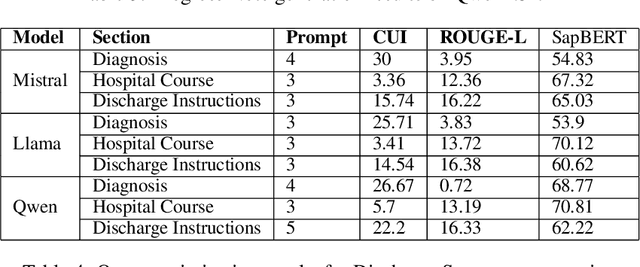


Recent advancements in large language models (LLMs) have shown potential for transforming data processing in healthcare, particularly in understanding complex clinical narratives. This study evaluates the efficacy of zero-shot LLMs in summarizing long clinical texts that require temporal reasoning, a critical aspect for comprehensively capturing patient histories and treatment trajectories. We applied a series of advanced zero-shot LLMs to extensive clinical documents, assessing their ability to integrate and accurately reflect temporal dynamics without prior task-specific training. While the models efficiently identified key temporal events, they struggled with chronological coherence over prolonged narratives. The evaluation, combining quantitative and qualitative methods, highlights the strengths and limitations of zero-shot LLMs in clinical text summarization. The results suggest that while promising, zero-shot LLMs require further refinement to effectively support clinical decision-making processes, underscoring the need for enhanced model training approaches that better capture the nuances of temporal information in long context medical documents.