 Add to Chrome
 Add to Firefox
 Add to Edge
Enhancing Structured Meaning Representations with Aspect Classification
Mar 25, 2026
To fully capture the meaning of a sentence, semantic representations should encode aspect, which describes the internal temporal structure of events. In graph-based meaning representation frameworks such as Uniform Meaning Representations (UMR), aspect lets one know how events unfold over time, including distinctions such as states, activities, and completed events. Despite its importance, aspect remains sparsely annotated across semantic meaning representation frameworks. This has, in turn, hindered not only current manual annotation, but also the development of automatic systems capable of predicting aspectual information. In this paper, we introduce a new dataset of English sentences annotated with UMR aspect labels over Abstract Meaning Representation (AMR) graphs that lack the feature. We describe the annotation scheme and guidelines used to label eventive predicates according to the UMR aspect lattice, as well as the annotation pipeline used to ensure consistency and quality across annotators through a multi-step adjudication process. To demonstrate the utility of our dataset for future automation, we present baseline experiments using three modeling approaches. Our results establish initial benchmarks for automatic UMR aspect prediction and provide a foundation for integrating aspect into semantic meaning representations more broadly.

Zero-shot Large Language Models for Long Clinical Text Summarization with Temporal Reasoning
Jan 30, 2025
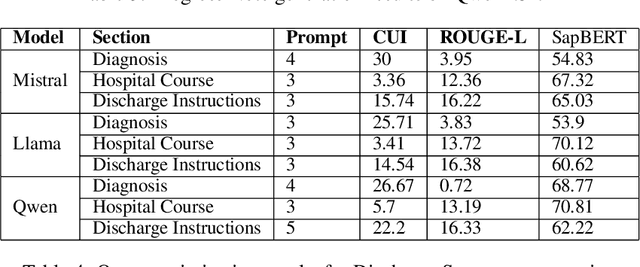


Recent advancements in large language models (LLMs) have shown potential for transforming data processing in healthcare, particularly in understanding complex clinical narratives. This study evaluates the efficacy of zero-shot LLMs in summarizing long clinical texts that require temporal reasoning, a critical aspect for comprehensively capturing patient histories and treatment trajectories. We applied a series of advanced zero-shot LLMs to extensive clinical documents, assessing their ability to integrate and accurately reflect temporal dynamics without prior task-specific training. While the models efficiently identified key temporal events, they struggled with chronological coherence over prolonged narratives. The evaluation, combining quantitative and qualitative methods, highlights the strengths and limitations of zero-shot LLMs in clinical text summarization. The results suggest that while promising, zero-shot LLMs require further refinement to effectively support clinical decision-making processes, underscoring the need for enhanced model training approaches that better capture the nuances of temporal information in long context medical documents.