 Add to Chrome
 Add to Firefox
 Add to Edge
Hybrid-Policy Self-Editing for Composable Unstructured Knowledge Editing
Aug 12, 2026
Large language models (LLMs) achieve remarkable performance across natural language tasks, yet they are trained on static corpora and their knowledge quickly becomes outdated in a fast-changing world. This motivates knowledge editing (KE), which updates specific knowledge in an LLM without changing unrelated others. Recent works move from structured knowledge triples toward unstructured KE (UKE), where the edit is a free-form passage that may state multiple facts at once. Nonetheless, existing editors inject such a passage yet fail to use it: the edited model can recall the passage, but can neither answer atomic questions about its facts nor compose them into multi-hop reasoning. We attribute this missing property, which we term composability, to editors' passive reliance on the fixed passage as the sole learning source. In response, we cast editing as a proactive self-distillation from a privileged in-context state of the same model, which requires no external supervision. We further reveal that due to the novelty of the injected knowledge, the pre-edited model's own rollouts rarely cover it, which limits the effectiveness of pure on-policy distillation. To close this gap, we propose HPSE, which builds a hybrid rollout that steps in to place missing facts onto the student's own trajectory precisely where its coverage fails, while staying on-policy elsewhere. We theoretically analyze HPSE's advantage over pure on-policy distillation, and empirically establish its plug-and-play improvements across four LLM backbones and two KE editors under various scenarios.

LIDAO: Towards Limited Interventions for Debiasing (Large) Language Models
Jun 01, 2024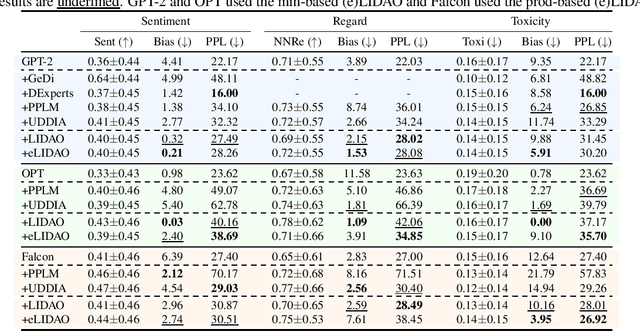
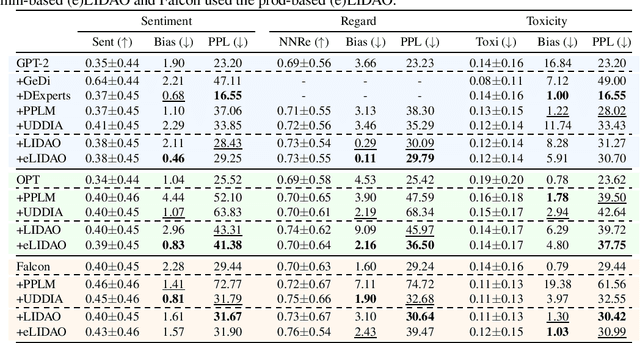
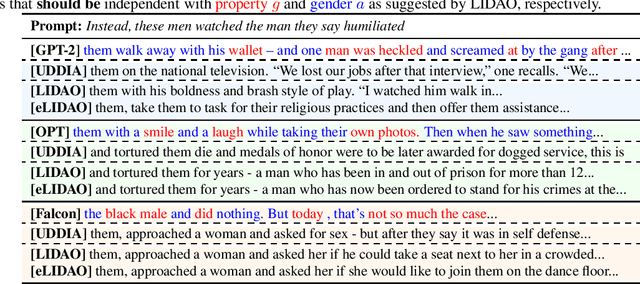
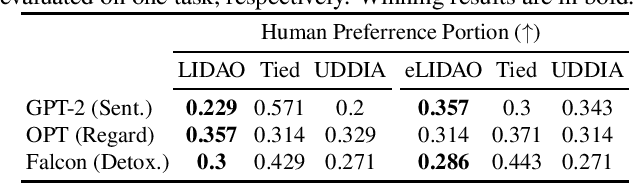
Large language models (LLMs) have achieved impressive performance on various natural language generation tasks. Nonetheless, they suffer from generating negative and harmful contents that are biased against certain demographic groups (e.g., female), raising severe fairness concerns. As remedies, prior works intervened the generation by removing attitude or demographic information, inevitably degrading the generation quality and resulting in notable \textit{fairness-fluency} trade-offs. However, it is still under-explored to what extent the fluency \textit{has to} be affected in order to achieve a desired level of fairness. In this work, we conduct the first formal study from an information-theoretic perspective. We show that previous approaches are excessive for debiasing and propose LIDAO, a general framework to debias a (L)LM at a better fluency provably. We further robustify LIDAO in adversarial scenarios, where a carefully-crafted prompt may stimulate LLMs exhibiting instruction-following abilities to generate texts with fairness issue appears only when the prompt is also taken into account. Experiments on three LMs ranging from 0.7B to 7B parameters demonstrate the superiority of our method.