 Add to Chrome
 Add to Firefox
 Add to Edge
Depth-Attention: Cross-Layer Value Mixing for Language Models
Jun 03, 2026
Self-attention selects information freely across the sequence, but across depth, Transformers merely add each layer's output to the residual stream, so later layers cannot selectively reuse earlier-layer representations. Recent cross-layer methods improve this flow but operate on hidden states outside attention, adding state beyond the key-value cache at inference--a cost that becomes increasingly salient as modern LLMs compress the cache with grouped-query and multi-head latent attention. We introduce Depth-Attention, which performs this selection inside the attention module itself: before a layer attends over the sequence, its query attends over the keys of earlier layers at the same token position and mixes their values into the value that self-attention then reads. Because Depth-Attention reuses the standard attention queries, keys, and value-cache slots, storing depth-mixed values in place of the original values, it adds no parameters and introduces no persistent inference state beyond the standard key-value cache--the same cache size as a vanilla decoder and less than hidden-state-based cross-layer methods. On Qwen3-style decoders at 1.5B and 3B parameters, Depth-Attention attains the lowest perplexity and the highest average downstream accuracy, improving over the vanilla Transformer by up to 2.3 accuracy points and surpassing strong cross-layer baselines in perplexity and average accuracy, while adding under 0.01% extra arithmetic FLOPs and no additional persistent inference state. The gains hold from 360M to 3B parameters and extend to looped Transformers.

PonderLM-3: Adaptive Token-Wise Pondering with Differentiable Masking
Mar 02, 2026Test-time scaling has shown that allocating more additional computation at inference can improve generation quality, motivating a natural follow-up question: where should this computation be spent? Building on this insight, we introduce PonderLM-3, a pretraining framework for token-wise adaptive pondering that learns to selectively allocate additional computation under purely self-supervised objectives, built on top of the PonderLM-2 backbone. This makes additional inference computation an allocatable per-token resource, so tokens receive more computation only when it is beneficial, rather than paying a uniform extra cost. To make this allocation learnable while maintaining train-inference consistency, PonderLM-3 injects a differentiable attention mask during pretraining and pairs it with a matching hard pruning rule at inference. PonderLM-3 defines a stronger Pareto frontier: compared with existing recursive or adaptive baselines, it achieves lower pretraining perplexity at equal inference FLOPs. On downstream benchmarks, PonderLM-3 attains comparable performance to fixed-step PonderLM-2 under the same maximum number of additional computation steps, while using fewer inference FLOPs in practice. Overall, PonderLM-3 provides an end-to-end differentiable and train-inference consistent framework for token-wise adaptive computation, enabling additional inference compute to be allocated where it is most useful rather than paid uniformly by every token.
AdaPonderLM: Gated Pondering Language Models with Token-Wise Adaptive Depth
Mar 02, 2026Test-time scaling via recurrent/iterative Transformers enables large language models to spend more computation at inference, but most pretrained recurrent LMs run a fixed number of iterations, wasting compute on easy tokens and lacking token-wise adaptivity. Following the core idea of Adaptive Computation Time(ACT) and Early Exit(EE), we propose AdaPonderLM, a self-supervised recurrent language model that learns token-wise early exiting during pretraining without manually tuned per-token/per-layer pruning ratios. AdaPonderLM uses iteration-specific MLP gates with a monotonic halting mask to decide when each token stops recurring, and introduces a KV reuse mechanism that reuses cached key/value states for halted tokens, ensuring train--test consistency and practical acceleration. Across Pythia backbones from 70M to 410M (pretraining) and up to 2.8B (continued pretraining), AdaPonderLM reduces inference compute at about 10% while maintaining comparable language modeling perplexity and competitive downstream accuracy. Our analysis shows the learned gates allocate more computation to high-NLL (hard) tokens, exhibiting adaptive computation time behavior in a fully self-supervised setting. Meanwhile, under iso-FLOPs, the learned halting policy consistently outperforms fixed pruning, showing AdaPonderLM allocates compute to the right tokens rather than just reducing average depth.
Pretraining with Token-Level Adaptive Latent Chain-of-Thought
Feb 09, 2026Scaling large language models by increasing parameters and training data is increasingly constrained by limited high-quality corpora and rising communication costs. This work explores an alternative axis: increasing per-token computation without expanding parameters, by internalizing latent Chain-of-Thought (CoT) into pretraining. We propose Pretraining with Token-Level Adaptive Latent CoT (adaptive latent CoT), where the model generates a variable-length latent CoT trajectory before emitting each token -- allocating longer trajectories to difficult tokens and shorter (or even zero) trajectories to easy ones. Importantly, this behavior emerges naturally from one-stage pretraining on general text and reduces computation in both training and inference via token-wise adaptive halting. Experiments with Llama architectures show that adaptive latent CoT consistently improves language modeling perplexity and broad downstream accuracy, even with fewer training FLOPs than prior recurrent baselines.
Pretraining Language Models to Ponder in Continuous Space
May 27, 2025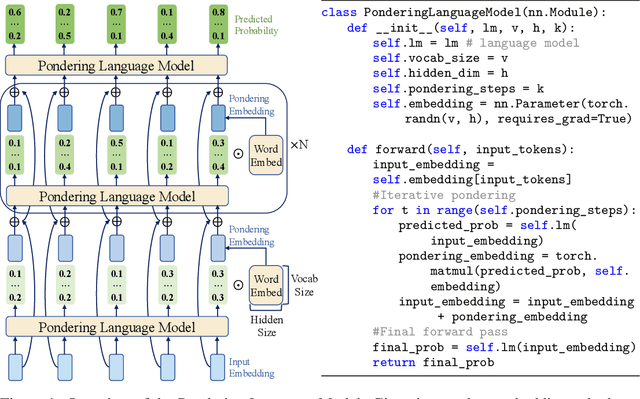
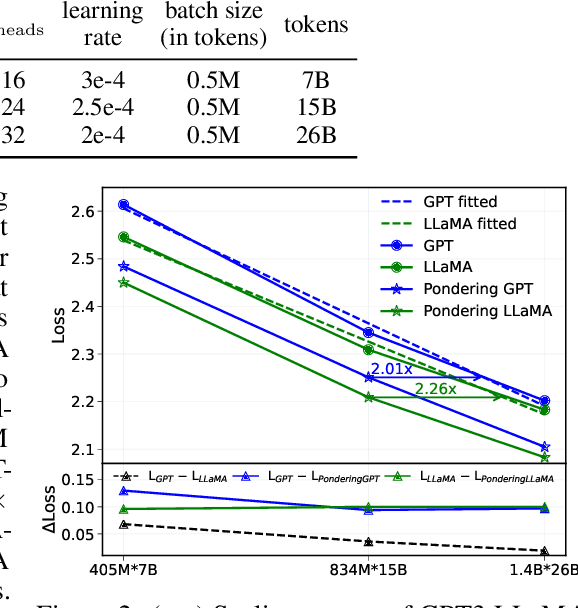
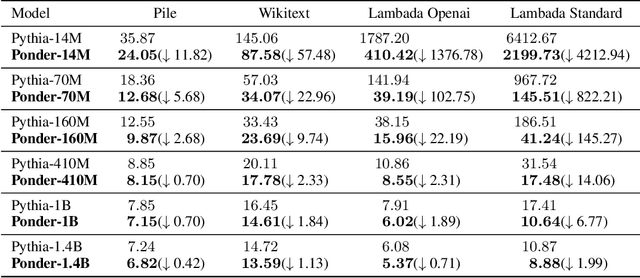
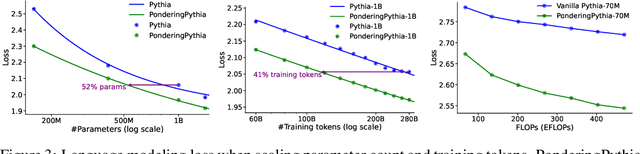
Humans ponder before articulating complex sentence elements, enabling deeper cognitive processing through focused effort. In this work, we introduce this pondering process into language models by repeatedly invoking the forward process within a single token generation step. During pondering, instead of generating an actual token sampled from the prediction distribution, the model ponders by yielding a weighted sum of all token embeddings according to the predicted token distribution. The generated embedding is then fed back as input for another forward pass. We show that the model can learn to ponder in this way through self-supervised learning, without any human annotations. Our method is straightforward and can be seamlessly integrated with various existing language models. Experiments across three widely used open-source architectures-GPT-2, Pythia, and LLaMA-and extensive downstream task evaluations demonstrate the effectiveness and generality of our method. For language modeling tasks, pondering language models achieve performance comparable to vanilla models with twice the number of parameters. On 9 downstream benchmarks, our pondering-enhanced Pythia models significantly outperform the official Pythia models. Notably, pondering-enhanced Pythia-1B is comparable to TinyLlama-1.1B, which is trained on 10 times more data. The code is available at https://github.com/LUMIA-Group/PonderingLM.