 Add to Chrome
 Add to Firefox
 Add to Edge
SibylSense: Adaptive Rubric Learning via Memory Tuning and Adversarial Probing
Feb 24, 2026
Designing aligned and robust rewards for open-ended generation remains a key barrier to RL post-training. Rubrics provide structured, interpretable supervision, but scaling rubric construction is difficult: expert rubrics are costly, prompted rubrics are often superficial or inconsistent, and fixed-pool discriminative rubrics can saturate and drift, enabling reward hacking. We present SibylSense, an inference-time learning approach that adapts a frozen rubric generator through a tunable memory bank of validated rubric items. Memory is updated via verifier-based item rewards measured by reference-candidate answer discriminative gaps from a handful of examples. SibylSense alternates memory tuning with a rubric-adversarial policy update that produces rubric-satisfying candidate answers, shrinking discriminative gaps and driving the rubric generator to capture new quality dimensions. Experiments on two open-ended tasks show that SibylSense yields more discriminative rubrics and improves downstream RL performance over static and non-adaptive baselines.

Group-disentangled Representation Learning with Weakly-Supervised Regularization
Oct 23, 2021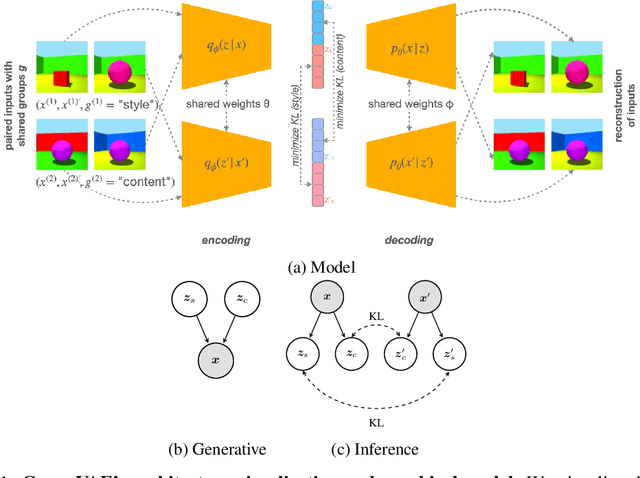
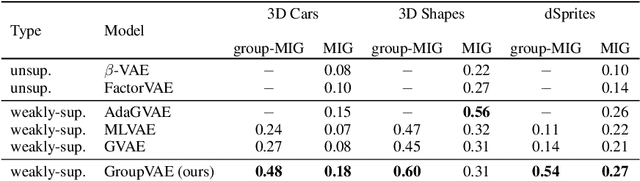
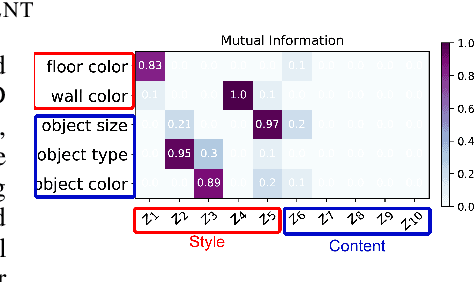
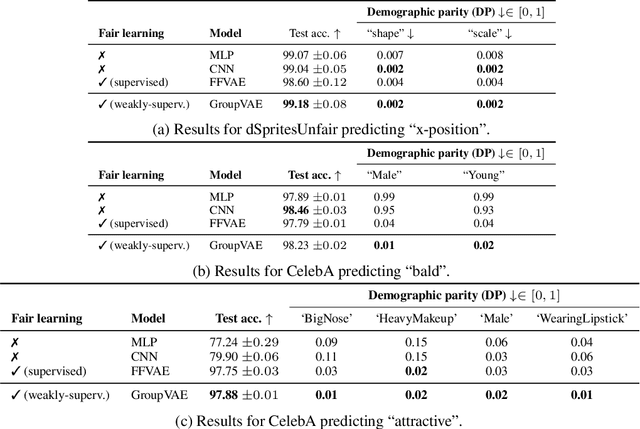
Learning interpretable and human-controllable representations that uncover factors of variation in data remains an ongoing key challenge in representation learning. We investigate learning group-disentangled representations for groups of factors with weak supervision. Existing techniques to address this challenge merely constrain the approximate posterior by averaging over observations of a shared group. As a result, observations with a common set of variations are encoded to distinct latent representations, reducing their capacity to disentangle and generalize to downstream tasks. In contrast to previous works, we propose GroupVAE, a simple yet effective Kullback-Leibler (KL) divergence-based regularization across shared latent representations to enforce consistent and disentangled representations. We conduct a thorough evaluation and demonstrate that our GroupVAE significantly improves group disentanglement. Further, we demonstrate that learning group-disentangled representations improve upon downstream tasks, including fair classification and 3D shape-related tasks such as reconstruction, classification, and transfer learning, and is competitive to supervised methods.