 Add to Chrome
 Add to Firefox
 Add to Edge
RGBX-Next: Towards Realistic Generative Rendering from G-Buffers
Aug 14, 2026
Diffusion models have achieved impressive results in image, video, and streaming generation. However, compared to traditional 3D rendering, they still lack precise control over the generated output. We believe a viable path forward is to use generative models as learned renderers conditioned on traditionally rendered G-buffers. We introduce RGBX-Next, a unified generative framework for forward and inverse rendering, which allows estimating G-buffers from images, videos, and streams, and rendering realistic images, videos, and streams from G-buffers. Our key contribution is a general recipe for finetuning diffusion transformer (DiT) models into generative forward and inverse renderers. We show that the resulting models achieve high quality in both realistic generative rendering and intrinsic decomposition. We will make all our models publicly available. We believe that the design principles presented in this paper will benefit future research on controllable generative forward and inverse rendering.

Transposer: Universal Texture Synthesis Using Feature Maps as Transposed Convolution Filter
Jul 14, 2020
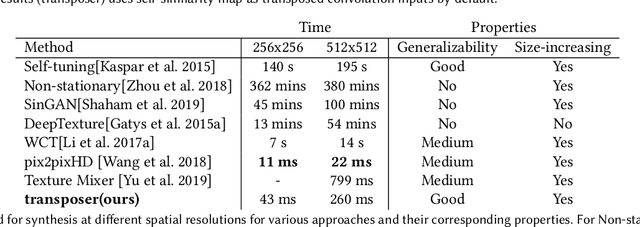

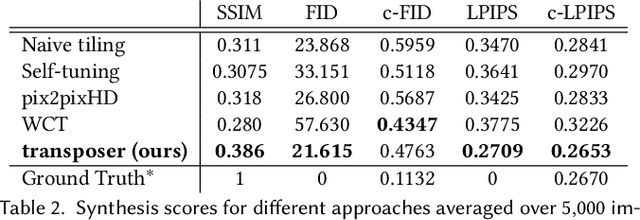
Conventional CNNs for texture synthesis consist of a sequence of (de)-convolution and up/down-sampling layers, where each layer operates locally and lacks the ability to capture the long-term structural dependency required by texture synthesis. Thus, they often simply enlarge the input texture, rather than perform reasonable synthesis. As a compromise, many recent methods sacrifice generalizability by training and testing on the same single (or fixed set of) texture image(s), resulting in huge re-training time costs for unseen images. In this work, based on the discovery that the assembling/stitching operation in traditional texture synthesis is analogous to a transposed convolution operation, we propose a novel way of using transposed convolution operation. Specifically, we directly treat the whole encoded feature map of the input texture as transposed convolution filters and the features' self-similarity map, which captures the auto-correlation information, as input to the transposed convolution. Such a design allows our framework, once trained, to be generalizable to perform synthesis of unseen textures with a single forward pass in nearly real-time. Our method achieves state-of-the-art texture synthesis quality based on various metrics. While self-similarity helps preserve the input textures' regular structural patterns, our framework can also take random noise maps for irregular input textures instead of self-similarity maps as transposed convolution inputs. It allows to get more diverse results as well as generate arbitrarily large texture outputs by directly sampling large noise maps in a single pass as well.