 Add to Chrome
 Add to Firefox
 Add to Edge
RGBX-Next: Towards Realistic Generative Rendering from G-Buffers
Aug 14, 2026
Diffusion models have achieved impressive results in image, video, and streaming generation. However, compared to traditional 3D rendering, they still lack precise control over the generated output. We believe a viable path forward is to use generative models as learned renderers conditioned on traditionally rendered G-buffers. We introduce RGBX-Next, a unified generative framework for forward and inverse rendering, which allows estimating G-buffers from images, videos, and streams, and rendering realistic images, videos, and streams from G-buffers. Our key contribution is a general recipe for finetuning diffusion transformer (DiT) models into generative forward and inverse renderers. We show that the resulting models achieve high quality in both realistic generative rendering and intrinsic decomposition. We will make all our models publicly available. We believe that the design principles presented in this paper will benefit future research on controllable generative forward and inverse rendering.

Random-Access Neural Compression of Material Textures
May 26, 2023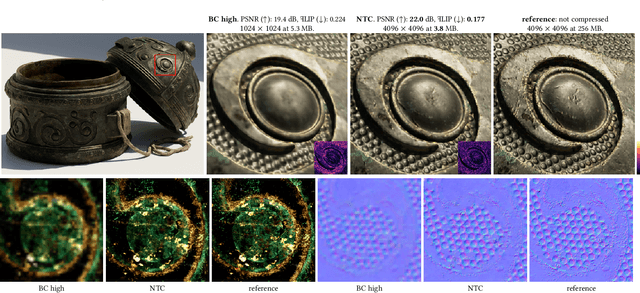
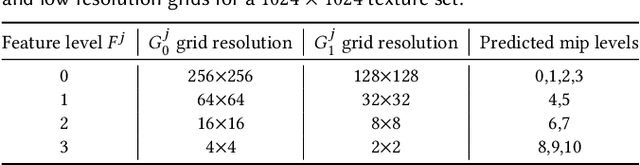

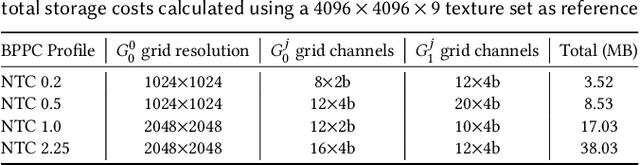
The continuous advancement of photorealism in rendering is accompanied by a growth in texture data and, consequently, increasing storage and memory demands. To address this issue, we propose a novel neural compression technique specifically designed for material textures. We unlock two more levels of detail, i.e., 16x more texels, using low bitrate compression, with image quality that is better than advanced image compression techniques, such as AVIF and JPEG XL. At the same time, our method allows on-demand, real-time decompression with random access similar to block texture compression on GPUs, enabling compression on disk and memory. The key idea behind our approach is compressing multiple material textures and their mipmap chains together, and using a small neural network, that is optimized for each material, to decompress them. Finally, we use a custom training implementation to achieve practical compression speeds, whose performance surpasses that of general frameworks, like PyTorch, by an order of magnitude.
Stochastic Texture Filtering
May 15, 2023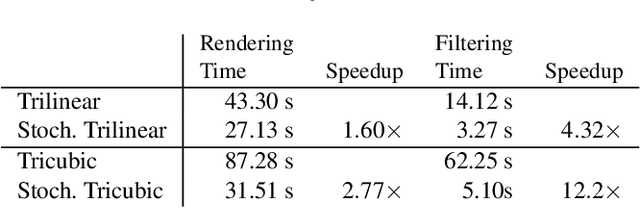
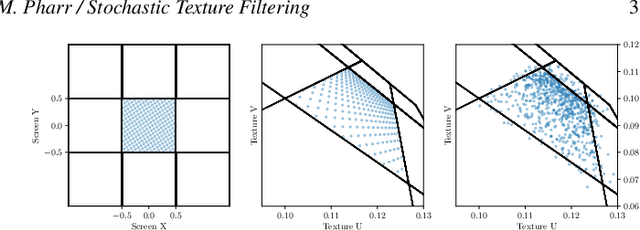
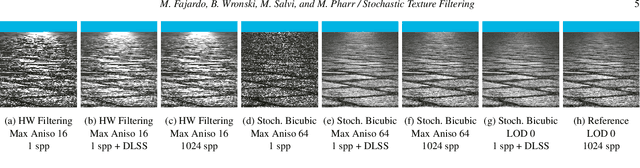
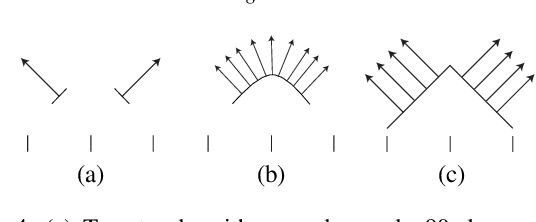
2D texture maps and 3D voxel arrays are widely used to add rich detail to the surfaces and volumes of rendered scenes, and filtered texture lookups are integral to producing high-quality imagery. We show that filtering textures after evaluating lighting, rather than before BSDF evaluation as is current practice, gives a more accurate solution to the rendering equation. These benefits are not merely theoretical, but are apparent in common cases. We further show that stochastically sampling texture filters is crucial for enabling this approach, which has not been possible previously except in limited cases. Stochastic texture filtering offers additional benefits, including efficient implementation of high-quality texture filters and efficient filtering of textures stored in compressed and sparse data structures, including neural representations. We demonstrate applications in both real-time and offline rendering and show that the additional stochastic error is minimal. Furthermore, this error is handled well by either spatiotemporal denoising or moderate pixel sampling rates.