 Add to Chrome
 Add to Firefox
 Add to Edge
Coco-Nut: Corpus of Japanese Utterance and Voice Characteristics Description for Prompt-based Control
Sep 24, 2023
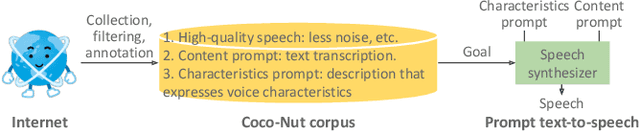
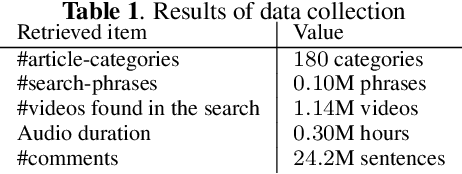
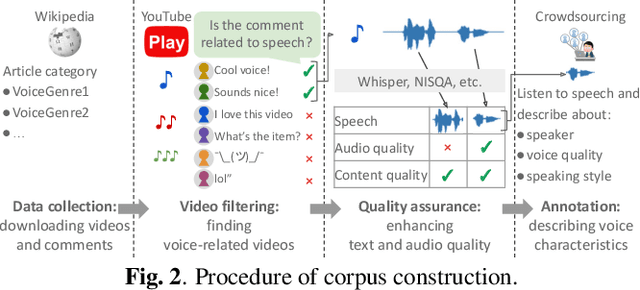
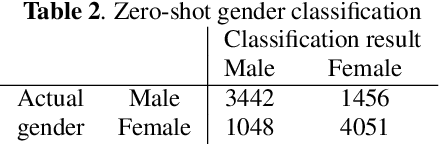
In text-to-speech, controlling voice characteristics is important in achieving various-purpose speech synthesis. Considering the success of text-conditioned generation, such as text-to-image, free-form text instruction should be useful for intuitive and complicated control of voice characteristics. A sufficiently large corpus of high-quality and diverse voice samples with corresponding free-form descriptions can advance such control research. However, neither an open corpus nor a scalable method is currently available. To this end, we develop Coco-Nut, a new corpus including diverse Japanese utterances, along with text transcriptions and free-form voice characteristics descriptions. Our methodology to construct this corpus consists of 1) automatic collection of voice-related audio data from the Internet, 2) quality assurance, and 3) manual annotation using crowdsourcing. Additionally, we benchmark our corpus on the prompt embedding model trained by contrastive speech-text learning.

Do learned speech symbols follow Zipf's law?
Sep 18, 2023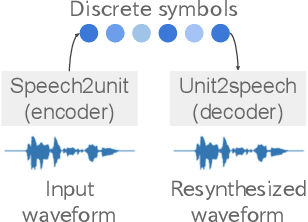
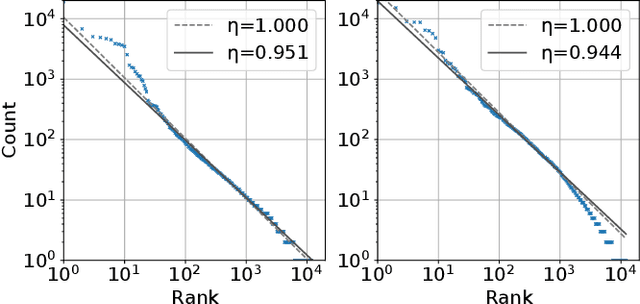
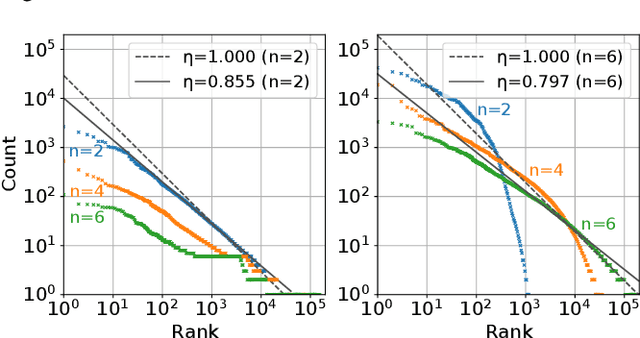
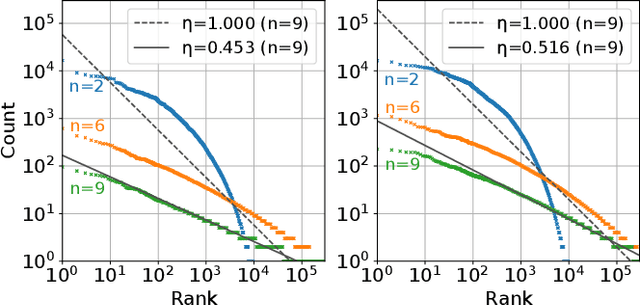
In this study, we investigate whether speech symbols, learned through deep learning, follow Zipf's law, akin to natural language symbols. Zipf's law is an empirical law that delineates the frequency distribution of words, forming fundamentals for statistical analysis in natural language processing. Natural language symbols, which are invented by humans to symbolize speech content, are recognized to comply with this law. On the other hand, recent breakthroughs in spoken language processing have given rise to the development of learned speech symbols; these are data-driven symbolizations of speech content. Our objective is to ascertain whether these data-driven speech symbols follow Zipf's law, as the same as natural language symbols. Through our investigation, we aim to forge new ways for the statistical analysis of spoken language processing.
Diversity-based core-set selection for text-to-speech with linguistic and acoustic features
Sep 15, 2023
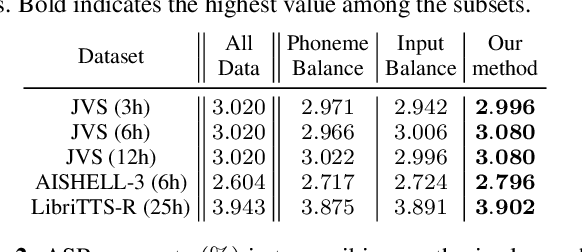
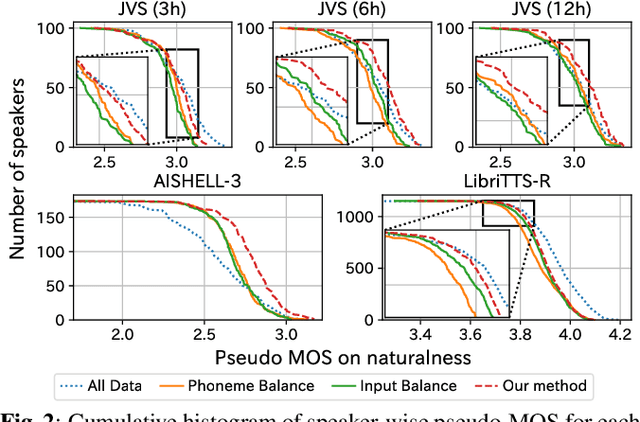
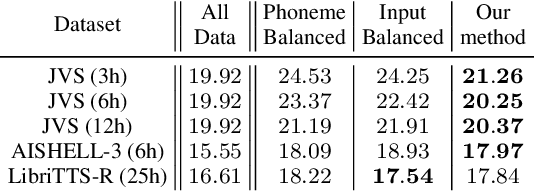
This paper proposes a method for extracting a lightweight subset from a text-to-speech (TTS) corpus ensuring synthetic speech quality. In recent years, methods have been proposed for constructing large-scale TTS corpora by collecting diverse data from massive sources such as audiobooks and YouTube. Although these methods have gained significant attention for enhancing the expressive capabilities of TTS systems, they often prioritize collecting vast amounts of data without considering practical constraints like storage capacity and computation time in training, which limits the available data quantity. Consequently, the need arises to efficiently collect data within these volume constraints. To address this, we propose a method for selecting the core subset~(known as \textit{core-set}) from a TTS corpus on the basis of a \textit{diversity metric}, which measures the degree to which a subset encompasses a wide range. Experimental results demonstrate that our proposed method performs significantly better than the baseline phoneme-balanced data selection across language and corpus size.
How Generative Spoken Language Modeling Encodes Noisy Speech: Investigation from Phonetics to Syntactics
Jun 01, 2023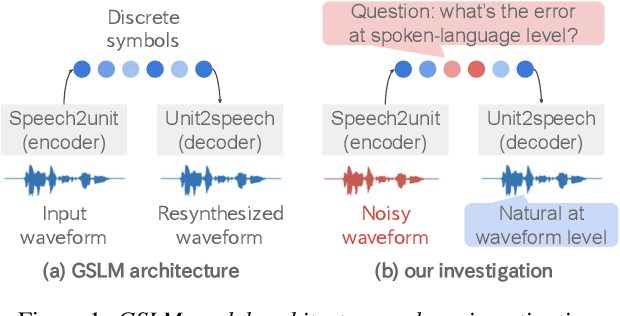
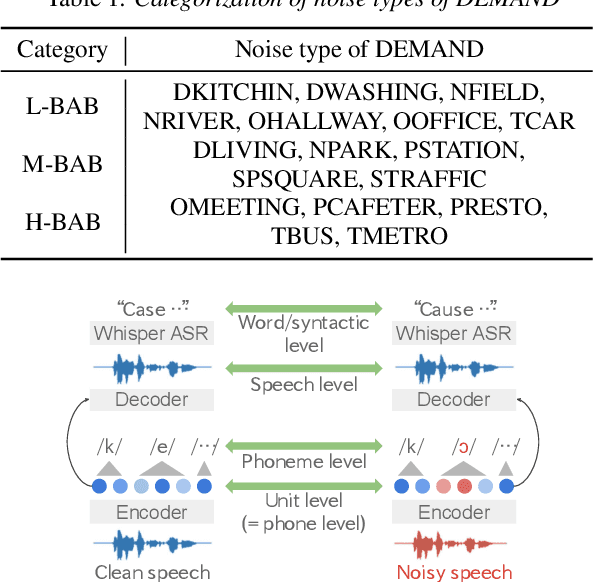
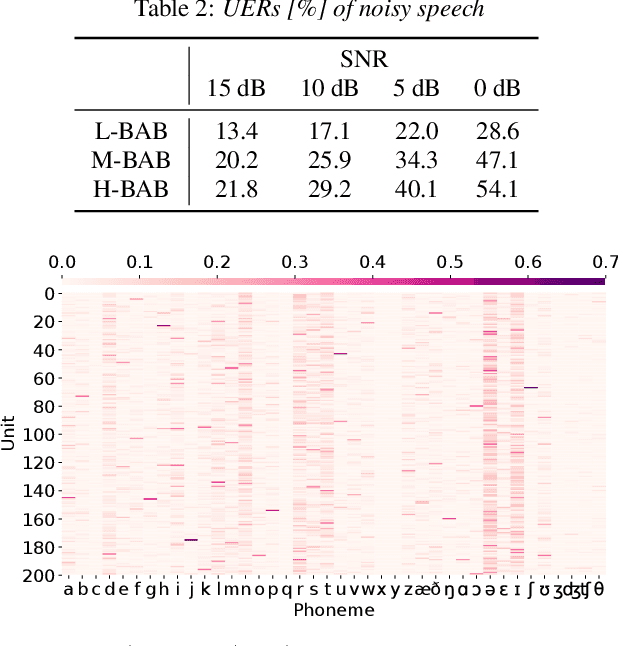
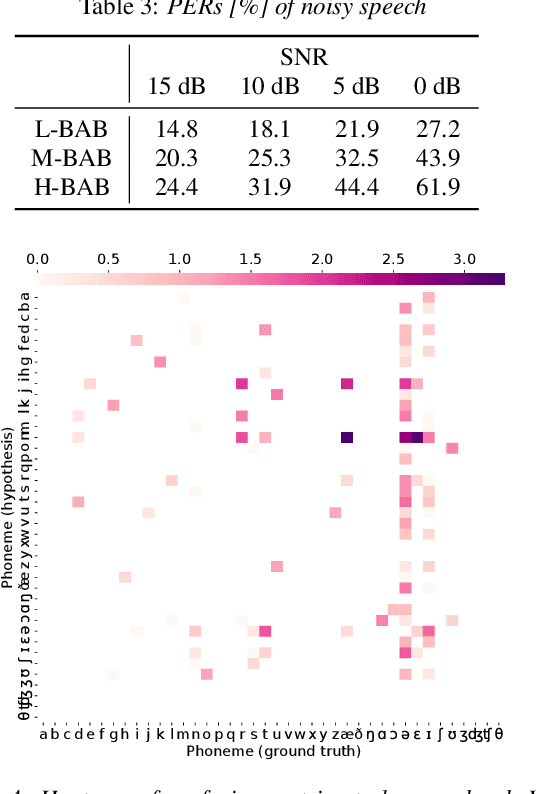
We examine the speech modeling potential of generative spoken language modeling (GSLM), which involves using learned symbols derived from data rather than phonemes for speech analysis and synthesis. Since GSLM facilitates textless spoken language processing, exploring its effectiveness is critical for paving the way for novel paradigms in spoken-language processing. This paper presents the findings of GSLM's encoding and decoding effectiveness at the spoken-language and speech levels. Through speech resynthesis experiments, we revealed that resynthesis errors occur at the levels ranging from phonology to syntactics and GSLM frequently resynthesizes natural but content-altered speech.
Laughter Synthesis using Pseudo Phonetic Tokens with a Large-scale In-the-wild Laughter Corpus
May 26, 2023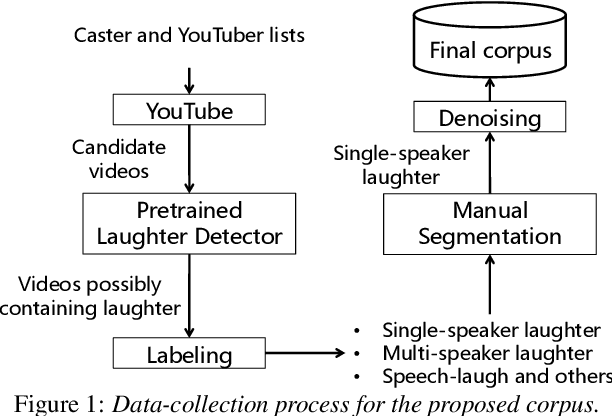
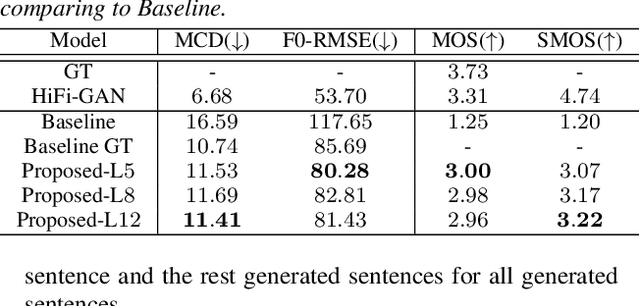
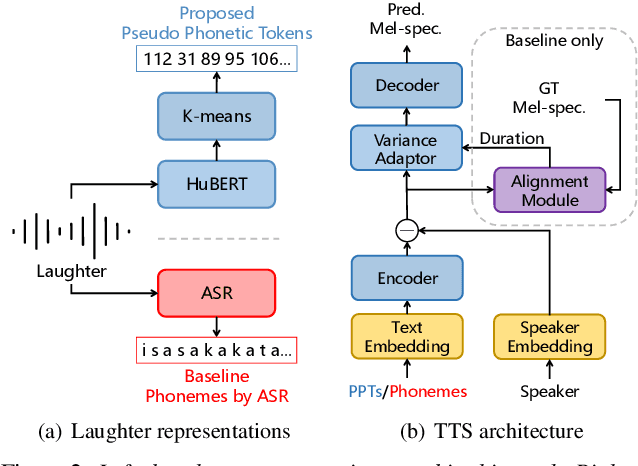
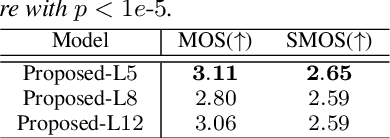
We present a large-scale in-the-wild Japanese laughter corpus and a laughter synthesis method. Previous work on laughter synthesis lacks not only data but also proper ways to represent laughter. To solve these problems, we first propose an in-the-wild corpus comprising $3.5$ hours of laughter, which is to our best knowledge the largest laughter corpus designed for laughter synthesis. We then propose pseudo phonetic tokens (PPTs) to represent laughter by a sequence of discrete tokens, which are obtained by training a clustering model on features extracted from laughter by a pretrained self-supervised model. Laughter can then be synthesized by feeding PPTs into a text-to-speech system. We further show PPTs can be used to train a language model for unconditional laughter generation. Results of comprehensive subjective and objective evaluations demonstrate that the proposed method significantly outperforms a baseline method, and can generate natural laughter unconditionally.
CALLS: Japanese Empathetic Dialogue Speech Corpus of Complaint Handling and Attentive Listening in Customer Center
May 23, 2023We present CALLS, a Japanese speech corpus that considers phone calls in a customer center as a new domain of empathetic spoken dialogue. The existing STUDIES corpus covers only empathetic dialogue between a teacher and student in a school. To extend the application range of empathetic dialogue speech synthesis (EDSS), we designed our corpus to include the same female speaker as the STUDIES teacher, acting as an operator in simulated phone calls. We describe a corpus construction methodology and analyze the recorded speech. We also conduct EDSS experiments using the CALLS and STUDIES corpora to investigate the effect of domain differences. The results show that mixing the two corpora during training causes biased improvements in the quality of synthetic speech due to the different degrees of expressiveness. Our project page of the corpus is http://sython.org/Corpus/STUDIES-2.
ChatGPT-EDSS: Empathetic Dialogue Speech Synthesis Trained from ChatGPT-derived Context Word Embeddings
May 23, 2023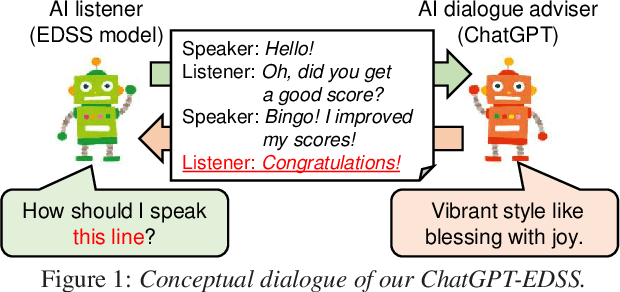
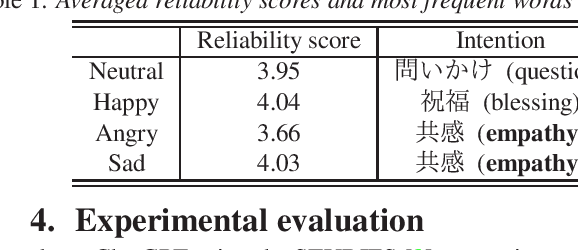
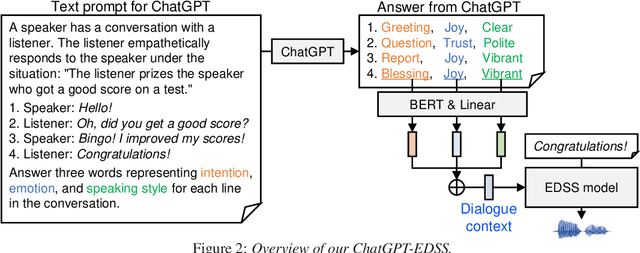
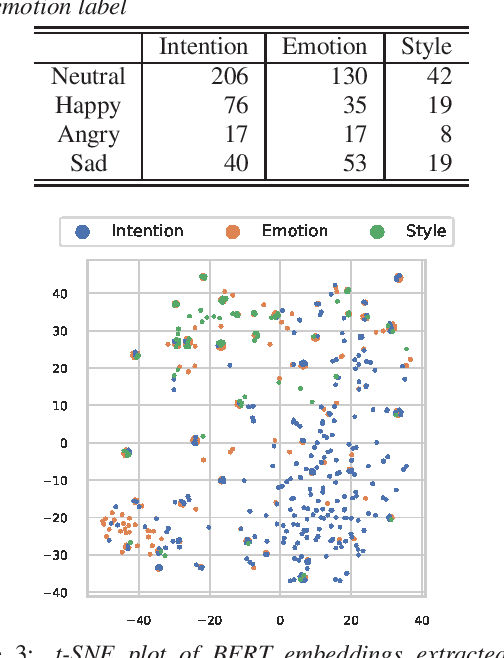
We propose ChatGPT-EDSS, an empathetic dialogue speech synthesis (EDSS) method using ChatGPT for extracting dialogue context. ChatGPT is a chatbot that can deeply understand the content and purpose of an input prompt and appropriately respond to the user's request. We focus on ChatGPT's reading comprehension and introduce it to EDSS, a task of synthesizing speech that can empathize with the interlocutor's emotion. Our method first gives chat history to ChatGPT and asks it to generate three words representing the intention, emotion, and speaking style for each line in the chat. Then, it trains an EDSS model using the embeddings of ChatGPT-derived context words as the conditioning features. The experimental results demonstrate that our method performs comparably to ones using emotion labels or neural network-derived context embeddings learned from chat histories. The collected ChatGPT-derived context information is available at https://sarulab-speech.github.io/demo_ChatGPT_EDSS/.
JNV Corpus: A Corpus of Japanese Nonverbal Vocalizations with Diverse Phrases and Emotions
May 21, 2023We present JNV (Japanese Nonverbal Vocalizations) corpus, a corpus of Japanese nonverbal vocalizations (NVs) with diverse phrases and emotions. Existing Japanese NV corpora lack phrase or emotion diversity, which makes it difficult to analyze NVs and support downstream tasks like emotion recognition. We first propose a corpus-design method that contains two phases: (1) collecting NVs phrases based on crowd-sourcing; (2) recording NVs by stimulating speakers with emotional scenarios. We then collect $420$ audio clips from $4$ speakers that cover $6$ emotions based on the proposed method. Results of comprehensive objective and subjective experiments demonstrate that the collected NVs have high emotion recognizability and authenticity that are comparable to previous corpora of English NVs. Additionally, we analyze the distributions of vowel types in Japanese NVs. To our best knowledge, JNV is currently the largest Japanese NVs corpus in terms of phrase and emotion diversities.
Environmental sound conversion from vocal imitations and sound event labels
Apr 29, 2023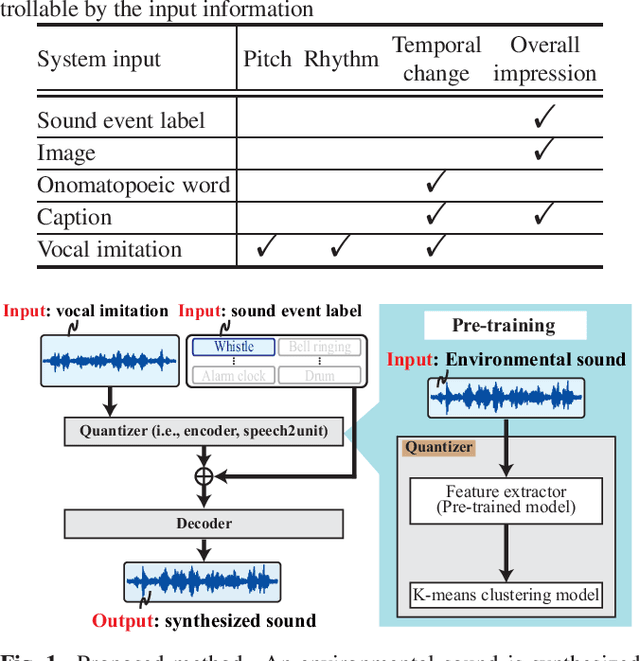
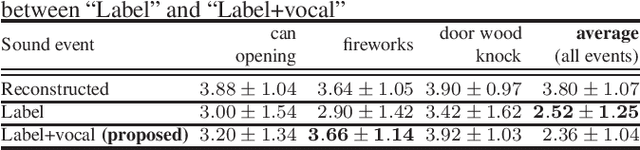
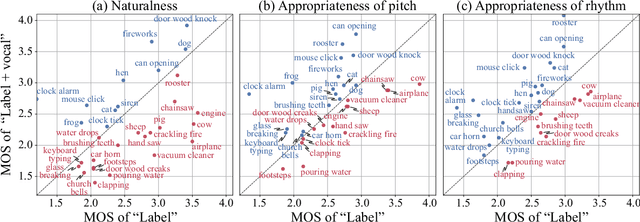
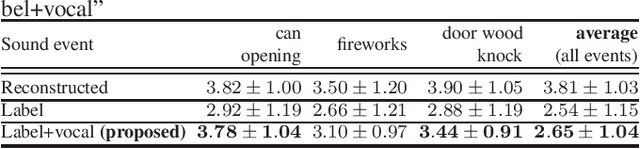
One way of expressing an environmental sound is using vocal imitations, which involve the process of replicating or mimicking the rhythms and pitches of sounds by voice. We can effectively express the features of environmental sounds, such as rhythms and pitches, using vocal imitations, which cannot be expressed by conventional input information, such as sound event labels, images, and texts, in an environmental sound synthesis model. Therefore, using vocal imitations as input for environmental sound synthesis will enable us to control the pitches and rhythms of sounds and generate diverse sounds. In this paper, we thus propose a framework for environmental sound conversion from vocal imitations to generate diverse sounds. We also propose a method of environmental sound synthesis from vocal imitations and sound event labels. Using sound event labels is expected to control the sound event class of the synthesized sound, which cannot be controlled by only vocal imitations. Our objective and subjective experimental results show that vocal imitations effectively control the pitches and rhythms of sounds and generate diverse sounds.
Learning to Speak from Text: Zero-Shot Multilingual Text-to-Speech with Unsupervised Text Pretraining
Feb 05, 2023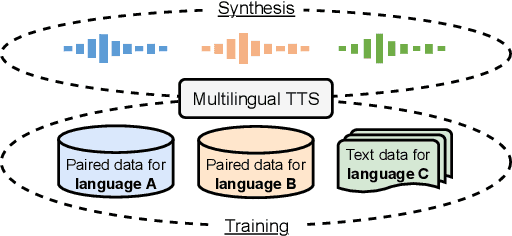
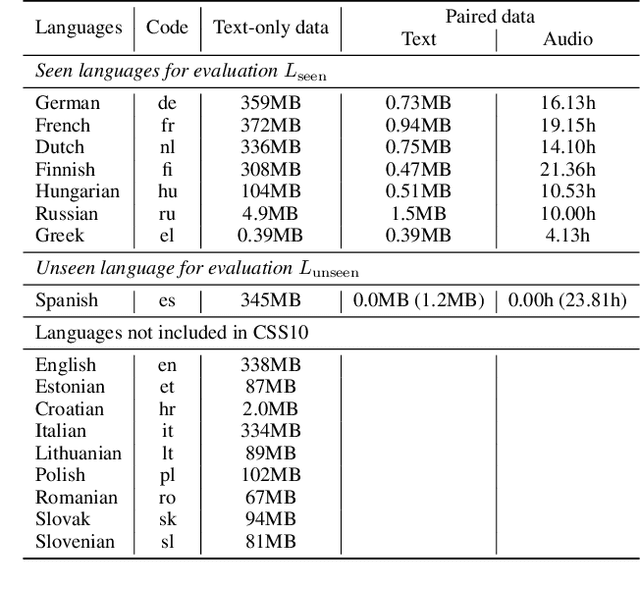
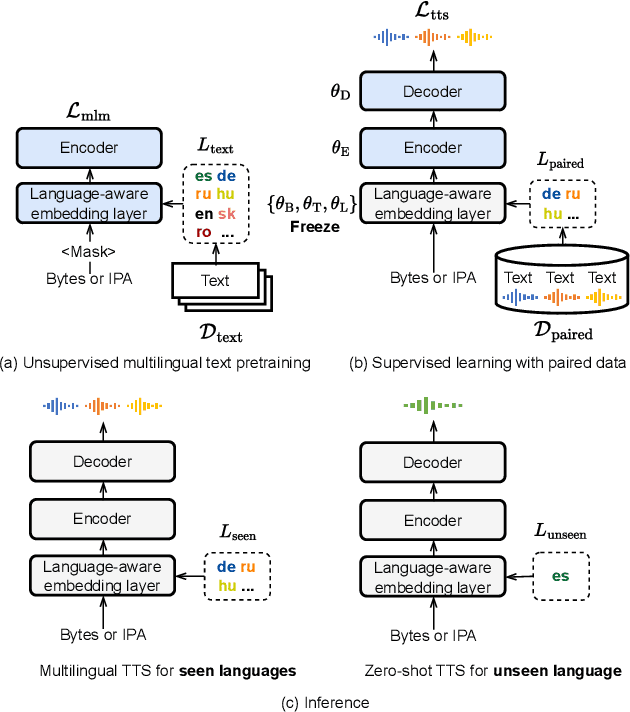
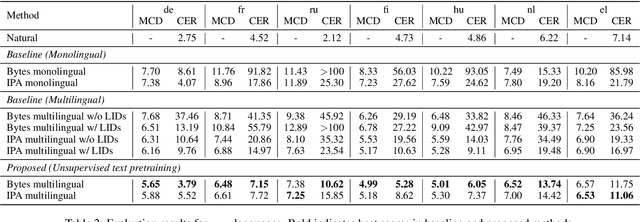
While neural text-to-speech (TTS) has achieved human-like natural synthetic speech, multilingual TTS systems are limited to resource-rich languages due to the need for paired text and studio-quality audio data. This paper proposes a method for zero-shot multilingual TTS using text-only data for the target language. The use of text-only data allows the development of TTS systems for low-resource languages for which only textual resources are available, making TTS accessible to thousands of languages. Inspired by the strong cross-lingual transferability of multilingual language models, our framework first performs masked language model pretraining with multilingual text-only data. Then we train this model with a paired data in a supervised manner, while freezing a language-aware embedding layer. This allows inference even for languages not included in the paired data but present in the text-only data. Evaluation results demonstrate highly intelligible zero-shot TTS with a character error rate of less than 12% for an unseen language. All experiments were conducted using public datasets and the implementation will be made available for reproducibility.