 Add to Chrome
 Add to Firefox
 Add to Edge
Second Order Drifting Models
Aug 08, 2026
Drifting models are a recent class of one-step generative models that evolve the model distribution during training using a predefined sample-based drift field. Although they avoid iterative inference, their kernel-based drift fields induce frequency-dependent training dynamics: In the linearized regime, each Fourier mode of the density residual decays at a rate determined by the kernel spectrum, leading to slow recovery of fine-scale structure. We propose Second-Order Drifting Models, which lift drifting dynamics into phase space by augmenting generated samples with artificial velocity variables. We show that the resulting density perturbations obey accelerated second-order dynamics in Fourier space, connecting drifting models to the celebrated Nesterov acceleration from optimization theory. This provides a principled mechanism for mitigating the spectral stiffness of first-order drifting while preserving one-step inference. We derive a practical semi-implicit training algorithm and evaluate it on synthetic distribution matching, sequential data generation, and robotic control. Across these settings, the second-order drifting model improves convergence behavior and achieves competitive or superior performance over first-order drifting baselines.

FdAudio: MeanFlow-Anchored Fréchet-Distance Post-Training for One-Step Text-to-Audio Generation
Jul 11, 2026While recent few-step sampling text-to-audio generation models like MeanAudio substantially accelerate generation by modeling average velocities, their strict one-step generation quality still lags significantly behind multi-step counterparts. We propose FdAudio to bridge this gap. Unlike MeanAudio, which relies solely on regression against target velocity fields, our post-training approach optimizes the final one-step distribution directly across pre-trained embedding spaces via a multi-representation Fréchet-distance (FD) loss. Crucially, to prevent the multi-step degradation that naive post-training with FD-loss causes, we introduce a MeanFlow consistency objective as a structural anchor. Results demonstrate that FdAudio establishes state-of-the-art one-step T2A generation quality among few-step systems, yielding an 11.4% reduction in FD score and a 28.8% improvement in FAD score relative to the baseline MeanAudio framework. Notably, we solve FD post-training's naive multi-step degradation issue by proposing the MeanFlow anchor, enabling a 25-step sampling path to maintain high-fidelity audio synthesis that matches or surpasses strong multi-step models at a fraction of their computational latency.
Towards Multiscale Graph-based Protein Learning with Geometric Secondary Structural Motifs
Jan 31, 2026Graph neural networks (GNNs) have emerged as powerful tools for learning protein structures by capturing spatial relationships at the residue level. However, existing GNN-based methods often face challenges in learning multiscale representations and modeling long-range dependencies efficiently. In this work, we propose an efficient multiscale graph-based learning framework tailored to proteins. Our proposed framework contains two crucial components: (1) It constructs a hierarchical graph representation comprising a collection of fine-grained subgraphs, each corresponding to a secondary structure motif (e.g., $α$-helices, $β$-strands, loops), and a single coarse-grained graph that connects these motifs based on their spatial arrangement and relative orientation. (2) It employs two GNNs for feature learning: the first operates within individual secondary motifs to capture local interactions, and the second models higher-level structural relationships across motifs. Our modular framework allows a flexible choice of GNN in each stage. Theoretically, we show that our hierarchical framework preserves the desired maximal expressiveness, ensuring no loss of critical structural information. Empirically, we demonstrate that integrating baseline GNNs into our multiscale framework remarkably improves prediction accuracy and reduces computational cost across various benchmarks.
RMFlow: Refined Mean Flow by a Noise-Injection Step for Multimodal Generation
Jan 31, 2026Mean flow (MeanFlow) enables efficient, high-fidelity image generation, yet its single-function evaluation (1-NFE) generation often cannot yield compelling results. We address this issue by introducing RMFlow, an efficient multimodal generative model that integrates a coarse 1-NFE MeanFlow transport with a subsequent tailored noise-injection refinement step. RMFlow approximates the average velocity of the flow path using a neural network trained with a new loss function that balances minimizing the Wasserstein distance between probability paths and maximizing sample likelihood. RMFlow achieves near state-of-the-art results on text-to-image, context-to-molecule, and time-series generation using only 1-NFE, at a computational cost comparable to the baseline MeanFlows.
Improving Flow Matching by Aligning Flow Divergence
Jan 31, 2026Conditional flow matching (CFM) stands out as an efficient, simulation-free approach for training flow-based generative models, achieving remarkable performance for data generation. However, CFM is insufficient to ensure accuracy in learning probability paths. In this paper, we introduce a new partial differential equation characterization for the error between the learned and exact probability paths, along with its solution. We show that the total variation gap between the two probability paths is bounded above by a combination of the CFM loss and an associated divergence loss. This theoretical insight leads to the design of a new objective function that simultaneously matches the flow and its divergence. Our new approach improves the performance of the flow-based generative model by a noticeable margin without sacrificing generation efficiency. We showcase the advantages of this enhanced training approach over CFM on several important benchmark tasks, including generative modeling for dynamical systems, DNA sequences, and videos. Code is available at \href{https://github.com/Utah-Math-Data-Science/Flow_Div_Matching}{Utah-Math-Data-Science}.
Learning to Control the Smoothness of Graph Convolutional Network Features
Oct 18, 2024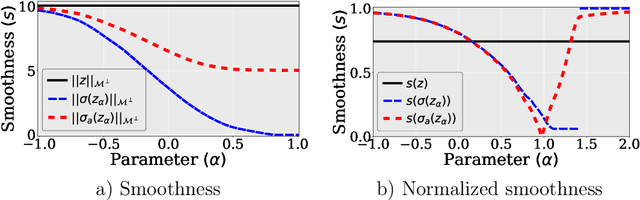
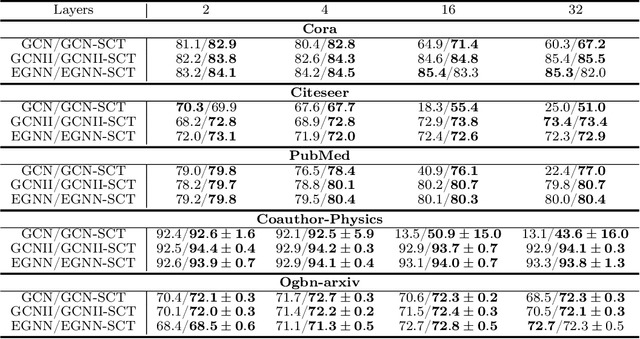
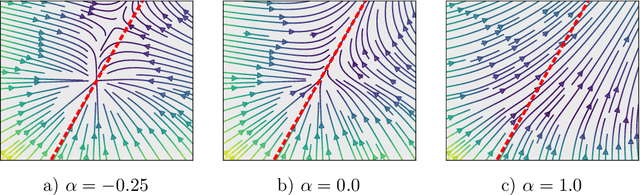

The pioneering work of Oono and Suzuki [ICLR, 2020] and Cai and Wang [arXiv:2006.13318] initializes the analysis of the smoothness of graph convolutional network (GCN) features. Their results reveal an intricate empirical correlation between node classification accuracy and the ratio of smooth to non-smooth feature components. However, the optimal ratio that favors node classification is unknown, and the non-smooth features of deep GCN with ReLU or leaky ReLU activation function diminish. In this paper, we propose a new strategy to let GCN learn node features with a desired smoothness -- adapting to data and tasks -- to enhance node classification. Our approach has three key steps: (1) We establish a geometric relationship between the input and output of ReLU or leaky ReLU. (2) Building on our geometric insights, we augment the message-passing process of graph convolutional layers (GCLs) with a learnable term to modulate the smoothness of node features with computational efficiency. (3) We investigate the achievable ratio between smooth and non-smooth feature components for GCNs with the augmented message-passing scheme. Our extensive numerical results show that the augmented message-passing schemes significantly improve node classification for GCN and some related models.