 Add to Chrome
 Add to Firefox
 Add to Edge
Spatial Memory Agent: Experience-Grounded Procedure Memory for Spatial Intelligence
Aug 13, 2026
Spatial intelligence is becoming a foundation for embodied agents, robotic planning, and multimodal assistants. To improve the spatial reasoning ability of VLM agents, existing work has mainly followed two lines. One line uses post-training methods, such as supervised fine-tuning and reinforcement learning. Another line adopts an agentic paradigm in which the model calls external spatial tools, such as depth estimation and 3D reconstruction tools, to gather intermediate spatial evidence. We study a complementary and underexplored route: Can a frozen VLM agent improve its spatial reasoning through \textbf{parameter-update-free self-evolution}, without depending on external expert spatial tools at inference time? We present \textbf{Spatial Memory Agent (SMA)}, an \textbf{experience-grounded runtime framework} that converts verified spatial experience into reusable transferable lessons. In a verifiable spatial environment, SMA queries the frozen VLM, obtains a predicted answer and reward, and uses \textbf{verifier-guided reflection} to distill compact transferable lessons from spatial experience. SMA further assigns each lesson a \textbf{Transfer Reliability Score (TRS)}, which is initialized uniformly and calibrated from later retrieval outcomes as visit evidence of future transfer reliability. During \textbf{read-only deployment}, SMA retrieves lessons by semantic filter and similarity-TRS combined ranking, allowing the retrieved memory to guide frozen model inference. Across five representative spatial benchmarks and four base VLMs, SMA achieves the highest macro average in every base-model block and the best accuracy among the evaluated methods in most of the 20 evaluations, establishing a practical parameter-update-free path for spatial self-evolution across the evaluated frozen model scales and environments.

Towards Cold-Start Drafting and Continual Refining: A Value-Driven Memory Approach with Application to NPU Kernel Synthesis
Mar 11, 2026Deploying Large Language Models to data-scarce programming domains poses significant challenges, particularly for kernel synthesis on emerging Domain-Specific Architectures where a "Data Wall" limits available training data. While models excel on data-rich platforms like CUDA, they suffer catastrophic performance drops on data-scarce ecosystems such as NPU programming. To overcome this cold-start barrier without expensive fine-tuning, we introduce EvoKernel, a self-evolving agentic framework that automates the lifecycle of kernel synthesis from initial drafting to continual refining. EvoKernel addresses this by formulating the synthesis process as a memory-based reinforcement learning task. Through a novel value-driven retrieval mechanism, it learns stage-specific Q-values that prioritize experiences based on their contribution to the current objective, whether bootstrapping a feasible draft or iteratively refining latency. Furthermore, by enabling cross-task memory sharing, the agent generalizes insights from simple to complex operators. By building an NPU variant of KernelBench and evaluating on it, EvoKernel improves frontier models' correctness from 11.0% to 83.0% and achieves a median speedup of 3.60x over initial drafts through iterative refinement. This demonstrates that value-guided experience accumulation allows general-purpose models to master the kernel synthesis task on niche hardware ecosystems. Our official page is available at https://evokernel.zhuo.li.
Boundary-Aware NL2SQL: Integrating Reliability through Hybrid Reward and Data Synthesis
Jan 15, 2026In this paper, we present BAR-SQL (Boundary-Aware Reliable NL2SQL), a unified training framework that embeds reliability and boundary awareness directly into the generation process. We introduce a Seed Mutation data synthesis paradigm that constructs a representative enterprise corpus, explicitly encompassing multi-step analytical queries alongside boundary cases including ambiguity and schema limitations. To ensure interpretability, we employ Knowledge-Grounded Reasoning Synthesis, which produces Chain-of-Thought traces explicitly anchored in schema metadata and business rules. The model is trained through a two-stage process: Supervised Fine-Tuning (SFT) followed by Reinforcement Learning via Group Relative Policy Optimization. We design a Task-Conditioned Hybrid Reward mechanism that simultaneously optimizes SQL execution accuracy-leveraging Abstract Syntax Tree analysis and dense result matching-and semantic precision in abstention responses. To evaluate reliability alongside generation accuracy, we construct and release Ent-SQL-Bench, which jointly assesse SQL precision and boundary-aware abstention across ambiguous and unanswerable queries. Experimental results on this benchmark demonstrate that BAR-SQL achieves 91.48% average accuracy, outperforming leading proprietary models, including Claude 4.5 Sonnet and GPT-5, in both SQL generation quality and boundary-aware abstention capability. The source code and benchmark are available anonymously at: https://github.com/TianSongS/BAR-SQL.
MemRL: Self-Evolving Agents via Runtime Reinforcement Learning on Episodic Memory
Jan 06, 2026The hallmark of human intelligence is the ability to master new skills through Constructive Episodic Simulation-retrieving past experiences to synthesize solutions for novel tasks. While Large Language Models possess strong reasoning capabilities, they struggle to emulate this self-evolution: fine-tuning is computationally expensive and prone to catastrophic forgetting, while existing memory-based methods rely on passive semantic matching that often retrieves noise. To address these challenges, we propose MemRL, a framework that enables agents to self-evolve via non-parametric reinforcement learning on episodic memory. MemRL explicitly separates the stable reasoning of a frozen LLM from the plastic, evolving memory. Unlike traditional methods, MemRL employs a Two-Phase Retrieval mechanism that filters candidates by semantic relevance and then selects them based on learned Q-values (utility). These utilities are continuously refined via environmental feedback in an trial-and-error manner, allowing the agent to distinguish high-value strategies from similar noise. Extensive experiments on HLE, BigCodeBench, ALFWorld, and Lifelong Agent Bench demonstrate that MemRL significantly outperforms state-of-the-art baselines. Our analysis experiments confirm that MemRL effectively reconciles the stability-plasticity dilemma, enabling continuous runtime improvement without weight updates.
Unveiling the Hidden: Movie Genre and User Bias in Spoiler Detection
Apr 28, 2025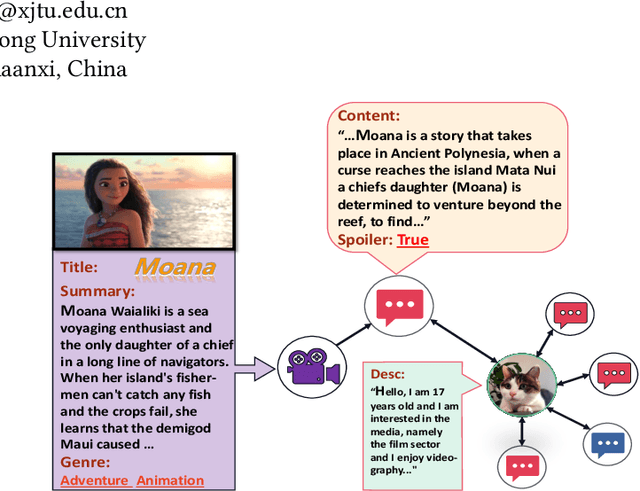
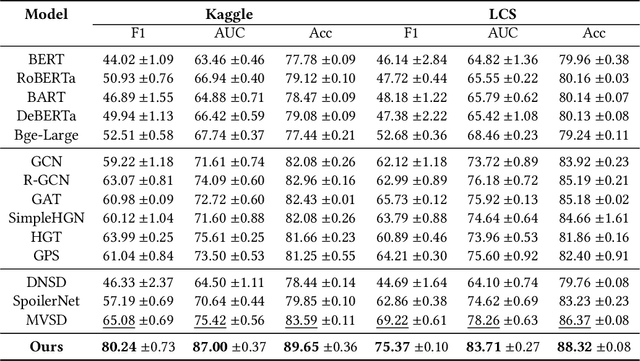
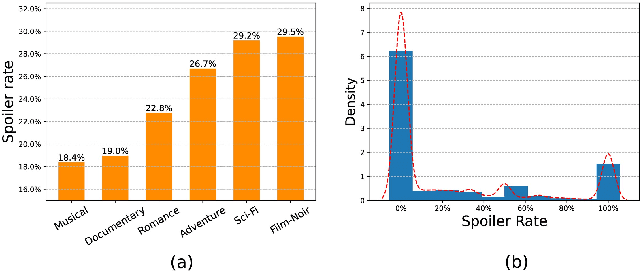
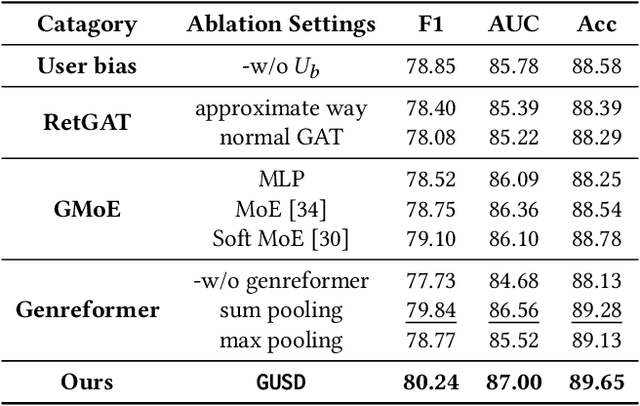
Spoilers in movie reviews are important on platforms like IMDb and Rotten Tomatoes, offering benefits and drawbacks. They can guide some viewers' choices but also affect those who prefer no plot details in advance, making effective spoiler detection essential. Existing spoiler detection methods mainly analyze review text, often overlooking the impact of movie genres and user bias, limiting their effectiveness. To address this, we analyze movie review data, finding genre-specific variations in spoiler rates and identifying that certain users are more likely to post spoilers. Based on these findings, we introduce a new spoiler detection framework called GUSD (The code is available at https://github.com/AI-explorer-123/GUSD) (Genre-aware and User-specific Spoiler Detection), which incorporates genre-specific data and user behavior bias. User bias is calculated through dynamic graph modeling of review history. Additionally, the R2GFormer module combines RetGAT (Retentive Graph Attention Network) for graph information and GenreFormer for genre-specific aggregation. The GMoE (Genre-Aware Mixture of Experts) model further assigns reviews to specialized experts based on genre. Extensive testing on benchmark datasets shows that GUSD achieves state-of-the-art results. This approach advances spoiler detection by addressing genre and user-specific patterns, enhancing user experience on movie review platforms.
PTCL: Pseudo-Label Temporal Curriculum Learning for Label-Limited Dynamic Graph
Apr 24, 2025Dynamic node classification is critical for modeling evolving systems like financial transactions and academic collaborations. In such systems, dynamically capturing node information changes is critical for dynamic node classification, which usually requires all labels at every timestamp. However, it is difficult to collect all dynamic labels in real-world scenarios due to high annotation costs and label uncertainty (e.g., ambiguous or delayed labels in fraud detection). In contrast, final timestamp labels are easier to obtain as they rely on complete temporal patterns and are usually maintained as a unique label for each user in many open platforms, without tracking the history data. To bridge this gap, we propose PTCL(Pseudo-label Temporal Curriculum Learning), a pioneering method addressing label-limited dynamic node classification where only final labels are available. PTCL introduces: (1) a temporal decoupling architecture separating the backbone (learning time-aware representations) and decoder (strictly aligned with final labels), which generate pseudo-labels, and (2) a Temporal Curriculum Learning strategy that prioritizes pseudo-labels closer to the final timestamp by assigning them higher weights using an exponentially decaying function. We contribute a new academic dataset (CoOAG), capturing long-range research interest in dynamic graph. Experiments across real-world scenarios demonstrate PTCL's consistent superiority over other methods adapted to this task. Beyond methodology, we propose a unified framework FLiD (Framework for Label-Limited Dynamic Node Classification), consisting of a complete preparation workflow, training pipeline, and evaluation standards, and supporting various models and datasets. The code can be found at https://github.com/3205914485/FLiD.