 Add to Chrome
 Add to Firefox
 Add to Edge
HaReCAP: Habitual-action Grounding for Recursive Large Language Model Agents
Aug 17, 2026
Long-horizon embodied tasks require LLM agents to iteratively decompose high-level goals, revise plans in response to environmental feedback, and ground leaf-level subgoals into valid executable actions. Recursive context-management methods such as ReCAP improve planning stability through multi-level task decomposition and parent-node refinement, but still repeatedly invoke the LLM at leaf nodes to ground atomic subtasks into exact valid actions. We refer to this final grounding step as last-mile grounding redundancy, which accumulates into substantial LLM-call and token overhead during long-horizon execution. To mitigate this issue, we propose HaReCAP (Habitual-action Grounded ReCAP), a low-intrusion leaf grounding extension for ReCAP. HaReCAP extracts frequent leaf decisions from successful trajectories and compiles them offline into auditable and abstainable one-step leaf-reflex rules. At runtime, it skips the leaf LLM call only when a rule can uniquely determine a legal action in the current valid-action set; otherwise, it falls back to the original ReCAP. This design avoids repeatedly carrying the full recursive context into the LLM for routine leaf action grounding, while preserving the original recursive control flow. We evaluate HaReCAP on Robotouille and ALFWorld with Qwen3.5-27B as the main model. On tasks solved by both ReCAP and HaReCAP, HaReCAP reduces token consumption by 14.67%, 17.93%, and 20.08% on Robotouille synchronous, Robotouille asynchronous, and ALFWorld, respectively. The results show that HaReCAP can serve as a low-intrusion extension to ReCAP-style recursive context-management frameworks, reducing last-mile grounding redundancy across environments and models on commonly successful trajectories.

An interpretable and trustworthy AI framework for large-scale longitudinal structure-pain association studies using data from the Osteoarthritis Initiative (OAI)
Jun 03, 2026Purpose: To develop an interpretable and trustworthy AI framework that combines deep learning based MRI Osteoarthritis Knee Score (MOAKS) prediction with interpretable statistical modeling to study structure-pain relationships at scale using data from the Osteoarthritis Initiative (OAI). Materials and Methods: We first developed a deep learning framework to predict MOAKS features directly from knee MRIs and incorporated conformal prediction to provide prediction uncertainty quantification. This uncertainty-aware strategy enables explicit filtering of model outputs, retaining only high-confidence MOAKS predictions at the knee level. Second, we applied a longitudinal latent class mixed model (LCMM) to examine associations between key structural abnormalities and four complementary knee pain measurements. Results: Among the three MRI-defined abnormalities (i.e., bone marrow lesions (BML), cartilage loss (CART), and meniscal extrusion (ME)), our framework substantially improved the Matthews correlation coefficient (MCC) and some other metrics. For example, MCC increased from 0.69 to 0.91 for BML, from 0.45 to 0.80 for CART, and from 0.59 to 0.89 for ME. Using these high-confidence predictions, we expanded the sample size to 2,175 knees for the LCMM analysis. Two distinct pain trajectories were identified (rapid and stable pain progression). The estimated odds ratios (95% CI) for the rapid progression group were 1.62 (1.12-2.35) for BML, 1.83 (1.24-2.70) for CART loss, and 2.50 (1.75-3.57) for ME. Conclusion: These results highlight the importance of these structural abnormalities as risk factors for pain and functional progression in osteoarthritis.
Unveiling Institution-Specific Bias in Pathology Foundation Models: Detriments, Causes, and Potential Solutions
Feb 24, 2025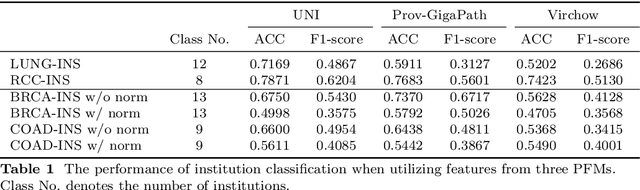
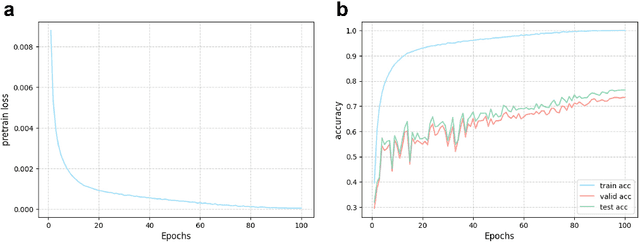
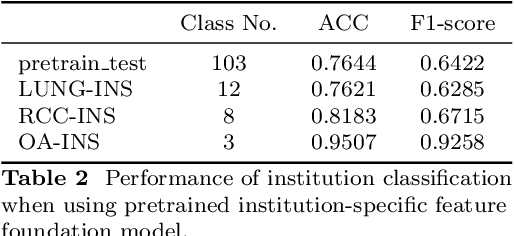
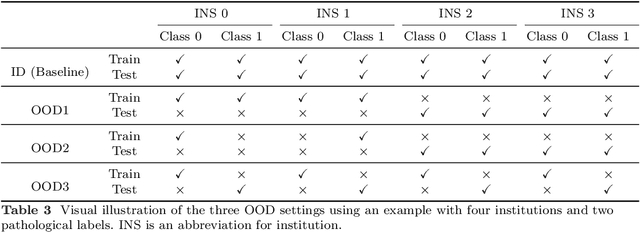
Pathology foundation models (PFMs) extract valuable discriminative features from images for downstream clinical tasks. PFMs have simplified the development of deep learning models, effectively leveraging prior knowledge to improve diagnostic accuracy in diverse scenarios. However, we find that PFMs sometimes struggle with certain challenges. Specifically, features extracted by PFMs are often contaminated by diagnosis-irrelevant information, i.e., institution-specific features associated with the images. This contamination can lead to spurious correlations, undermining the models' generalization ability when applied in real-world clinical settings. In this work, we first reveal the issue of feature contamination in PFMs, demonstrate the presence of institution-specific features, thoroughly investigate its negative impacts, analyze the underlying causes, and provide insights into potential solutions. Specifically, we find that institution-specific information is embedded in pathological images and can be readily captured by current PFMs. Through extensive experiments, we demonstrate the detrimental impact of this irrelevant information, particularly in out-of-distribution (OOD) settings, where reliance on contaminated features leads to significant performance degradation. This indicates that the models are being misled by non-diagnostic information. We further delve into the reasons PFMs extract such institution-specific information and validate our findings. Finally, we propose a simple yet effective solution to mitigate the influence of irrelevant information. This study is not intended to criticize existing PFMs, as they have indeed greatly advanced the development of computational pathology. our aim is to inspire future research to focus on innovative training strategies, rather than relying exclusively on scaling laws, to realize more generalized PFMs.
A Dual-Attention Neural Network for Pun Location and Using Pun-Gloss Pairs for Interpretation
Oct 14, 2021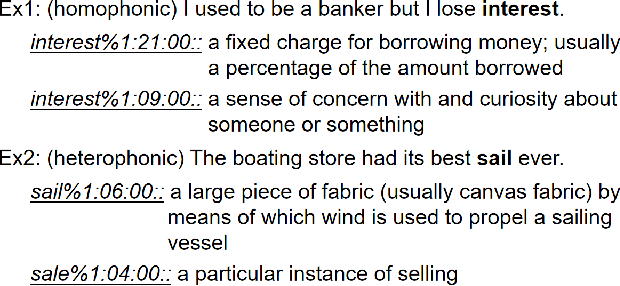

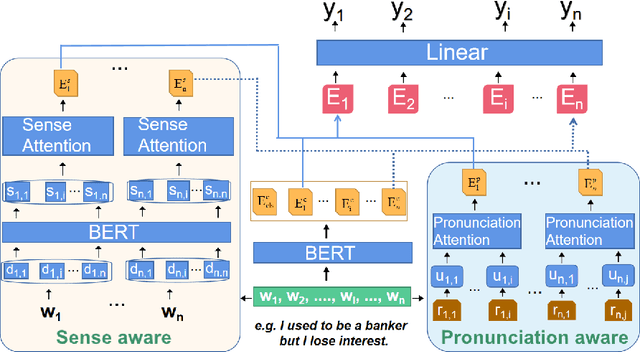
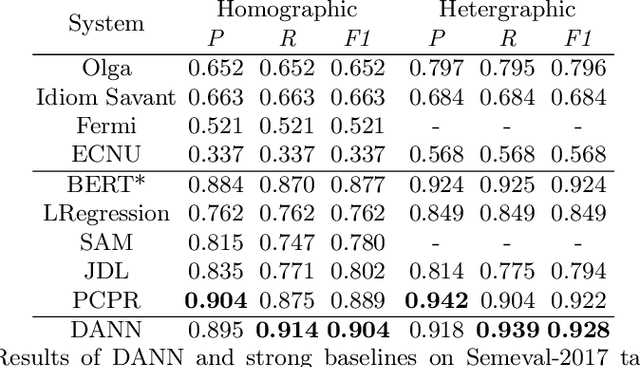
Pun location is to identify the punning word (usually a word or a phrase that makes the text ambiguous) in a given short text, and pun interpretation is to find out two different meanings of the punning word. Most previous studies adopt limited word senses obtained by WSD(Word Sense Disambiguation) technique or pronunciation information in isolation to address pun location. For the task of pun interpretation, related work pays attention to various WSD algorithms. In this paper, a model called DANN (Dual-Attentive Neural Network) is proposed for pun location, effectively integrates word senses and pronunciation with context information to address two kinds of pun at the same time. Furthermore, we treat pun interpretation as a classification task and construct pungloss pairs as processing data to solve this task. Experiments on the two benchmark datasets show that our proposed methods achieve new state-of-the-art results. Our source code is available in the public code repository.