 Add to Chrome
 Add to Firefox
 Add to Edge
HaReCAP: Habitual-action Grounding for Recursive Large Language Model Agents
Aug 17, 2026
Long-horizon embodied tasks require LLM agents to iteratively decompose high-level goals, revise plans in response to environmental feedback, and ground leaf-level subgoals into valid executable actions. Recursive context-management methods such as ReCAP improve planning stability through multi-level task decomposition and parent-node refinement, but still repeatedly invoke the LLM at leaf nodes to ground atomic subtasks into exact valid actions. We refer to this final grounding step as last-mile grounding redundancy, which accumulates into substantial LLM-call and token overhead during long-horizon execution. To mitigate this issue, we propose HaReCAP (Habitual-action Grounded ReCAP), a low-intrusion leaf grounding extension for ReCAP. HaReCAP extracts frequent leaf decisions from successful trajectories and compiles them offline into auditable and abstainable one-step leaf-reflex rules. At runtime, it skips the leaf LLM call only when a rule can uniquely determine a legal action in the current valid-action set; otherwise, it falls back to the original ReCAP. This design avoids repeatedly carrying the full recursive context into the LLM for routine leaf action grounding, while preserving the original recursive control flow. We evaluate HaReCAP on Robotouille and ALFWorld with Qwen3.5-27B as the main model. On tasks solved by both ReCAP and HaReCAP, HaReCAP reduces token consumption by 14.67%, 17.93%, and 20.08% on Robotouille synchronous, Robotouille asynchronous, and ALFWorld, respectively. The results show that HaReCAP can serve as a low-intrusion extension to ReCAP-style recursive context-management frameworks, reducing last-mile grounding redundancy across environments and models on commonly successful trajectories.

Federated Learning with Limited Node Labels
Jun 18, 2024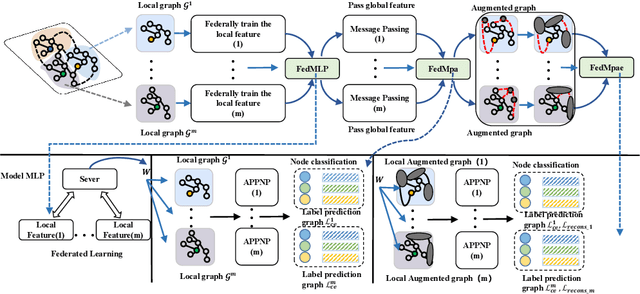
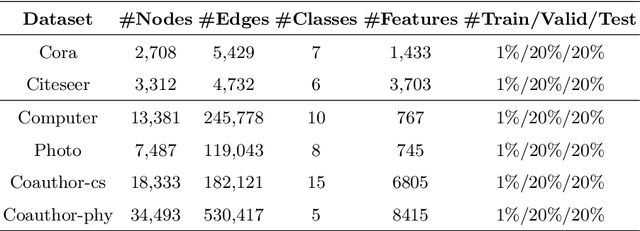
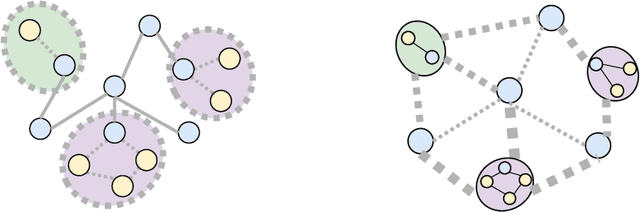
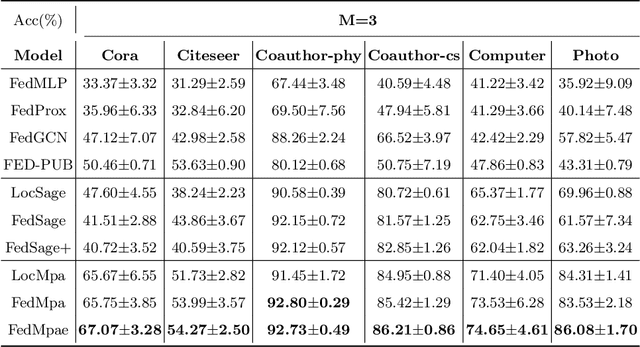
Subgraph federated learning (SFL) is a research methodology that has gained significant attention for its potential to handle distributed graph-structured data. In SFL, the local model comprises graph neural networks (GNNs) with a partial graph structure. However, some SFL models have overlooked the significance of missing cross-subgraph edges, which can lead to local GNNs being unable to message-pass global representations to other parties' GNNs. Moreover, existing SFL models require substantial labeled data, which limits their practical applications. To overcome these limitations, we present a novel SFL framework called FedMpa that aims to learn cross-subgraph node representations. FedMpa first trains a multilayer perceptron (MLP) model using a small amount of data and then propagates the federated feature to the local structures. To further improve the embedding representation of nodes with local subgraphs, we introduce the FedMpae method, which reconstructs the local graph structure with an innovation view that applies pooling operation to form super-nodes. Our extensive experiments on six graph datasets demonstrate that FedMpa is highly effective in node classification. Furthermore, our ablation experiments verify the effectiveness of FedMpa.
PrUE: Distilling Knowledge from Sparse Teacher Networks
Jul 03, 2022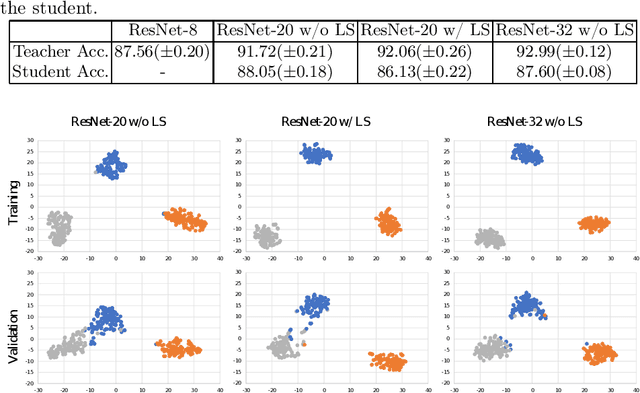
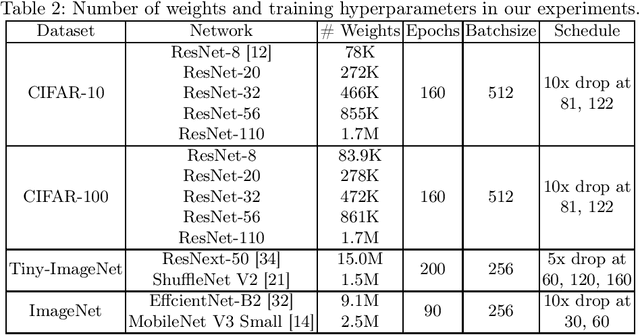
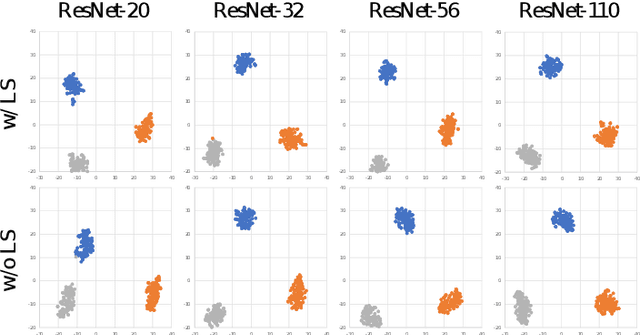
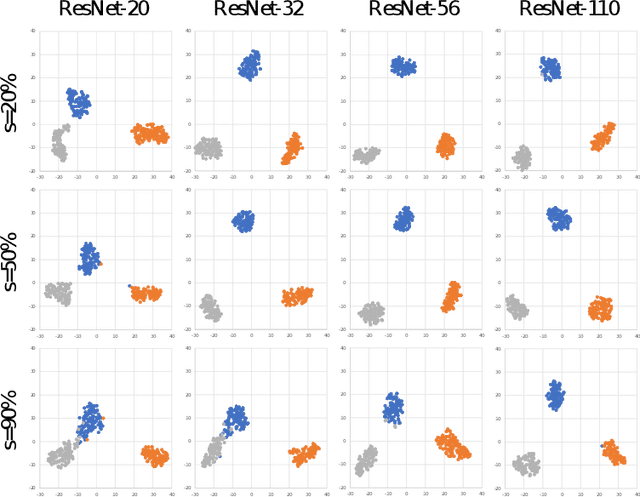
Although deep neural networks have enjoyed remarkable success across a wide variety of tasks, their ever-increasing size also imposes significant overhead on deployment. To compress these models, knowledge distillation was proposed to transfer knowledge from a cumbersome (teacher) network into a lightweight (student) network. However, guidance from a teacher does not always improve the generalization of students, especially when the size gap between student and teacher is large. Previous works argued that it was due to the high certainty of the teacher, resulting in harder labels that were difficult to fit. To soften these labels, we present a pruning method termed Prediction Uncertainty Enlargement (PrUE) to simplify the teacher. Specifically, our method aims to decrease the teacher's certainty about data, thereby generating soft predictions for students. We empirically investigate the effectiveness of the proposed method with experiments on CIFAR-10/100, Tiny-ImageNet, and ImageNet. Results indicate that student networks trained with sparse teachers achieve better performance. Besides, our method allows researchers to distill knowledge from deeper networks to improve students further. Our code is made public at: \url{https://github.com/wangshaopu/prue}.