 Add to Chrome
 Add to Firefox
 Add to Edge
Ask to Be Sure: Informative Interactions for Confident Multi-Turn LLM Recommendation
Aug 16, 2026
Recent advances in large language models (LLMs) have enabled their use as conversational recommender systems (CRS), demonstrating strong recommendation accuracy and natural dialogue. However, guiding multi-turn interactions to elicit user preferences effectively remains challenging. Existing approaches either use separate reinforcement learning agents with templated interactions or optimize for interactivity judged by another LLM, without measuring how much useful information is actually gained. We propose a new approach that quantifies the effectiveness of each interaction by the reduction in the assistant's uncertainty, measured via entropy over recommendations. We apply this entropy reduction as a reward---without relying on ground-truth recommendations, which are often unavailable in real-world scenarios---to fine-tune the LLM, enabling strategic interaction generation. Empirical results with supervised fine-tuning (SFT) and direct preference optimization (DPO) on the INSPIRED and ReDial datasets show that our method improves both recommendation quality and conversational efficiency.

Scaling Automatic Research Agents via World Models
Aug 12, 2026Automating empirical research is a long-standing direction of AI. Recent automatic research (AutoResearch) agents bring this goal within reach, as modern LLMs show the capability to independently implement solutions and learn from the execution outcomes. Behind these gains, post-training (especially RL) plays a central role. In this paper, we identify a fundamental tension when scaling RL for these agents: the two components of every AutoResearch trajectory (agent generation and environment execution) scale in very different manners, since all generation shares compute through batching, while each execution occupies its exclusive sandbox and real machine time. As a result, the environment execution dominates the training cost and becomes the bottleneck as trajectories grow. To resolve this tension, we propose World Model RL (WMRL), which replaces environment execution with a world model to remove this bottleneck. Additionally, the world model can be imperfect, as its rewards are corrupted by bias and noise. Therefore, we further equip WMRL with two mitigations, Online Debiasing and Inverse-Variance Denoising, which offset the bias and suppress the noise respectively. Theoretically, we prove that both mitigations of WMRL strictly improve the convergence guarantee. Empirically, WMRL accelerates training by 3-4x on various tasks at different agent scales, while exceeding the performance of standard RL baselines. Moreover, our post-trained 4B and 9B agents outperform much larger open-weight agents of 48B and 120B on held-out benchmarks. Beyond AutoResearch, WMRL also transfers to post-training embodied VLA policies, which demonstrates the generalizability of our method.
Learning with Less: Knowledge Distillation from Large Language Models via Unlabeled Data
Nov 12, 2024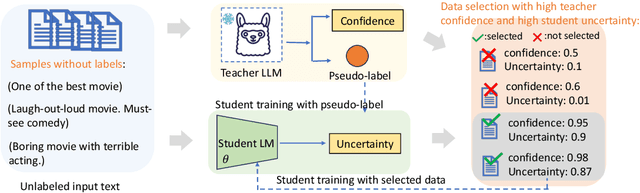
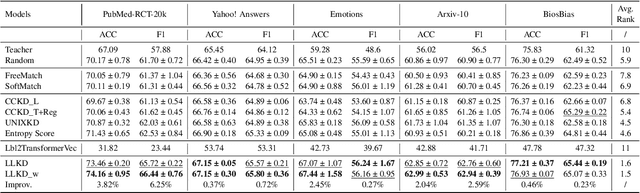
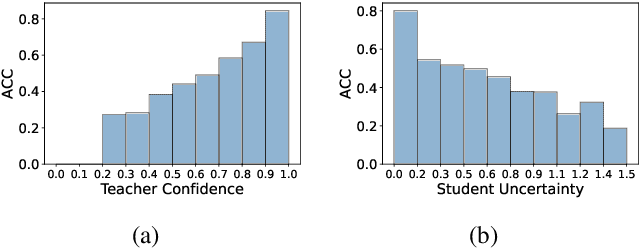

In real-world NLP applications, Large Language Models (LLMs) offer promising solutions due to their extensive training on vast datasets. However, the large size and high computation demands of LLMs limit their practicality in many applications, especially when further fine-tuning is required. To address these limitations, smaller models are typically preferred for deployment. However, their training is hindered by the scarcity of labeled data. In contrast, unlabeled data is often readily which can be leveraged by using LLMs to generate pseudo-labels for training smaller models. This enables the smaller models (student) to acquire knowledge from LLMs(teacher) while reducing computational costs. This process introduces challenges, such as potential noisy pseudo-labels. Selecting high-quality and informative data is therefore critical to enhance model performance while improving the efficiency of data utilization. To address this, we propose LLKD that enables Learning with Less computational resources and less data for Knowledge Distillation from LLMs. LLKD is an adaptive sample selection method that incorporates signals from both the teacher and student. Specifically, it prioritizes samples where the teacher demonstrates high confidence in its labeling, indicating reliable labels, and where the student exhibits a high information need, identifying challenging samples that require further learning. Our comprehensive experiments show that LLKD achieves superior performance across various datasets with higher data efficiency.