 Add to Chrome
 Add to Firefox
 Add to Edge
Quantum Reservoir Computing: Recent Advances and Future Directions
Jul 20, 2026
Quantum reservoir computing (QRC) uses the dynamics of a fixed or weakly tuned quantum system to transform temporal and sequential inputs into measured features, while training is typically confined to a classical readout. This separation reduces reliance on repeated quantum parameter updates and avoids the barren plateaus associated with variational circuit training. Its computational power is often attributed to the exponentially large Hilbert space of the quantum system. However, the memory, nonlinearity, and expressivity that determine what a reservoir can actually compute depend jointly on the input encoding, quantum evolution, observables, measurement, and readout, not on Hilbert space dimension alone. On hardware, these capabilities are further constrained by finite sampling, hardware noise, measurement backaction, and the cost of estimating observables, so a large state space alone does not guarantee useful computation. In this survey, we develop a common system model that connects these components and use it to organize QRC foundations, computational properties, reservoir architectures, operating protocols, and physical implementations. We examine spin, photonic, superconducting, bosonic, neutral atom, and other analog platforms, together with applications, software and high performance computing support, benchmarking, and reproducibility. The analysis distinguishes hardware demonstrations from simulations and identifies the assumptions and resources that govern comparisons across implementations. Current results do not establish a broad quantum advantage over well matched classical reservoirs. We therefore specify the resource accounting, benchmark standards, and theoretical criteria needed to evaluate claims of quantum advantage.

Robustness of SAM: Segment Anything Under Corruptions and Beyond
Jun 13, 2023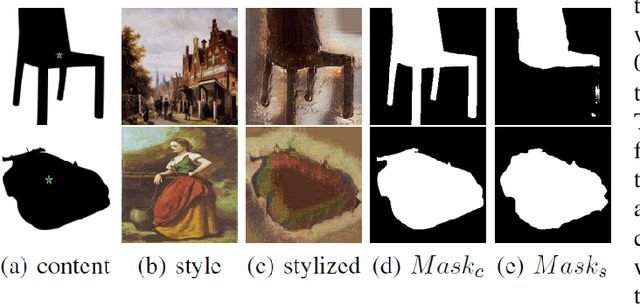
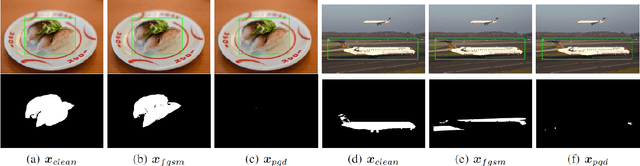
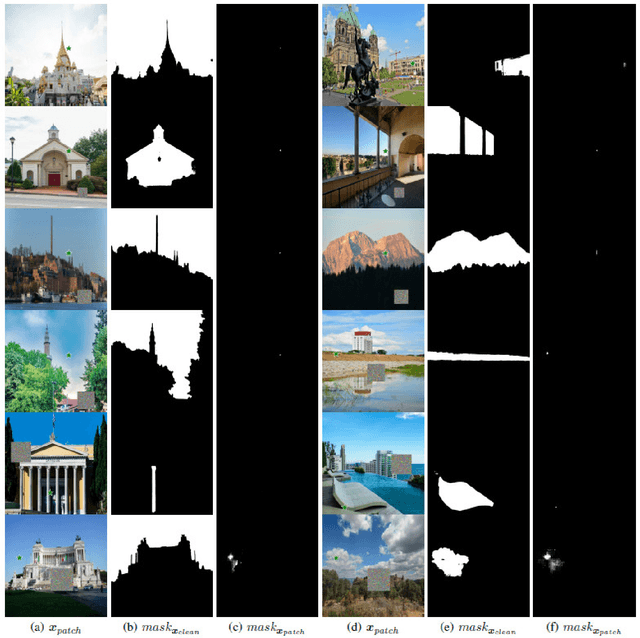

Segment anything model (SAM), as the name suggests, is claimed to be capable of cutting out any object. SAM is a vision foundation model which demonstrates impressive zero-shot transfer performance with the guidance of a prompt. However, there is currently a lack of comprehensive evaluation of its robustness performance under various types of corruptions. Prior works show that SAM is biased towards texture (style) rather than shape, motivated by which we start by investigating SAM's robustness against style transfer, which is synthetic corruption. With the effect of corruptions interpreted as a style change, we further evaluate its robustness on 15 common corruptions with 5 severity levels for each real-world corruption. Beyond the corruptions, we further evaluate the SAM robustness on local occlusion and adversarial perturbations. Overall, this work provides a comprehensive empirical study on the robustness of the SAM under corruptions and beyond.
Segment Anything Meets Semantic Communication
Jun 03, 2023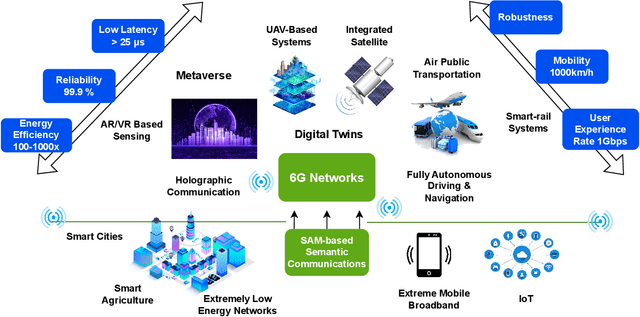
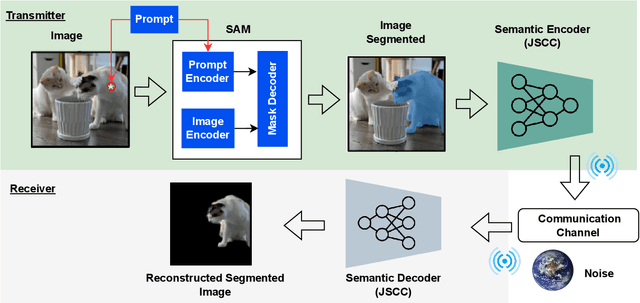
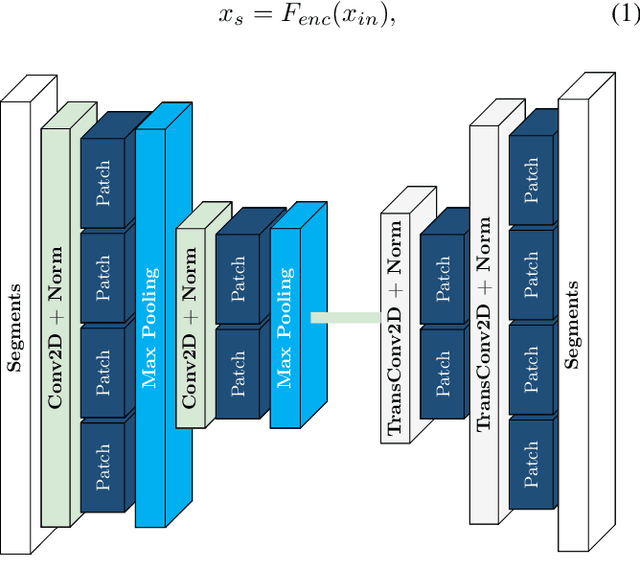
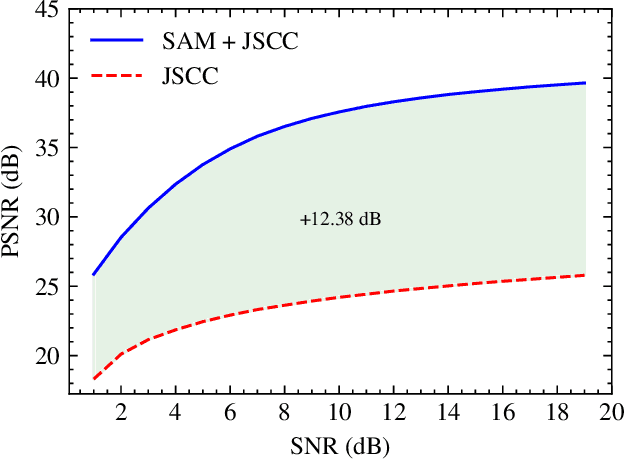
In light of the diminishing returns of traditional methods for enhancing transmission rates, the domain of semantic communication presents promising new frontiers. Focusing on image transmission, this paper explores the application of foundation models, particularly the Segment Anything Model (SAM) developed by Meta AI Research, to improve semantic communication. SAM is a promptable image segmentation model that has gained attention for its ability to perform zero-shot segmentation tasks without explicit training or domain-specific knowledge. By employing SAM's segmentation capability and lightweight neural network architecture for semantic coding, we propose a practical approach to semantic communication. We demonstrate that this approach retains critical semantic features, achieving higher image reconstruction quality and reducing communication overhead. This practical solution eliminates the resource-intensive stage of training a segmentation model and can be applied to any semantic coding architecture, paving the way for real-world applications.