 Add to Chrome
 Add to Firefox
 Add to Edge
Towards Robust EEG Decoding Based on Riemannian Self-Attention
Jun 24, 2026
Brain-Computer Interface (BCI) based on electroencephalography (EEG) enables direct interaction between the brain and external environments and has significant applications in assistive technologies, medical rehabilitation, and entertainment. Recently, EEG decoding methods based on Symmetric Positive Definite (SPD) learning have demonstrated superior performance. However, these methods typically employ basic network architectures and do not explicitly capture local relationships between EEG signals. This limitation is problematic for EEG signals due to their inherently low Signal-to-Noise Ratio (SNR). Moreover, most existing Riemannian manifold-based methods are restricted to specific metrics. The most widely used is the Affine-Invariant Metric (AIM). However, it has a quadratic dependency on the SPD matrices and cannot handle ill-conditioned SPD matrices, which hinders the effectiveness of networks. In contrast, the Bures-Wasserstein Metric (BWM) exhibits linear dependence on SPD matrices and demonstrates superior performance for ill conditioning. To overcome these challenges, we propose a Riemannian self-attention network based on the BWM. Additionally, the recently introduced power-deformed generalized Bures-Wasserstein metric reveals a nonlinear relationship between SPD matrices and matrix power deformation. This metric provides a more nuanced representation of the geometric structure of the SPD manifold. Consequently, we extend our model to a learnable version. For simplicity, we refer to it as GBWAtt. Experimental results on three EEG benchmarking datasets validate the robustness and effectiveness of our proposed method. The code is available at https://github.com/jissc/GBWAtt.

A Sliced-Wasserstein Framework on Correlation Matrices for EEG Decoding
Jun 04, 2026Electroencephalography (EEG) offers noninvasive, millisecond resolution recordings of neuronal activity and is widely used in neuroscience and healthcare. Many EEG decoding pipelines rely on covariance descriptors for their robustness to noise, but such representations are sensitive to channel-wise scaling. Recent studies have therefore advocated full-rank correlation matrices as a scale-invariant alternative for EEG decoding. In this paper, we propose a general framework for Sliced Wasserstein (SW) discrepancies on manifolds endowed with Pullback Euclidean Metrics (PEMs), termed Pullback Euclidean Metric Sliced Wasserstein (PEMSW). Within this framework, we instantiate two Correlation Sliced-Wasserstein (CorSW) discrepancies on the manifold of full-rank correlation matrices under two recently introduced correlation geometries, \textit{i.e.}, the Off-Log Metric (OLM) and Log-Scaled Metric (LSM). Building on CorSW, we further develop a domain generalization (DG) framework for EEG decoding. Experiments on three EEG datasets demonstrate improved generalization under distribution shifts, with low training overhead and no additional inference cost. The source code is available at https://github.com/ChenHu-ML/CorSW.
Learning to Normalize on the SPD Manifold under Bures-Wasserstein Geometry
Apr 01, 2025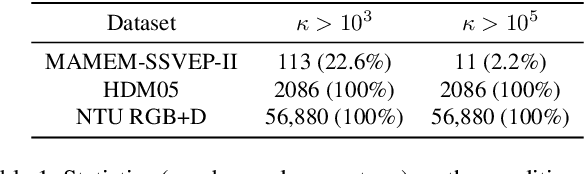
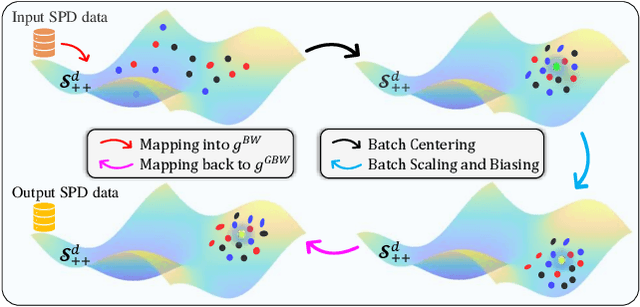
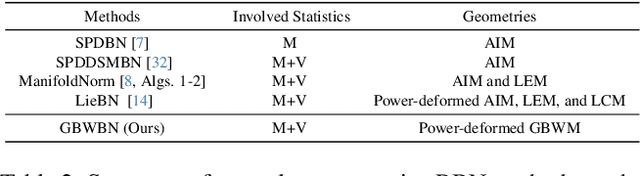
Covariance matrices have proven highly effective across many scientific fields. Since these matrices lie within the Symmetric Positive Definite (SPD) manifold - a Riemannian space with intrinsic non-Euclidean geometry, the primary challenge in representation learning is to respect this underlying geometric structure. Drawing inspiration from the success of Euclidean deep learning, researchers have developed neural networks on the SPD manifolds for more faithful covariance embedding learning. A notable advancement in this area is the implementation of Riemannian batch normalization (RBN), which has been shown to improve the performance of SPD network models. Nonetheless, the Riemannian metric beneath the existing RBN might fail to effectively deal with the ill-conditioned SPD matrices (ICSM), undermining the effectiveness of RBN. In contrast, the Bures-Wasserstein metric (BWM) demonstrates superior performance for ill-conditioning. In addition, the recently introduced Generalized BWM (GBWM) parameterizes the vanilla BWM via an SPD matrix, allowing for a more nuanced representation of vibrant geometries of the SPD manifold. Therefore, we propose a novel RBN algorithm based on the GBW geometry, incorporating a learnable metric parameter. Moreover, the deformation of GBWM by matrix power is also introduced to further enhance the representational capacity of GBWM-based RBN. Experimental results on different datasets validate the effectiveness of our proposed method.