 Add to Chrome
 Add to Firefox
 Add to Edge
Element-Aware Group Learning for E-Commerce Image Generation
Aug 01, 2026
Recent advances in image generation and editing have made prompt quality a key bottleneck for e-commerce creatives. Vision-language models (VLMs) can generate image-editing prompts from product images and metadata, but further improving their prompt-writing capabilities requires post-training with feedback from the generated images. Group Relative Policy Optimization (GRPO) is a natural framework for such outcome-level reward optimization. However, it assigns credit only at the full-prompt level, even though image quality often depends on specific design elements such as composition, background, and the presentation of selling points. Existing fine-grained credit assignment methods typically require step-level supervision or learned critics. To address this, we propose EAGLE-GRPO (Element-Aware Group Learning for E-Commerce Image Generation), which decomposes the group-centered reward over predefined elements. We cast element-level credit assignment as a kernel ridge regression problem and derive a closed-form solution, without additional rollouts or separate credit-assignment models. This yields interpretable per-element advantages and more precise policy updates. Experiments show that EAGLE-GRPO sustains performance gains over more training steps before plateauing and generates prompts that produce higher-quality e-commerce images than competitive VLM prompt-writing baselines.

SeriesBench: A Benchmark for Narrative-Driven Drama Series Understanding
Apr 30, 2025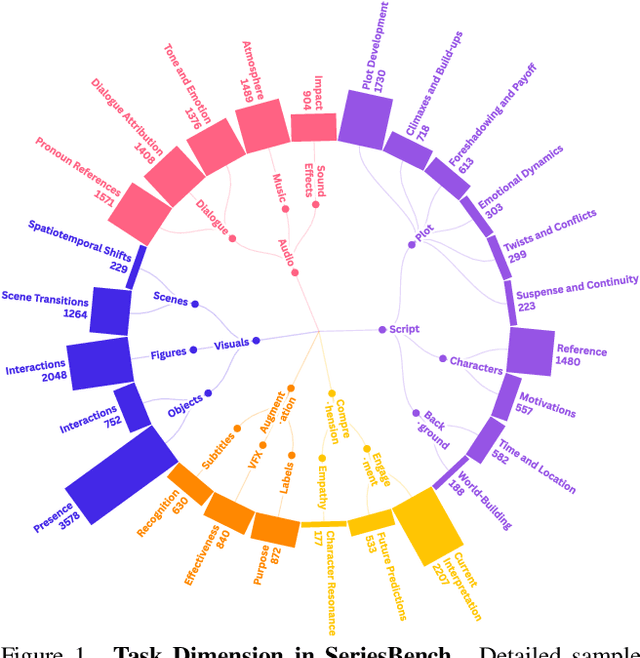
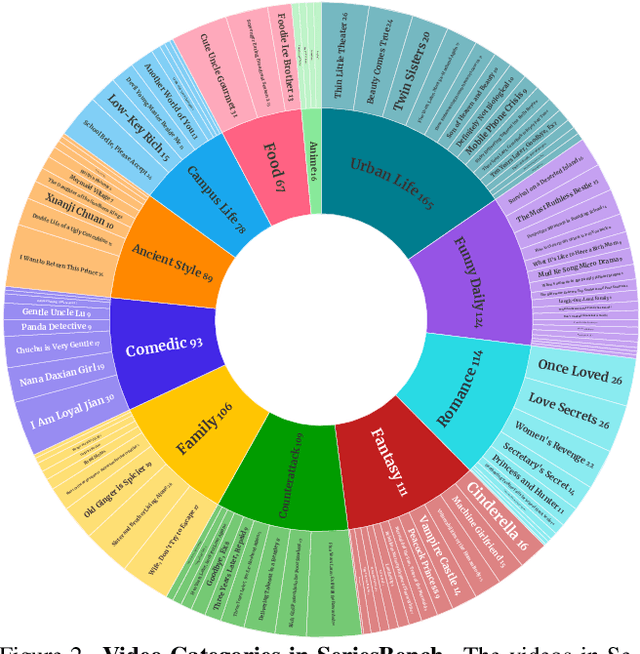
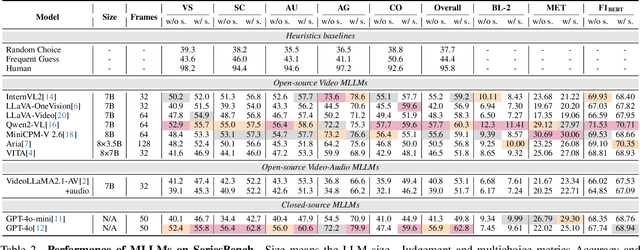
With the rapid development of Multi-modal Large Language Models (MLLMs), an increasing number of benchmarks have been established to evaluate the video understanding capabilities of these models. However, these benchmarks focus on \textbf{standalone} videos and mainly assess ``visual elements'' like human actions and object states. In reality, contemporary videos often encompass complex and continuous narratives, typically presented as a \textbf{series}. To address this challenge, we propose \textbf{SeriesBench}, a benchmark consisting of 105 carefully curated narrative-driven series, covering 28 specialized tasks that require deep narrative understanding. Specifically, we first select a diverse set of drama series spanning various genres. Then, we introduce a novel long-span narrative annotation method, combined with a full-information transformation approach to convert manual annotations into diverse task formats. To further enhance model capacity for detailed analysis of plot structures and character relationships within series, we propose a novel narrative reasoning framework, \textbf{PC-DCoT}. Extensive results on \textbf{SeriesBench} indicate that existing MLLMs still face significant challenges in understanding narrative-driven series, while \textbf{PC-DCoT} enables these MLLMs to achieve performance improvements. Overall, our \textbf{SeriesBench} and \textbf{PC-DCoT} highlight the critical necessity of advancing model capabilities to understand narrative-driven series, guiding the future development of MLLMs. SeriesBench is publicly available at https://github.com/zackhxn/SeriesBench-CVPR2025.