 Add to Chrome
 Add to Firefox
 Add to Edge
HarnessEval-W: Agentifying the Evaluation of Visual Worlds
Aug 17, 2026
A benchmark should deliver more than a scalar score: what makes an evaluation trustworthy is the reasoning that justifies the score. This is especially critical for world models, where judging a rollout requires understanding whether physics, causality, and world state evolve correctly. Humans spot such violations naturally, yet no existing benchmark automates this capability: metrics are computed brute-force, leaving no reasoning chain that can be examined or verified. We introduce HarnessEval-W, an agentified evaluation pipeline that brings the harness paradigm from the LLM ecosystem to world model benchmarking. Rather than applying a fixed rubric, HarnessEval-W interprets the context of each evaluation case, decomposes the evaluation question into measurable subproblems, and spawns specialized sub-agents, each equipped with tailored context and diagnostic tools to reason over its own subproblem. The parent agent then validates the gathered evidence and summarizes it into the final verdict. This hierarchical workflow turns every evaluation into a transparent evidence tree whose complete reasoning chain justifies the result. We apply HarnessEval-W to 18 representative world models over 330 evaluation cases. Its judgments closely align with human preferences while providing verifiable, fine-grained diagnoses of every generated rollout. We open-source the full pipeline as a live benchmark and invite the broad community to contribute to grow new skills and evaluation cases as world models evolve.

JEPA-VLA: Video Predictive Embedding is Needed for VLA Models
Feb 12, 2026Recent vision-language-action (VLA) models built upon pretrained vision-language models (VLMs) have achieved significant improvements in robotic manipulation. However, current VLAs still suffer from low sample efficiency and limited generalization. This paper argues that these limitations are closely tied to an overlooked component, pretrained visual representation, which offers insufficient knowledge on both aspects of environment understanding and policy prior. Through an in-depth analysis, we find that commonly used visual representations in VLAs, whether pretrained via language-image contrastive learning or image-based self-supervised learning, remain inadequate at capturing crucial, task-relevant environment information and at inducing effective policy priors, i.e., anticipatory knowledge of how the environment evolves under successful task execution. In contrast, we discover that predictive embeddings pretrained on videos, in particular V-JEPA 2, are adept at flexibly discarding unpredictable environment factors and encoding task-relevant temporal dynamics, thereby effectively compensating for key shortcomings of existing visual representations in VLAs. Building on these observations, we introduce JEPA-VLA, a simple yet effective approach that adaptively integrates predictive embeddings into existing VLAs. Our experiments demonstrate that JEPA-VLA yields substantial performance gains across a range of benchmarks, including LIBERO, LIBERO-plus, RoboTwin2.0, and real-robot tasks.
Vid2World: Crafting Video Diffusion Models to Interactive World Models
May 20, 2025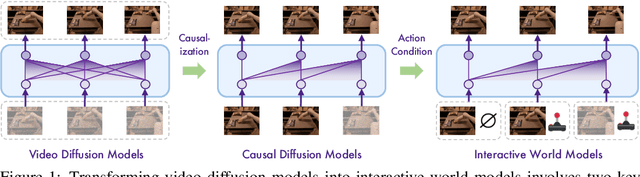
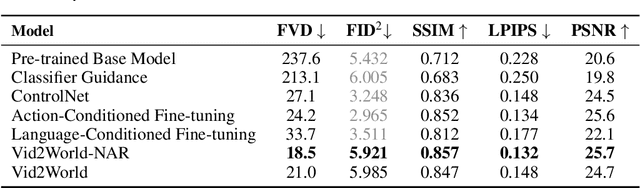
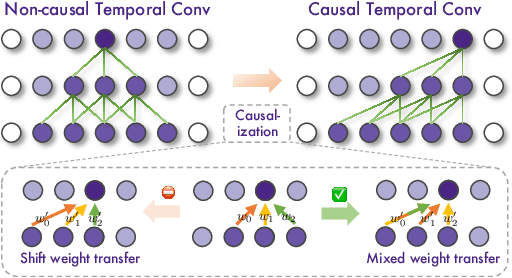

World models, which predict transitions based on history observation and action sequences, have shown great promise in improving data efficiency for sequential decision making. However, existing world models often require extensive domain-specific training and still produce low-fidelity, coarse predictions, limiting their applicability in complex environments. In contrast, video diffusion models trained on large, internet-scale datasets have demonstrated impressive capabilities in generating high-quality videos that capture diverse real-world dynamics. In this work, we present Vid2World, a general approach for leveraging and transferring pre-trained video diffusion models into interactive world models. To bridge the gap, Vid2World performs casualization of a pre-trained video diffusion model by crafting its architecture and training objective to enable autoregressive generation. Furthermore, it introduces a causal action guidance mechanism to enhance action controllability in the resulting interactive world model. Extensive experiments in robot manipulation and game simulation domains show that our method offers a scalable and effective approach for repurposing highly capable video diffusion models to interactive world models.