 Add to Chrome
 Add to Firefox
 Add to Edge
FeatureBench: Benchmarking Agentic Coding for Complex Feature Development
Feb 11, 2026
Agents powered by large language models (LLMs) are increasingly adopted in the software industry, contributing code as collaborators or even autonomous developers. As their presence grows, it becomes important to assess the current boundaries of their coding abilities. Existing agentic coding benchmarks, however, cover a limited task scope, e.g., bug fixing within a single pull request (PR), and often rely on non-executable evaluations or lack an automated approach for continually updating the evaluation coverage. To address such issues, we propose FeatureBench, a benchmark designed to evaluate agentic coding performance in end-to-end, feature-oriented software development. FeatureBench incorporates an execution-based evaluation protocol and a scalable test-driven method that automatically derives tasks from code repositories with minimal human effort. By tracing from unit tests along a dependency graph, our approach can identify feature-level coding tasks spanning multiple commits and PRs scattered across the development timeline, while ensuring the proper functioning of other features after the separation. Using this framework, we curated 200 challenging evaluation tasks and 3825 executable environments from 24 open-source repositories in the first version of our benchmark. Empirical evaluation reveals that the state-of-the-art agentic model, such as Claude 4.5 Opus, which achieves a 74.4% resolved rate on SWE-bench, succeeds on only 11.0% of tasks, opening new opportunities for advancing agentic coding. Moreover, benefiting from our automated task collection toolkit, FeatureBench can be easily scaled and updated over time to mitigate data leakage. The inherent verifiability of constructed environments also makes our method potentially valuable for agent training.

Vid2World: Crafting Video Diffusion Models to Interactive World Models
May 20, 2025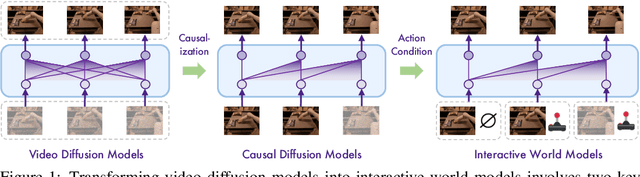
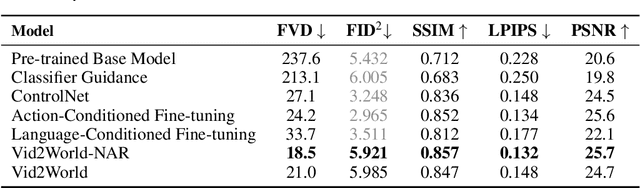
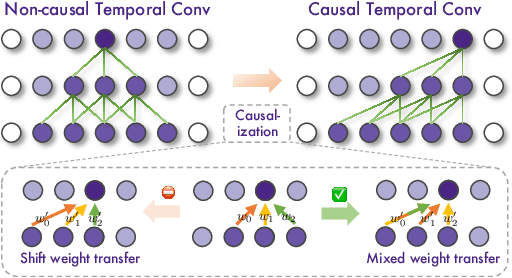

World models, which predict transitions based on history observation and action sequences, have shown great promise in improving data efficiency for sequential decision making. However, existing world models often require extensive domain-specific training and still produce low-fidelity, coarse predictions, limiting their applicability in complex environments. In contrast, video diffusion models trained on large, internet-scale datasets have demonstrated impressive capabilities in generating high-quality videos that capture diverse real-world dynamics. In this work, we present Vid2World, a general approach for leveraging and transferring pre-trained video diffusion models into interactive world models. To bridge the gap, Vid2World performs casualization of a pre-trained video diffusion model by crafting its architecture and training objective to enable autoregressive generation. Furthermore, it introduces a causal action guidance mechanism to enhance action controllability in the resulting interactive world model. Extensive experiments in robot manipulation and game simulation domains show that our method offers a scalable and effective approach for repurposing highly capable video diffusion models to interactive world models.